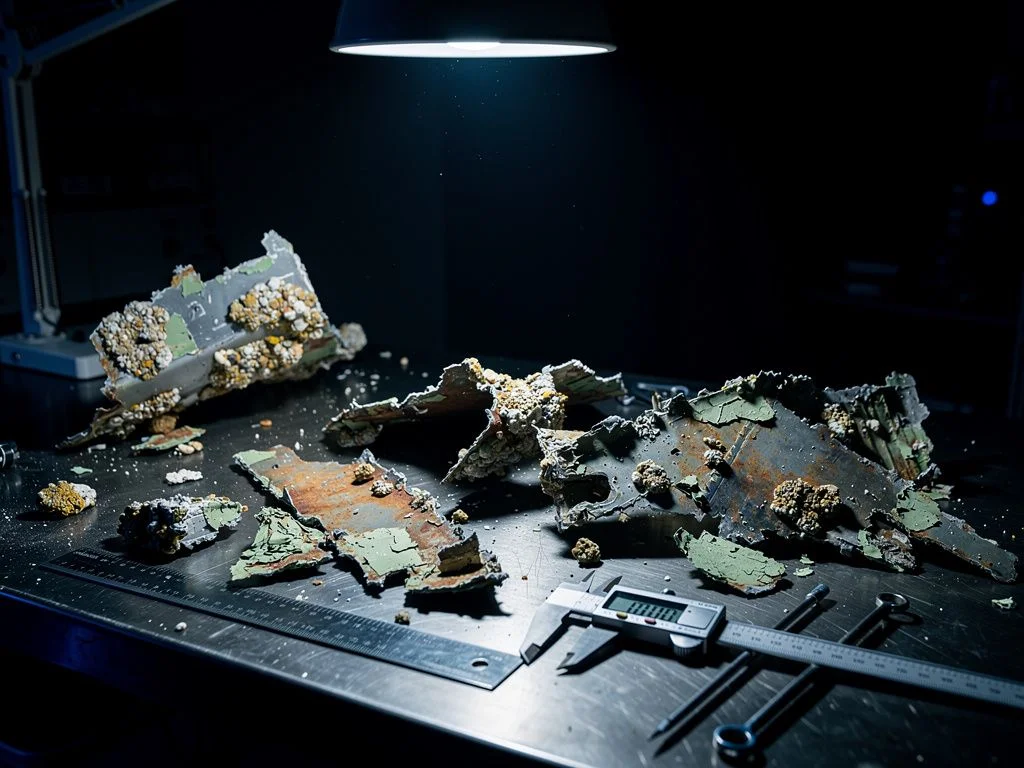
Debris Analysis
Malaysia's investigators examined 27 items of debris recovered from Indian Ocean coastlines. Three were confirmed as MH370 and seven more were judged almost certain to be from it. This analysis examines the debris evidence, drift modelling, chain of custody, and what the discovery pattern tells us about the aircraft's final location.
The Physical Evidence
Between July 2015 and January 2017, debris washed ashore across the western Indian Ocean, and Malaysia's 2018 Safety Investigation Report examined 27 items: three confirmed as MH370, seven almost certain, eight highly likely, two likely and seven not identifiable. They were found from Réunion and Mauritius to Mozambique, Tanzania, South Africa, and Madagascar. These represent the only physical evidence that MH370 entered the Indian Ocean, and their discovery locations are central to understanding what happened to the aircraft.
Strong: debris locations are independently verifiable through recovery reports and official identification. Drift modelling introduces uncertainty in reconstructing the entry point, as multi-year ocean drift is inherently stochastic.
Confirmed & Likely Debris
Key pieces of recovered wreckage. Confirmation status reflects official identification by the Malaysian investigation team, French BEA, or ATSB.
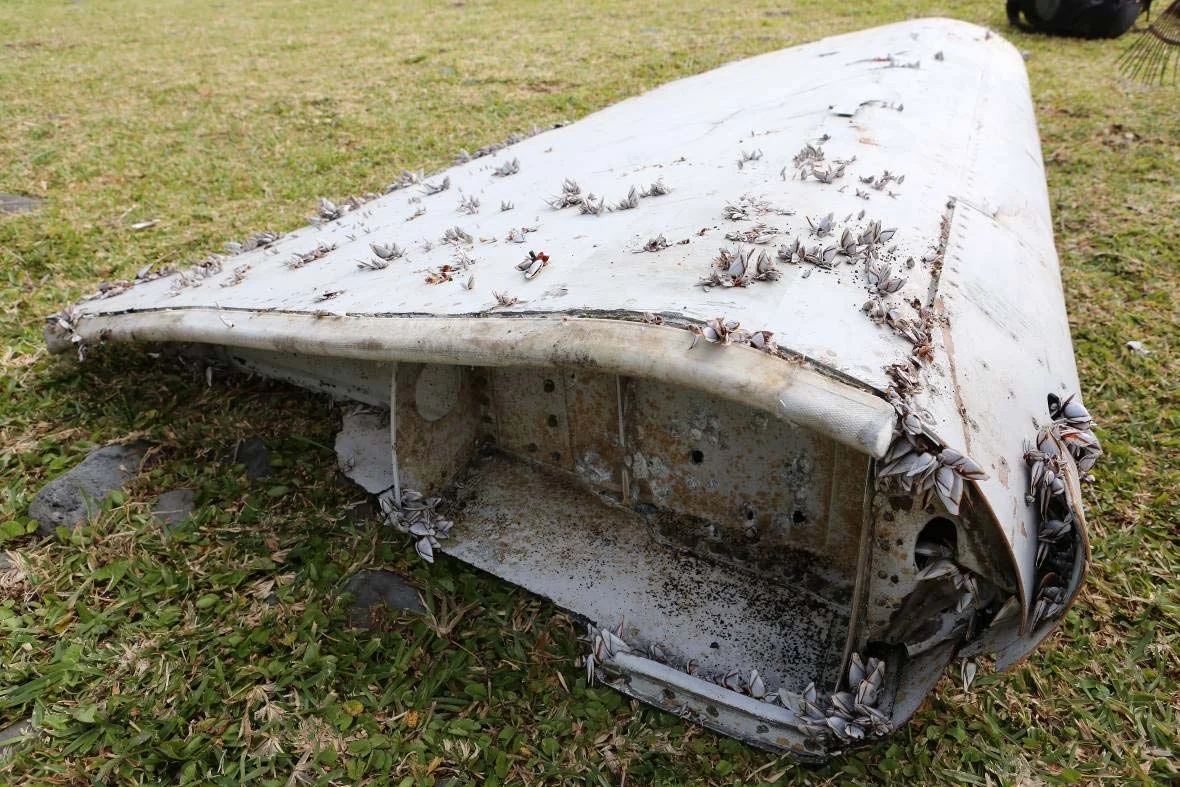
Flaperon (right wing)
Confirmed MH370First physical evidence of MH370. Boeing 777 flaperon positively identified by French BEA through serial number and maintenance records. The French marine biologist who examined its barnacles estimated 15 to 16 months of growth, an estimate he called very approximate.
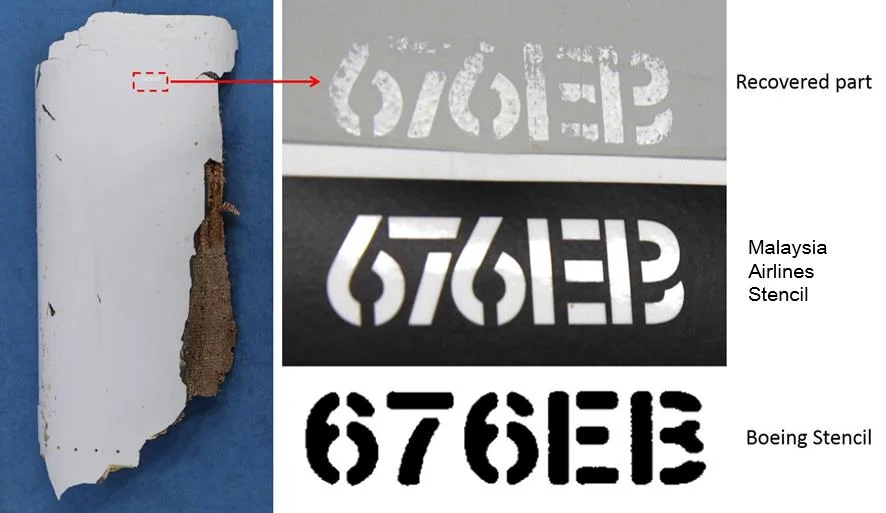
Flap fairing fragment
Confirmed MH370Found by independent searcher Blaine Gibson. Identified as 777 component by ATSB. Stencilling "676EB" matched Malaysia Airlines maintenance stencil pattern.
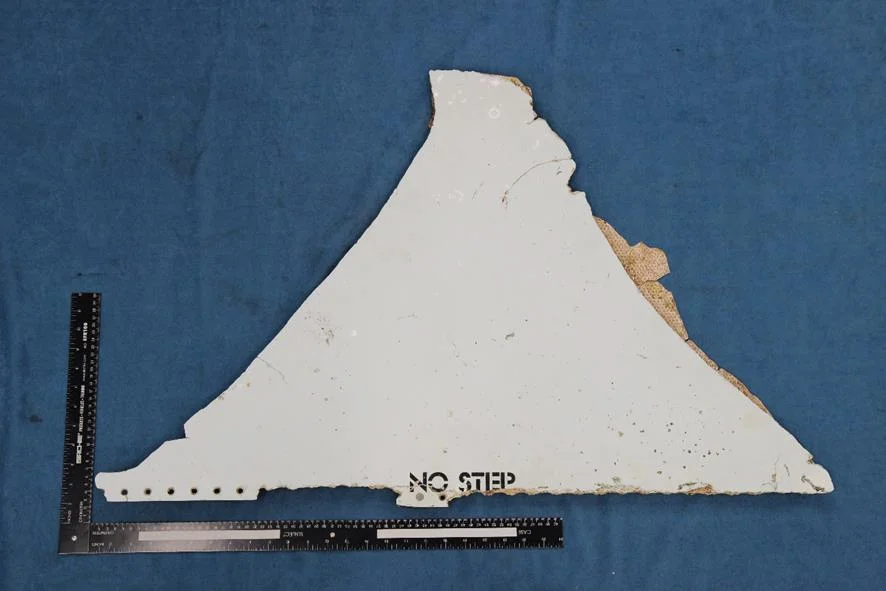
Horizontal stabiliser fragment
Confirmed MH370Large structural piece with "NO STEP" marking. Paint scheme and construction consistent with 9M-MRO (MH370 aircraft).
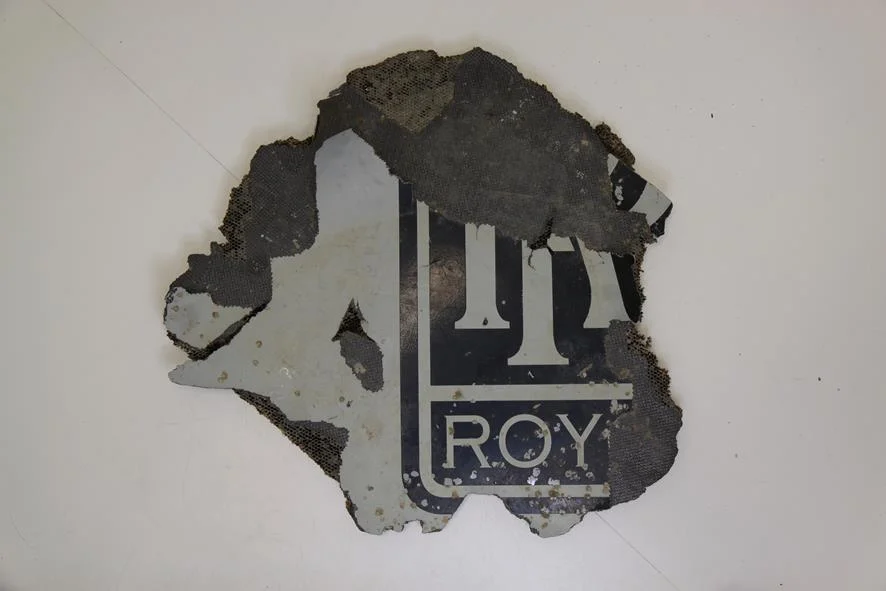
Engine cowling fragment
Confirmed MH370Rolls-Royce Trent 800 engine cowling with partial "ROY" lettering from Rolls-Royce branding. Manufacturing data consistent with MH370 aircraft engines.
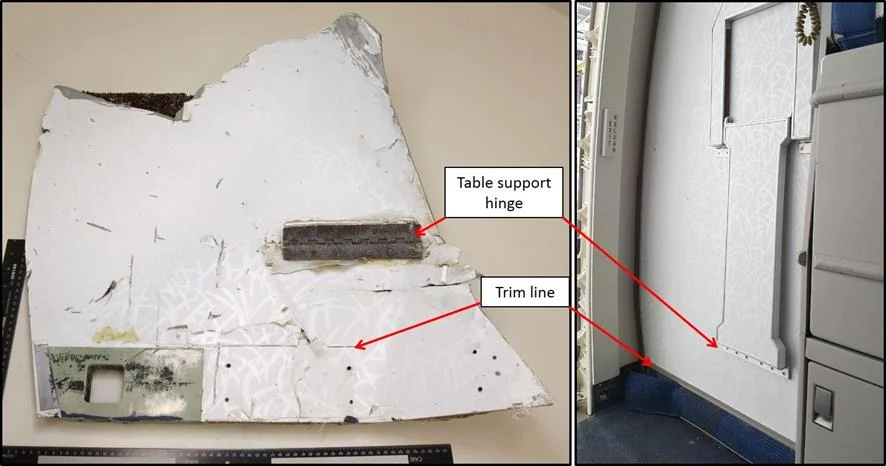
Interior panel fragment
Almost certain MH370Cabin interior bulkhead panel with table support hinge and trim line matching 777 economy class configuration. Pattern and construction compared directly to reference aircraft.
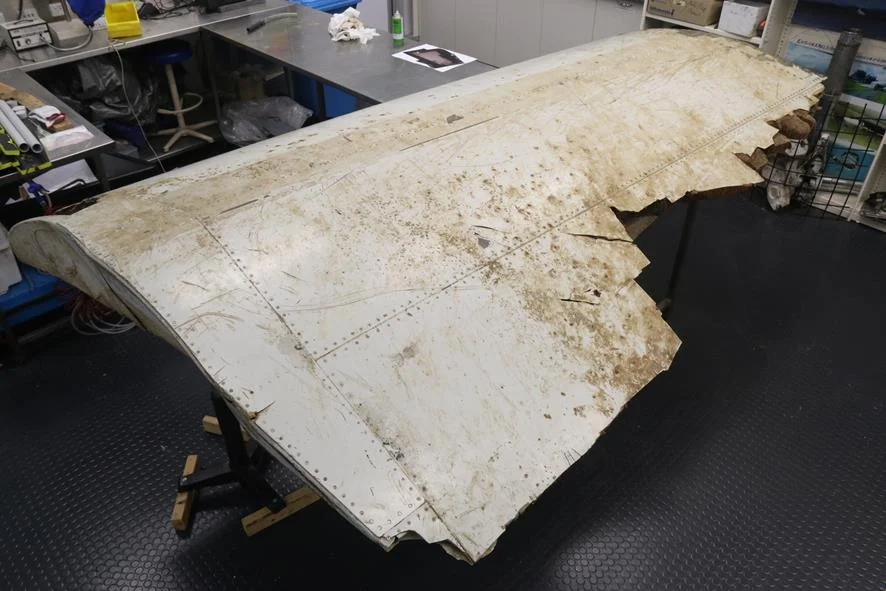
Wing flap segment
Confirmed MH370Right outboard wing flap. Confirmed by Malaysian investigation team as 9M-MRO component. ATSB analysis found flaps were in retracted position at separation.
Nose cone fragment
Almost certain MH370Radome or nose cone section. Boeing 777-compatible construction. Found at Mossel Bay by independent searcher.
Wing trailing edge
Almost certain MH370Trailing edge component. Marine biology analysis of attached organisms supports extended ocean exposure.
Additional fragments (25+)
Likely MH370Over 25 additional fragments recovered, mostly by independent searcher Blaine Gibson. Many classified as "almost certain" or "likely" MH370 based on materials and construction, though lacking unique serial numbers for definitive confirmation.
All Recovered Debris Mapped to Aircraft
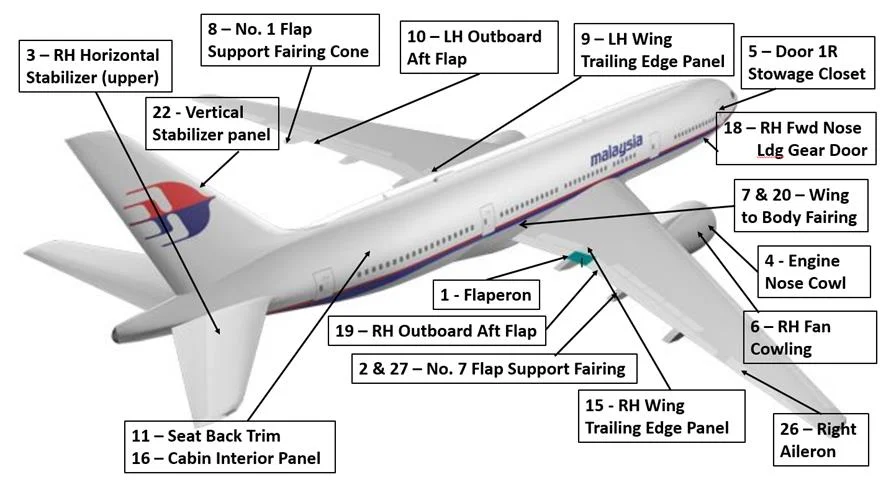
Source: Ministry of Transport Malaysia, published in ATSB "The Operational Search for MH370" (CC BY 3.0 AU). Numbers correspond to debris examination items in the Malaysian Safety Investigation Report appendices.
Flaperon Buoyancy Testing (France)
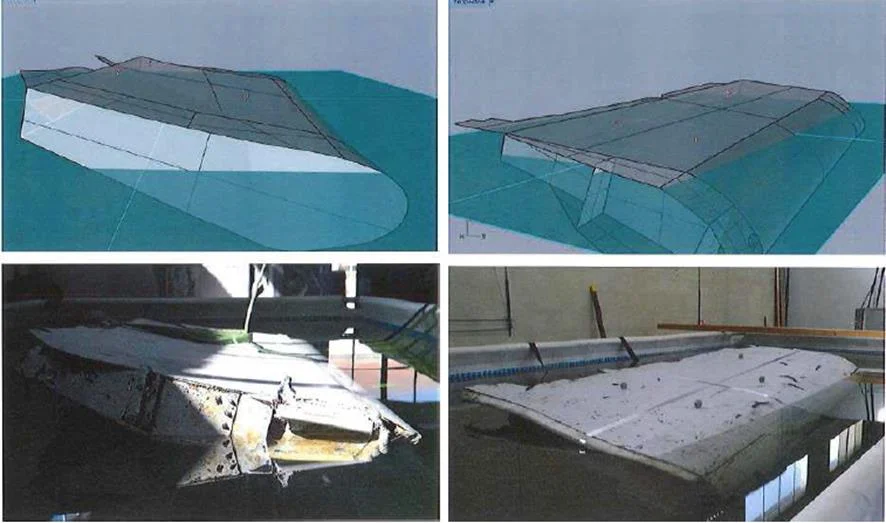
Source: Direction Generale de l'Armement Techniques Aeronautiques (DGA), published in ATSB report (CC BY 3.0 AU). Top: simulation models of flaperon flotation behaviour. Bottom: the actual MH370 flaperon during buoyancy testing at the DGA facility in Toulouse.
Debris photographs: Australian Transport Safety Bureau / Australian Government, from "MH370 - Search and debris examination update" (AE-2014-054, November 2016). Licensed under Creative Commons Attribution 3.0 Australia. Flaperon photo source: Bureau d'Enquetes et d'Analyses (BEA), published in ATSB report.
Debris Discovery Map
Discovery locations of confirmed MH370 debris across the Indian Ocean, with major ocean current flows. The first official drift forecast, in June 2014, pointed to Sumatra and was later withdrawn. By October 2014 the official view was that any debris had most likely gone west, away from Australia. The vast majority was found on African coastlines, thousands of kilometres from the search zone.
The Geographical Contradiction
Between July 2015 and June 2016, confirmed Boeing 777 wreckage washed ashore on coastlines thousands of kilometres from the presumed crash site. Where and when each piece appeared tells a story that doesn't neatly fit the official drift models.
Forbes' Argument
The first official drift forecast (June 2014) pointed to the west coast of Sumatra and was later withdrawn as erroneous. By October 2014 the official line was that any debris was far more likely to have travelled west, away from Australia. Debris then appeared overwhelmingly on African coasts, thousands of kilometres from the search zone.
If the aircraft crashed in the southern Indian Ocean (~34°S), prevailing currents should carry floating debris east toward Australia before any reaches Africa.
The debris pattern is more consistent with a crash point closer to the equatorial Indian Ocean, where the South Equatorial Current flows westward toward Africa.
Mainstream Counterargument
Post-discovery drift modelling (Durgadoo et al., 2021) demonstrates that debris from the 7th arc search area can reach both African and Australian coasts over 16+ months.
Multi-year ocean drift is stochastic: seasonal current variability, wind effects, and the Indian Ocean Dipole create highly complex dispersal patterns that simple current maps don't capture.
Reverse-drift modelling by Iannello/Ulich uses actual debris recovery points to narrow the entry point and supports a location along the 7th arc, consistent with Inmarsat data.
- Durgadoo et al., debris drift modelling (2021)
- CSIRO / UWA pre-discovery drift models (2014–2015) : Published in CSIRO technical reports
- Iannello & Godfrey, reverse-drift modelling
Chain of Custody
How debris was found, identified, and what forensic analysis reveals about the manner of impact.
Discovery Method
The flaperon was found by beachcombers on Réunion. The majority of subsequent pieces were discovered by Blaine Gibson, an independent American lawyer who funded his own search of African coastlines. Some critics have questioned how one person found so many pieces, though Gibson documented his systematic beach-walking methodology.
Identification Process
The flaperon was examined by the French BEA (Bureau d'Enquêtes et d'Analyses) under judicial authority. Subsequent pieces were assessed by the Malaysian investigation team and ATSB. Identification relies on part numbers, manufacturing stamps, paint analysis, and material composition matching Boeing 777-200ER specifications.
Forensic Indicators
The flaperon showed trailing edge damage consistent with high-energy water impact. French investigators found the flaperon was in the retracted position, potentially inconsistent with a controlled ditching (which would typically deploy flaps). Goose barnacles (Lepas anatifera) were found on the flaperon, the largest 36mm long. Their age is disputed: the French expert who measured them put the largest at 15 to 16 months, and growth studies published since allow as little as about four (see Barnacle Paradox below).
French Investigation
France opened its own judicial investigation into MH370 because French nationals were aboard. The BEA conducted independent analysis of the flaperon at their Toulouse facility. Their findings (which confirmed the part as MH370) were published separately from the Malaysian report and provide independent verification. The broader French judicial investigation went far beyond debris analysis, pursuing questions about SATCOM data integrity and US obstruction via Boeing trade secrets.
- French BEA, Flaperon Examination: Information Note No. 2 (2015) : Original BEA page removed; examination details in Malaysian Safety Investigation Report appendices
- Malaysian Safety Investigation Report (2018)
The Barnacle Paradox
Marine biology analysis of debris has produced an unresolved scientific puzzle that complicates simple interpretations of when and where the debris entered the ocean.
The Age Dispute
MH370 disappeared on March 8, 2014. The flaperon was found on July 29, 2015, 508 days later. The largest goose barnacle (Lepas anatifera) on it measured 36mm. Joseph Poupin, the French marine biologist who measured it in August 2015, extrapolated a growth curve and put its age at 476 days, or 15 to 16 months, which would mean it settled about a month after the aircraft vanished. He called that estimate "very approximate and based on limited data". Growth studies published since point the other way. Martin Stelfox and colleagues (Marine Pollution Bulletin, 2020) grew Lepas anatifera on buoys in a Maldives lagoon at 28 to 31°C, and the largest reached 35mm in 105 days. A UNSW team measured faster growth still in a related species, and its co-author Iain Suthers said in 2021 that the flaperon's 36mm barnacles "were much younger than previously realised". Jeff Wise's 2024 reporting draws the inference: at Stelfox's rate the flaperon floated for no more than about four months. Forbes argues from that figure. The same literature carries two cautions: growth flattens as a barnacle nears full size and runs slower in cool water, and the 2023 USF paper repeated Poupin's 15 to 16 months without challenging it. The official reports that followed Poupin's left the question open. The French isotope team said it couldn't determine with certainty how long the shells took to grow, though the largest it had could have formed in a few months, and Patrick De Deckker's report for the ATSB says the timing of settlement and the barnacles' ages are still unknown.
The Flotation Paradox
When French DGA researchers placed the flaperon in a water tank in Toulouse, it floated at an angle with one long edge well above water. Yet this above-water edge was thickly colonised by Lepas barnacles, which require submersion and can't grow in air. Marine invertebrate expert Jim Carlton (Williams College) summarised: "Lepas don't lie"; the barnacle positions indicate the flaperon was fully submerged for an extended period, which contradicts its observed buoyancy.
Isotope Temperature Analysis
Oxygen isotopes in a barnacle's shell record the temperature of the water it grew in. The French judicial analysis (Blamart & Bassinot, 2016) found the largest shells it was given began growing in water near 28.5°C and finished near 25.4°C, which matches the sea off Réunion in May and June 2015. Gregory Herbert's team at USF (AGU Advances, 2023) re-read the French data with a new calibration and got about 27°C falling to 23 to 24°C, which they call the first confirmation of a more southerly drift track. Neither result reaches back to the crash. The shells tested appear to be only a few months old, so they record the end of the drift, and any route to Réunion ends in warm water. The southern half of the search area, at about 16 to 18°C in March by De Deckker's figures, would show only in the oldest shells. The 2023 paper says only partial reconstructions are possible until the French government releases the largest, oldest barnacles for study.
Possible Explanations
If the younger age is right, several hypotheses try to explain it: (1) barnacle size gives a minimum time afloat, because growth flattens with size and varies with temperature and food (Marine Biology, 2023); (2) debris may have been beached or partially submerged for months before re-entering ocean circulation; (3) a 2024 analysis from 370Location.org suggests some barnacles may have colonised the flaperon after it beached on Réunion, during wave wash near shore. None of these explanations have been conclusively proven.
Contested, and still open. The expert who measured the largest barnacle put it at 15 to 16 months, which fits a 2014 crash, and called his own estimate very approximate. The four-month reading rests on faster growth measured since, in warm water, and Forbes builds on it. The shells tested for temperature are too young to say where the flaperon started. So the barnacles can't yet settle the drift in either direction, and they won't until the largest shells are analysed. The flotation finding still has no agreed explanation: barnacles growing on an edge that rides out of the water.
- Poupin, marine biology report on the flaperon barnacles, 12 Aug 2015 (Safety Investigation Report, Appendix 2.6A)
- Blamart & Bassinot, isotope analysis of the flaperon barnacles, 2016 (Safety Investigation Report, Appendix 2.6B, in French)
- ATSB, The Operational Search for MH370, 3 Oct 2017 (Appendix F: De Deckker on the barnacle shells)
- Stelfox et al., Minimum drift times infer trajectories of ghost nets found in the Maldives, Marine Pollution Bulletin 154 (2020)
- Mesaglio et al., The ecology of Lepas-based biofouling communities, Marine Biology 168 (2021)
- UNSW, Could a common barnacle help find missing persons lost at sea? (26 Feb 2021)
- Jeff Wise, The Sea Creatures That Opened a New Mystery About MH370, New York magazine (2024)
- Al-Qattan et al., Isotope Sclerochronology for MH370 Drift Paths, AGU Advances (2023)
- Seasonal growth rates of gooseneck barnacles (Lepas spp.), Marine Biology (2023)
- 370Location.org, Barnacle Growth on MH370 Debris (2024)
- Jeff Wise, Deep Dive MH370: "Lepas Don't Lie" (2024)
Challenges to Debris Authenticity
Several researchers and journalists have raised specific concerns about the debris evidence. These arguments range from legitimate scientific anomalies to more speculative claims. The counterarguments are presented alongside each challenge.
Minimal Biofouling on Most Debris
Marine biologists who examined debris photographs noted surprisingly little marine growth. Cathryn Clarke Murray estimated the Mozambique pieces looked like they'd been in water "about a month." Sam Chan concluded "a couple of weeks, certainly not indicative of something in the water for multiple years." Geoscience Australia found all organisms were from tropical waters, not the cold southern Indian Ocean where the crash supposedly occurred.
Debris that beaches and re-floats can lose biofouling from sun exposure and sand abrasion. Over 16+ months of drift through both cold and warm waters, marine growth colonisation can restart multiple times. The tropical-zone organisms are consistent with debris spending its final months in warmer equatorial waters before landing on African/island coastlines.
The Blaine Gibson Question
Background
Blaine Alan Gibson (b. 1957) is the son of Phil Gibson, former Chief Justice of the California Supreme Court. He holds a master's degree from Johns Hopkins School of Advanced International Studies. He worked for the US State Department in Rio de Janeiro (1986-87), then spent a decade consulting in post-Soviet Russia, where he founded Siberia-Pacific Co. (1992) and a Russian-American pen-pal service. He speaks fluent Russian. In 2002, he participated in a workshop on small innovative firms in Russian nuclear cities. He describes himself as an "adventure lawyer" and previously searched for the Ark of the Covenant.
Gibson found roughly half of all suspected MH370 debris, more than every government search team combined. The circumstances of his discoveries raise questions that nobody has satisfactorily answered.
He found his first piece ("No Step") within 20 minutes of his first-ever beach search. In June 2016, he found multiple pieces while being filmed by a French TV crew. In December 2016, a piece apparently washed ashore within 30 minutes of Gibson passing a spot on Madagascar's 2,300-mile coastline. He reported finding debris being used by a nine-year-old girl to fan a kitchen fire.
Jeff Wise documented a consistent biofouling anomaly: nearly all Gibson-found debris showed minimal marine organism colonisation despite alleged months or years at sea. Tsunami debris, by contrast, is typically covered in barnacles and algae within weeks. The Gibson-found pieces looked, as Wise put it, "completely innocent of marine life."
Gibson systematically searched beaches in debris accumulation zones predicted by drift models. Other beachcombers and locals found pieces independently. The debris he recovered was examined by the ATSB and Malaysian authorities and confirmed as authentic Boeing 777 material with matching part numbers and paint schemes.
Planting 27 items across six countries and territories over 18 months, using genuine aircraft components with correct manufacturing data, would require access to a 777 parts inventory and coordination that goes well beyond any individual.
Forbes has defended Gibson against Wise's characterisations, and some researchers consider the statistical argument overblown given that Gibson was the only person systematically searching African beaches full-time.
Open question. The debris Gibson found is real; how one man recovered so much of it is what stays unsettled. His State Department background, decade in Russia, and the statistical improbability of his finds remain open questions. The detail that ties his finds to the wider case is the biofouling: the Gibson-recovered pieces carry the same sparse, tropical-water marine growth seen across the entire debris field, the pattern that keeps resisting a cold southern-ocean crash. This thread deserves more investigation, not less.
The Missing Identification Plate
The external serial number plate that should have been on the flaperon's inboard edge was missing. Florence de Changy has argued that ID plates "are only removed on decommissioned planes," suggesting the part could have come from a scrapped aircraft rather than MH370.
French BEA investigators used an endoscope to read internal identification numbers, and one of three series of numbers matched MH370's Boeing 777 (9M-MRO). The flaperon was formally confirmed as MH370 on September 3, 2015. External plates can be dislodged by impact forces and ocean abrasion over 16 months. A Rolls-Royce engine cowling fragment was also confirmed through internal manufacturing data.
Shore-Dwelling Species on Open-Ocean Debris
Geoscience Australia found two-thirds of molluscs on debris were shallow coastal species, not open-ocean species. The "No Step" piece carried Petaloconchus renisectus (a shore-dwelling sea snail) and serpulid tube worms "usually found living on the seabed rather than floating debris." Two moderately old specimens (~8 months) were shore-dwelling species, suggesting debris was near a coastline approximately 8 months before washing ashore.
Debris that beaches in shallow waters and is re-floated by storms will accumulate coastal species. Over 16 months of drift, pieces may beach and re-float multiple times. This is consistent with drift models showing debris reaching African and island coastlines within 6–12 months, where shore-dwelling organisms could attach before the debris was pushed further along the coast or found.
Genuine parts, an anomalous drift story. The planting hypothesis collapses on the practicalities: sourcing authentic 777 components with matching serial numbers, paint, and maintenance data, then seeding them across six countries with no leak, is not a feasible operation. So the debris is real Boeing 777 material. What it doesn't do is confirm the official account. The Mozambique pieces Australia examined carried tropical species and no cold-water ones, and the age of the flaperon's barnacles is disputed. The parts are authentic; where they went into the water is what the biology hasn't settled.
- Jeff Wise, MH370 Debris Was Planted, Ineptly (2016)
- Jeff Wise, Bioforensic Analysis of Suspected MH370 Debris (2016)
- Florence de Changy, The Disappearing Act (2021) : Published by HarperCollins
- Airline Ratings, MH370 Debris: Now For The Facts (2018)
What the Debris Tells Us
Unlike satellite data or radar traces, wreckage can be touched, weighed, and chemically tested. How it's interpreted shapes the search strategy and determines which theories remain viable.
Entry Point Implications
If debris drifted from the 7th arc, the current Ocean Infinity search is looking in the right area.
Reverse-drift modelling from actual recovery points narrows the probable entry point more than forward modelling from assumed crash locations.
The 2026 search zone was partially informed by debris drift analysis, adding independent confirmation beyond Inmarsat data alone.
Open Questions
The age of the flaperon's barnacles is disputed: 15 to 16 months by the estimate of the expert who measured them, as little as about four by growth rates measured since. The official reports that followed couldn't fix it.
The 2023 USF study says only partial drift reconstructions are possible until the French government releases the largest, oldest barnacles for study. Until then the isotope and growth-rate questions stay open.
The debris planting hypothesis faces significant practical objections (sourcing authentic 777 parts with matching serial numbers, paint, and manufacturing data, coordinated across six countries and territories with no leaks), but the biofouling anomalies are real and demand better explanation.
Three searches, no wreckage. Ocean Infinity's 2026 deep-sea search, guided by debris-derived drift models and independent flight-path work, again found nothing, bringing the total to three major campaigns across 240,000+ sq km of seabed with no trace of the aircraft. Line up what the debris actually shows: authentic 777 parts; tropical species and no cold-water ones on the pieces Australia examined; barnacles whose age the official reports couldn't fix, with the largest and oldest shells not yet released for study by the 2023 paper's account; and every deep-water search of the modeled crash site coming up empty. The biology on its own doesn't rule the official drift in or out. The searches are what weigh against the official southern-Indian-Ocean crash-and-drift story and toward the reading the rest of this site argues, that MH370's fate stays unresolved and the Inmarsat-only reconstruction doesn't fully account for where these pieces came from. The debris is real; the crash site its drift was meant to point to is what keeps coming up empty. For the wider case, see the ocean search tracker, the Inmarsat analysis, and the satellite video forensics.