The Miley 2016 Paper
A 60-year veteran of fusion research published a complete p-B11 reactor design in 2016. It used the exact physics cluster, picosecond lasers, kilotesla fields, and aneutronic fuel, that Forbes argues shows up in the MH370 orb signature.
1 The Paper
"Reactor for boron fusion with picosecond ultrahigh power laser pulses and ultrahigh magnetic field trapping"
George H. Miley, Heinrich Hora, Götz J. Kirchhoff
Journal of Physics: Conference Series, Vol. 717, Article 012095, 2016
Proceedings of IFSA 2015 (Ninth International Conference on Inertial Fusion Sciences and Applications), Seattle, 20–25 September 2015
DOI: 10.1088/1742-6596/717/1/012095 · arXiv: 1511.03231
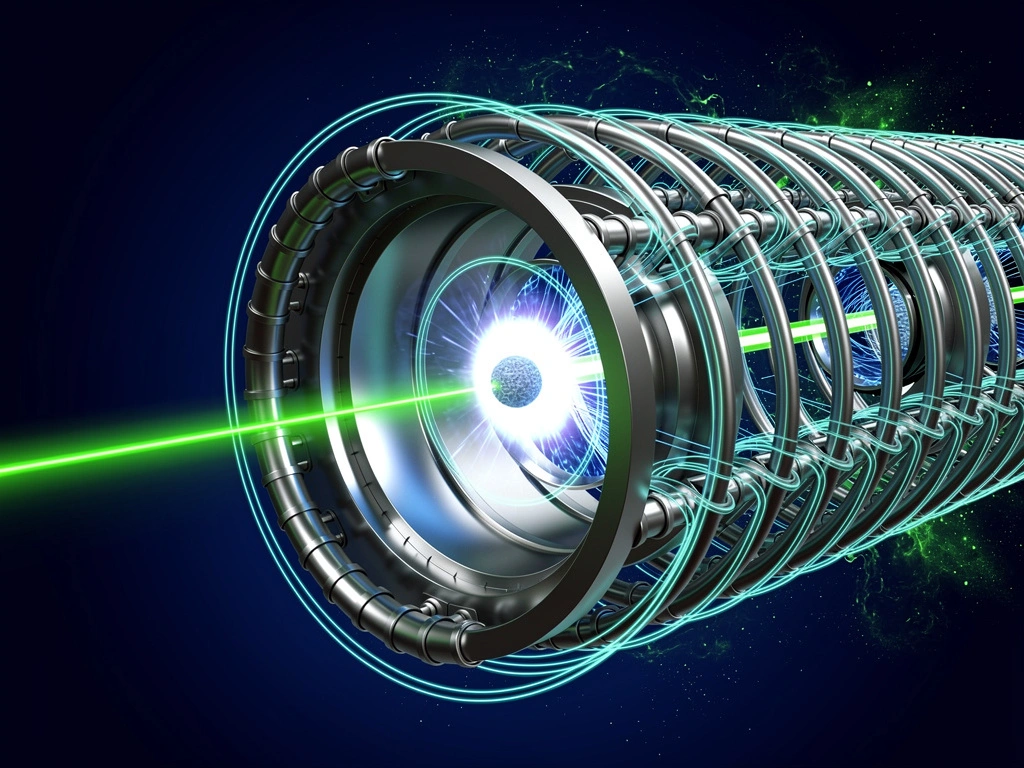
The paper describes a compact fusion reactor combining three enabling technologies into one device: picosecond ultra-high-power laser pulses for plasma ignition, kilotesla-class magnetic confinement for energy trapping, and proton-boron-11 fuel for aneutronic output.
Ten years before the MH370 orbs surfaced in public, three physicists laid out the reactor that arguably explains them. In December 2016, the IFSA conference proceedings carried a paper by George Miley, Heinrich Hora, and Götz Kirchhoff specifying the laser pulse duration, the magnetic field strength, the pellet composition, the expected reaction cross-sections, and the energy-gain predictions for a compact p-B11 fusion device. The work cites earlier experimental results from Hora and collaborators on chirped-pulse amplification in the picosecond regime, and it reads like what it is: a reactor engineering study by someone who's spent sixty years on the problem and knows which parameters are negotiable and which aren't.
George Miley isn't a fringe figure. He joined the University of Illinois in 1961, founded the Fusion Studies Laboratory there, ran the journal Fusion Technology for 25 years, and has a list of authored or co-authored papers running into the hundreds. Inertial-electrostatic confinement (IEC), one of the three standard compact fusion geometries, was largely his invention. When Miley publishes a reactor paper, other people in the field read it.
What Forbes noticed, ten years after publication, is that almost nobody outside fusion research did.
Evidence Assessment
| Claim | Source | Confidence |
|---|---|---|
| Miley, Hora & Kirchhoff published the paper in Journal of Physics: Conference Series, Vol. 717 (IFSA 2015 proceedings) | Journal DOI 10.1088/1742-6596/717/1/012095 | Established |
| The paper specifies engineering parameters sufficient for a net-gain p-B11 reactor | Paper text, pages on pulse duration and magnetic trapping | Strong |
| The physics has been partially reproduced by HB11 Energy (2023) and TAE Technologies | HB11 2023 paper in Applied Sciences; TAE 2023 Nature announcement | Strong |
| A fielded classified reactor based on this physics exists | Forbes' interpretation of DIRD document cluster and program funding history | Informed |
| Miley personally worked on the classified version of the reactor | Forbes' inference from funding patterns | Speculative |
2 What the Paper Actually Specifies
Most fusion papers hedge. They describe what might be possible with future improvements, or they present a small experimental result and extrapolate. Miley's 2016 paper does something less common: it writes down a reactor.
Fuel. Proton-boron-11 (p-B11). The reaction is p + 11B → 3 α + 8.7 MeV. No neutrons in the dominant channel. The three alpha particles are easy to slow in a conducting medium, which means direct energy conversion: you can harvest the energy electrostatically without a thermal cycle. No steam turbines. No nuclear-grade heat exchangers. No tritium breeding blanket.
Ignition. A picosecond laser pulse of 1018 W/cm2 or higher, delivered by a chirped-pulse amplification architecture of the kind Gerard Mourou and Donna Strickland won the 2018 Nobel Prize for. The pulse compresses and ignites a small pellet of boron embedded in a proton-rich matrix. Because the pulse is short (picoseconds, not nanoseconds like the NIF shots), the plasma doesn't have time to disassemble before the reaction gets going. This is the "non-equilibrium" condition the paper hinges on.
Confinement. An ultra-high magnetic field in the kilotesla range, produced by discharging a capacitor bank through a coil structure. Kilotesla is 50 times stronger than the 20-tesla REBCO magnets that Commonwealth Fusion Systems and MIT demonstrated in 2021, but kilotesla pulses (rather than sustained fields) have been produced in laboratory conditions for decades. The field traps the reactive plasma long enough for the alpha particles to thermalise and deliver their energy before the plasma expands.
Yield. The paper's own projections show net energy gain above unity, scaling with pulse energy. Not fusion ignition in the NIF sense (where the plasma self-heats to sustain the reaction) but pulsed-mode operation, where each shot produces more energy than the laser-plus-magnet system put into it.
Put the four together and you have a compact device. A kilotesla magnet coil is small. A chirped-pulse amplifier is benchtop. A boron pellet is milligrams. The result is a fusion reactor that could fit in a shipping container, not a reactor that requires a stadium of laser optics.
The four reactor stages in sequence. A chirped-pulse amplifier fires a picosecond pulse into a p-B¹¹ pellet; the impact ignites a non-equilibrium plasma; a kilotesla coil-pulse traps the reactive volume; three alpha particles emerge per reaction, with no neutrons in the dominant channel.
One caveat on the direct-conversion piece. The Miley framework specifies it as part of the reactor design, but commercial implementations have diverged. HB11 Energy's current 1 GW commercial concept uses a conventional steam cycle. Direct alpha capture at reactor scale is hard to engineer and finance for first-of-a-kind hardware, so they've gone thermal for the demonstration plant. The physics case for direct conversion still stands; it's a question of which generation of reactor it shows up in.
3 Why (Almost) Nobody Noticed
Forbes' title ("They Solved Fusion in 2016. Nobody Noticed.") is rhetorical. The fusion community noticed. HB11 Energy was founded the following year, in 2017, by Heinrich Hora and colleagues, directly building on this physics. TAE Technologies, Tri Alpha before the rebrand, had been pursuing p-B11 in their own field-reversed configuration devices since 1998. Los Alamos and Sandia continue running picosecond laser experiments. The concept has been in the specialist literature for a decade.
What didn't happen is the public reception. When someone says "fusion is twenty years away," they mean ITER, tokamak fusion, or NIF-scale inertial confinement. The mainstream energy press covers those programs. Compact alternative-geometry fusion, even from Nobel-adjacent physicists, doesn't fit the frame. An equivalent tokamak result would have pulled ten times the attention.
There's a structural reason for this. Mainstream fusion research is organised around a small number of large facilities funded by government grants that run on decade-long cycles. Alternative concepts live on venture money, academic side-projects, and private lab work. The two communities read different journals, attend different conferences, and cite different work. Miley published in conference proceedings, a venue that the tokamak world treats as adjacent rather than central. It's how the field is sorted.
But the structural invisibility creates an opportunity. If a classified program wanted to run on this physics without drawing attention, the alternative-geometry literature is the ideal camouflage. The work gets published in open journals, makes progress, and is quietly ignored by the people who would otherwise ask the hardest questions. Forbes' argument is that this is what happened.
4 Connection to the MH370 Orbs
Forbes' claim is specific. He argues that the three glowing objects in the satellite videos are compact p-B11 fusion devices operating in pulsed mode, built on the same physics the Miley–Hora–Kirchhoff paper documented in 2016: a particular engineering package with a particular signature, not generic UFO speculation.
Three features of the Miley paper line up with what Forbes says the orb footage shows.
Geometry. A compact reactor of this kind is naturally roughly spherical or short-cylinder. The magnet coils are axisymmetric. The plasma volume is small and concentrated. An external observer at a distance of hundreds of metres would see a glowing region a few metres across. That matches the visual scale in the videos.
Emission spectrum. A p-B11 plasma radiates in the visible and near-infrared through bremsstrahlung, recombination lines, and plasma emission. It doesn't emit the characteristic blue-white ultraviolet flash of a fission-driven detonation. An aircraft-mounted observer would see a steady or pulsed glow, not a lightning-bright burst. That also matches.
Absence of neutrons. The dominant p-B11 reaction channel produces three alpha particles, not neutrons. A fielded device would still produce some neutrons through side reactions (p + 11B → 11C + n, about 0.2% of the total), but the overall neutron yield is roughly a thousand times lower than D-T fusion and ten thousand times lower than fission. That's below the detection threshold for the satellite-borne systems that watch for nuclear events.
This is where the Miley paper and the Gsponer paper join hands. Gsponer identified aneutronic fusion as the pathway that bypasses the CTBT monitoring regime. Miley described the specific reactor configuration that would produce an aneutronic yield. Together, they constitute a detailed, peer-reviewed blueprint for a weapon class that the treaty can't see and the public conversation doesn't discuss.
Neither author claimed they were describing anything other than civilian fusion research. That's what makes the papers useful. They're the open-literature version of work that, if it exists in fielded form, lives inside Special Access Programs where Forbes and everyone else only sees the downstream effects.
One piece of that funding history stopped being an inference on 18 September 2026. The Department of War's PURSUE portal published the full library of Defence Intelligence Reference Documents commissioned under the Pentagon's AAWSAP contract, and attachment 1 is Inertial Electrostatic Confinement Fusion, 72 pages, dated 10 March 2010, reference DIA-08-1003-006. Its author is George Miley, University of Illinois. The Defense Intelligence Agency paid the same physicist to write its reference document on compact fusion six years before the paper Forbes builds his argument on.
Read that for what it is and no further. A DIRD is a literature review of published work, not a report on a device, and 36 of the 37 use no UAP, UFO or flying-disc terminology anywhere. It tells you the agency wanted this specific physics surveyed by this specific person, which is a documented interest rather than a documented reactor. The row above that rates a fielded classified reactor as Forbes' interpretation stays exactly where it is.
5 What Has Happened Since 2016
If the 2016 paper were isolated, it would be easy to dismiss as an ambitious design study that never went anywhere. It isn't.
HB11 Energy, founded in Australia in 2017 by Hora and collaborators, has been running the proton-boron concept as a commercial venture. In 2022, Margarone, Bonvalet, Batani and colleagues reported in Applied Sciences the first proof-of-principle demonstration of efficient α-particle generation from p-B fusion using a PW-class laser, with the experiment run at HB11 partner facilities. The 2023 Journal of Fusion Energy review by McKenzie, Batani, Hora and others (DOI 10.1007/s10894-023-00349-9) synthesises the field. Sub-reactor scale, but experimental confirmation that the physics works as the Hora line of papers said it would.
TAE Technologies, the former Tri Alpha Energy, has been pursuing field-reversed configuration p-B11 since 1998. Their Norm device exceeded expectations in late 2025, allowing TAE to skip the planned Copernicus prototype and move directly to Da Vinci, the first-of-a-kind 50 MWe commercial fusion power plant. Siting and start of construction are targeted for end of 2026. In 2023, TAE and Japan's National Institute for Fusion Science reported the first p-11B fusion measurements in a magnetically confined plasma at the Large Helical Device. TAE states it has raised more than $1.5 billion in private capital, from investors including Google, Chevron, Vulcan Capital, and New Enterprise Associates. In December 2025, Trump Media and Technology Group announced an all-stock merger valuing TAE at more than $6 billion. Serious money sits in this physics, and it isn't a secret. (Funding figure as of August 2026.)
In December 2022, the National Ignition Facility achieved net energy gain from inertial confinement fusion. The NIF isn't the Miley–Hora–Kirchhoff design (it uses nanosecond pulses rather than picosecond), but the core insight, short-pulse laser ignition of a compact fuel pellet, is the same. NIF proved the physics works at large scale. The 2016 paper argued it works at small scale. The December 2022 result narrows the gap between the two.
So when Forbes says "they solved fusion in 2016," he's compressing a decade-long arc. The solution was a set of papers by physicists who already knew the answer and were publishing the roadmap in specialist journals while the mainstream press kept asking when ITER would be finished. The papers are still there. Anyone with a DOI can read the roadmap. And the distance between the open literature and the classified capability is exactly the distance every post-1945 US defence program has always maintained.
6 The Anonymous Schematic
On 28 May 2026, Forbes gave two hours of a livestream to a single image. He calls it the "ion pumpy thing", and by his own reckoning he'd had it for almost two years: an account posting as TMBSPACESHIPS replied to him on Twitter with the picture, and at the time he couldn't read it. "None of these words made any sense to me," he says at 13:28. "I had no idea what I was potentially looking at in this image."
What the image shows is a labelled cutaway of a compact fusion reactor, and the labels use real vocabulary. Three of them Forbes reads off the drawing directly. At 20:29 he points at the green body in the middle and says "look at what it says on that part in the image itself directly": the piston has "full command of adiabatic pressure". Boron-11 injection comes up at 23:17, where he hunts for the point it enters the flow. Then an orange component at 24:02, which he reads out as "min field ionizer, HVHF AC". Elsewhere he's interpreting rather than reading: the ionizer pulling air in is his inference ("Oh, so this is air breathing", 22:51), and the tidy list of centrifugal rotation, double layers, undulator rings and Hastelloy screens comes from a summary he asks a voice assistant to generate at 28:04, which he then confirms against his own reading ("I only missed one, chat").
Keep one detail, because it shows the drawing rewards checking. Reading the alloy off the image, Forbes stops on it: "For all I knew, that could have been a madeup word. It's not. This is like some special metal that can withstand super high temperatures and corrosion." Hastelloy is real, and it's the right family of material for the job.
Forbes reads that fluency as evidence of access. At 14:07 he ties it to this page's subject: "This is the dense plasma focus, dense plasma fusion device that George Miley talks about. This is literally it. It's so accurately it that I know now George Miley had to be a black project engineer that helped build this for them."
There's a checkable version of that instinct, and it lands somewhere more interesting.
The trace. At 17:48 Forbes reads one block of text straight off the image:
"A direct energy conversion process based on cusp and traveling wave direct energy converters recirculate electric energy into the fusion core as required for regime operation. The leftover beam then exiting the converter is in the form of fast bunches facilitating further conditioning and utilization."
That passage is in a public NASA document. The final report on a NASA Innovative Advanced Concepts (NIAC) Phase I grant, "Aneutronic Fusion Spacecraft Architecture", dated September 2012 and hosted on nasa.gov since 2017, breaks its propulsion concept into three stages. Stage two reads:
"A direct energy-conversion process (based on cusp and traveling-wave direct energy converters [15]) re-circulates electric energy into the fusion core, as required for its regime operation. The ‘leftover’ beam then exiting the converter is in the form of fast ‘bunches,’ facilitating further conditioning and utilization."
Now look at the cover page. The principal investigator is Alfonso G. Tarditi, then in the physics department at the University of Houston at Clear Lake. He lists two collaborators: John H. Scott of NASA Johnson Space Center, and George H. Miley of the University of Illinois at Urbana-Champaign. Section 3.5.1 names the plasma source the team worked with: a 50 kV, 50 mA inertial-electrostatic confinement device with a 44-inch spherical stainless steel chamber, used to generate a plasma jet and take preliminary Faraday-cup diagnostics. It sits in the Fusion Studies Laboratory at Illinois, which Miley founded and which section 1 of this page describes.
So the sentence on the anonymous drawing sounds like Miley because it appears in a NASA study that names Miley as a collaborator, and that ran its experiments on his laboratory's hardware.
One caveat on the direction of that trace. That "[15]" is the only numbered citation anywhere in the report, whose reference list is otherwise author-year ([Miley, 2004], [Momota, 1992] and so on). An orphan marker like that usually means the paragraph was carried over from another document with numbered references, so the wording may predate this report rather than originate in it. A search for the exact string turns up nothing else public, which makes the NIAC report the earliest identified appearance rather than a proven origin.
What the converters are. Both devices named in that sentence are real, and neither is fringe. A travelling-wave direct energy converter is a linear accelerator run backwards: fusion products arrive as a fast beam, pass through a series of ring electrodes, and the electrodes draw energy out of the beam as high-frequency AC rather than pushing it faster. A cusp converter handles the upstream job, using a magnetic geometry that pinches to a point to sort electrons out of the ion flow so the two species can be collected at different potentials. Run them in series and a reactor makes electricity directly from charged fusion products, with no steam anywhere in the loop.
That's the same direct-conversion promise section 2 sets out for p-B11, arrived at from the propulsion side instead of the power side. Tarditi's report is blunt about what would justify the work: the latest composite-cycle steam turbine generators reach up to 60% efficiency, so a serious development programme for direct conversion "would be then justified if the perspective of reaching conversion efficiencies near 90% would appear, at least in principle, realistic". The effort outlived the grant. Tarditi, Chap, Wolinsky and Scott presented "Progress Towards the Development of a Traveling Wave Direct Energy Converter for Aneutronic Fusion Propulsion Applications" at AIAA Propulsion and Energy in Orlando on 27 July 2015, filed as NASA document 20150013832 and report JSC-CN-33721.
Where the trace stops. One block of text goes back to Tarditi. Search the text layer of his 33-page report for the rest of the drawing and you come up empty: no "centrifugal", no "undulator", no "Hastelloy", and no "dense plasma focus" anywhere in it. "Cusp" appears exactly once, in the sentence quoted above. The report does use the phrase "magnetic piston", but for compressing an ion beam, which is a different thing from a piston commanding adiabatic pressure. So whoever assembled the image drew on at least one further source, and that source hasn't been identified. Anyone who finds it has closed a real gap in this analysis. Which raises a question the trace opens without settling: who sits down with a NASA Innovative Advanced Concepts report, draws the reactor it describes, and then hands the drawing to a YouTuber from behind an anonymous handle?
What survives. Forbes ties the drawing to Miley through the dense plasma focus, and that link is documented, just not secret. At STAIF-2006, Sean D. Knecht, Robert E. Thomas, Franklin B. Mead of the Air Force Research Laboratory propulsion directorate at Edwards AFB, Miley, and H. David Froning published "Propulsion and Power Generation Capabilities of a Dense Plasma Focus (DPF) Fusion System for Future Military Aerospace Vehicles" (AIP Conference Proceedings 813, pages 1232 to 1239, DOI 10.1063/1.2169306). It's a parametric study of a p-11B dense plasma focus run in support of what the abstract calls "a USAF advanced military aerospace vehicle concept study": thrust varied from 100 kN to 1,000 kN at specific impulses of 1,500 and 2,000 seconds, thrust-to-weight ratios from 2.1 to 44.1, and military versatility in sub-orbital space "as early as 2025, and beyond as early as 2050".
The vehicle that abstract sizes the reactor for combines dense plasma focus fusion with "advanced ‘waverider’-like airframe configurations utilizing air-breathing MHD propulsion and power technology". So air-breathing propulsion is not an unsourced flourish on the anonymous drawing; it's in the abstract of a paper Miley co-wrote with an Air Force propulsion scientist in 2006. And the excess power the study models is spent on a list the authors write out plainly: "communication systems, pulsed-train plasmoid weapons, ultrahigh-power lasers, shielding/cloaking devices and gravity or time-distorting devices". That sentence sits in AIP Conference Proceedings with an AFRL address on the title page, approved for public release under clearance AFRL-ERS-PAS-2005-240.
The mechanics of that device get their own explainer in the dense plasma focus 101 guide, and the 2006 paper is covered in detail on the Froning page, where Forbes is recorded reading its abstract aloud.
Set the two documents beside each other. A NASA-funded architecture study for an aneutronic fusion spacecraft, naming Miley as a collaborator and working with his laboratory's IEC device. An Air Force co-authored study of a dense plasma focus sized for military aerospace vehicles, with Miley in the author list and air-breathing MHD in the abstract. Both public, both carrying DOIs or NASA document numbers, neither of them obscure to anyone who goes looking. Forbes' instinct that the drawing points back at Miley is sound, and so is his instinct that air-breathing belongs in the same picture. The route is the ordinary one: Miley's name sits on the open literature this technology lives in, and someone who had read that literature drew a picture of it.
What the image still can't do is authenticate itself. An anonymous account sent it, nobody has produced a chain of custody, and this page doesn't treat it as evidence that a device was built. Traced rather than assumed, it's a compilation from open aneutronic-fusion-propulsion sources, at least two of which carry George Miley's name. That's a smaller claim than the one Forbes makes for it, and a far more useful one, because a reader can check every step of it.
Schematic: Evidence Assessment
| Claim | Source | Confidence |
|---|---|---|
| The schematic's direct-conversion annotation is near-verbatim from the Tarditi NIAC final report | Report conclusions, stage (ii), against transcript 70M-6hMUZEk at 17:48 | Established |
| George Miley is a named collaborator on that NASA study, which took diagnostics on the IEC device in the Illinois laboratory he founded | Report cover page and section 3.5.1. The report names Miley as a collaborator, not as an author | Established |
| Miley co-authored a dense plasma focus propulsion study for military aerospace vehicles with an AFRL scientist, with air-breathing MHD in its abstract | Knecht, Thomas, Mead, Miley & Froning, DOI 10.1063/1.2169306; DTIC postprint AFRL-PR-ED-TP-2005-359 | Established |
| Whoever produced the schematic had read the open aneutronic-fusion-propulsion literature | The verbatim match, plus correct use of Hastelloy, cusp and TWDEC terminology | Strong |
| Whether the direct-conversion wording originates in the NIAC report or was carried into it from an earlier Tarditi document | The orphan "[15]" marker in an otherwise author-year reference list | Open question |
| Source of the centrifugal-separation, undulator and adiabatic-piston annotations | None found; absent from both the Tarditi report and the 2006 DPF paper | Open question |
| The schematic depicts a device that was actually built | Anonymous social-media image, no chain of custody | Unestablished |
7 Open Questions
- Has anyone reproduced the specific Miley configuration? The paper gives enough parameters to attempt reproduction. HB11 has come closest. A laboratory that ran a full-parameter test of the kilotesla-plus-picosecond architecture would either validate the reactor concept or identify the engineering gap.
- What did Miley's collaborators work on separately? Heinrich Hora, Miley's frequent co-author on the p-B11 line, has a documented UNSW Sydney affiliation and a long publication list. S. Krupakar Murali is less public. A bibliographic trace of their subsequent work would reveal whether the 2016 paper has been quietly extended or whether it stands alone.
- Where does the kilotesla magnet technology come from? The 2016 paper treats kilotesla pulsed fields as a solved problem. It's not quite solved in the open literature; kilotesla has been produced in single-shot destructive experiments, but repeatable kilotesla is a harder target. If classified magnet research has solved it, that's one of the most valuable pieces of metadata in the whole argument.
- Has the US Patent Office issued anything resembling Miley's device? A patent search on picosecond-laser p-B11 configurations filed by institutional applicants (universities, national labs, or defence contractors) would reveal whether the concept has been claimed, classified under the Invention Secrecy Act, or simply left open.
None of these questions are blockers for the central argument. The open literature already contains a viable compact-reactor design with named authors, a public DOI, and a decade of follow-on experimental work. They're the lines along which the next reporting should run.
8 Timeline
9 Key Sources
public/transcripts/70M-6hMUZEk.json.