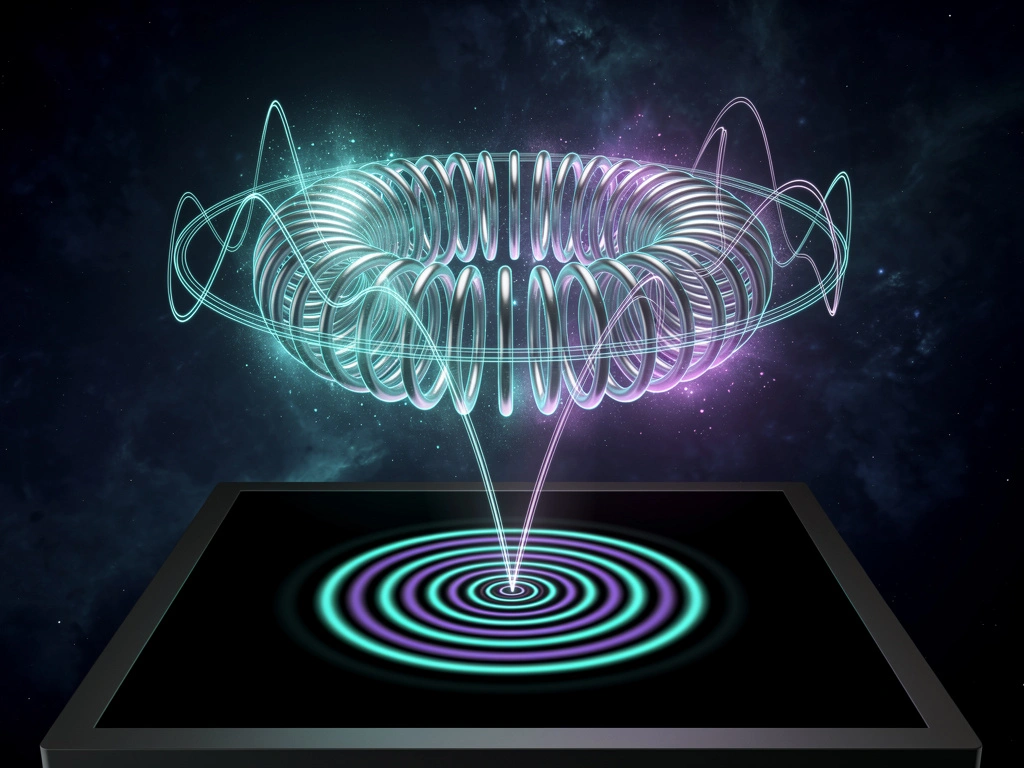
The A Vector Potential
Ashton Forbes calls it the classified secret behind advanced propulsion. The vector potential is real, confirmed physics, and the research program built on it is more serious than the fringe label lets on. The one piece still unproven is whether any of it flies.
Ashton Forbes holds up a book on camera and tells you the secret the government has been hiding is a letter of the alphabet. "The classified aspect is the 5D torque, is the A vector potential," he says in his June 18 stream. It sounds like the setup to a joke.
It isn't. The vector potential is one of the strangest and most real objects in physics, and the reason it's strange is worth your time even if you never buy a word of what Forbes builds on top of it. So here's the split this page keeps in view: the foundation is settled physics, the research built on it is more real than you've been told, and the one piece genuinely missing is proof that any of it flies.
1 The experiment that made the vector potential real
In 1959, two physicists at the University of Bristol published four pages that changed how physicists think about electromagnetism. Yakir Aharonov and David Bohm asked a question that sounds almost pedantic. In classical physics you can describe a magnetic field two ways: with the field itself, written B, or with a mathematical helper called the vector potential, written A. For a century, A was treated as bookkeeping. Convenient for the equations, not something you could ever measure. The field B was real. A was scaffolding.
Aharonov and Bohm showed the scaffolding does something.
Their thought experiment was clean. Take a long, thin solenoid, an electromagnet coiled so tightly that essentially all the magnetic field stays trapped inside it. Outside the coil, B is zero. Now fire electrons past it, split into two beams that pass on either side and recombine on a screen. Classically, nothing should happen, because the electrons travel only through the region where the field is zero. But quantum mechanics runs on the vector potential, not the field, and A is not zero outside the solenoid. Their prediction: the interference pattern on the screen shifts, by an amount set by the magnetic flux the electrons never touched. Published as "Significance of Electromagnetic Potentials in the Quantum Theory," Physical Review volume 115, pages 485 to 491.
That's a deeply weird result. It says a charged particle responds to a magnetic field in a region where there is no magnetic field. The information reaches it through the potential.
For decades the effect was argued over, because real solenoids leak, and a skeptic could always say the electrons felt a little stray field. Akira Tonomura's team at Hitachi closed that door in 1986. They built a microscopic magnet shaped like a doughnut, covered it in a superconducting layer that expels magnetic field by the Meissner effect, and wrapped it in copper so no electron could reach the field. Then they watched the electron waves shift anyway. The paper ran in Physical Review Letters volume 56, pages 792 to 795, with seven authors led by Tonomura. Field completely shielded. Effect still there.
So when Forbes says the vector potential is real physics and not a fiction, he's right, and he's standing on some of the best-confirmed strange results in quantum mechanics. The Aharonov-Bohm effect is in graduate textbooks. It underlies real technology, from electron holography to the theory behind topological quantum computing. None of that is fringe. Hold onto it, because everything that follows is a question of how far you can carry it.
Evidence Assessment
| Claim | Source | Confidence |
|---|---|---|
| The vector potential A has physical, observable consequences where the field B is zero | Aharonov-Bohm (1959); Tonomura et al. (1986), peer-reviewed and replicated | Established |
| A serious, credentialed, government-adjacent research thread has pursued these mechanisms | Puthoff, Haisch, Alcubierre, Barrett, Froning papers + Navy Pais patents + recurring across the propulsion-network record | Strong |
| Gravity and inertia are residual effects of the quantum vacuum (the underlying physics) | Puthoff (1989); Haisch, Rueda & Puthoff (1994), peer-reviewed minority view | Contested |
| The key mechanism (A-vector / SU2) is deliberately classified behind the Pais patents | Forbes inference from how the work is buried; plausible but not documented | Informed assessment |
| Conditioning the vector potential produces working propulsion, and the Pais device flies | No public reproducible thrust; US 10,144,532 B2 grant discloses no test data or prototype | Speculative |
2 From a real effect to a propulsion program
Here's where the road forks. The vector potential being physically real is one claim. That you can "condition" electromagnetic fields to grab hold of gravity and move a craft is a completely different one, and the distance between them is the whole story.
Forbes didn't invent the bridge. He inherited a lineage of real, published, credentialed papers, and to his credit he names them on stream. The striking thing about that lineage is how serious the names on it are, even as the venues drift away from peer review the closer you get to the propulsion claim. Hold both facts at once: this is real science, and the last mile of it has never been publicly demonstrated.
Start at the serious end. In 1989, Hal Puthoff published "Gravity as a zero-point-fluctuation force" in Physical Review A (volume 39, pages 2333 to 2342), reviving an old idea of Andrei Sakharov's that gravity might not be fundamental at all but a residual effect of the quantum vacuum. Five years later Bernard Haisch, Alfonso Rueda, and Puthoff extended the move to inertia, arguing in Physical Review A (volume 49, pages 678 to 694) that an object's resistance to acceleration could be a Lorentz force from the same vacuum field. These are real papers in a real journal. They're also minority positions that most physicists don't accept, and neither one has produced a device.
The same year Haisch and company published on inertia, a Mexican physicist named Miguel Alcubierre wrote down the equation that launched a thousand YouTube channels. "The warp drive: hyper-fast travel within general relativity," Classical and Quantum Gravity volume 11, pages L73 to L77, 1994. It's a genuine solution to Einstein's equations, and it does let you move faster than light without locally breaking relativity. The catch that Alcubierre stated in the paper itself: it requires negative energy density, exotic matter nobody knows how to make in the amounts required. A real result with a real caveat, and the caveat is load-bearing.
Now the thinner end. H. David Froning and Terence Barrett spent years arguing that you could sidestep Alcubierre's exotic-matter problem by "conditioning" ordinary electromagnetic fields into a form that couples to gravity. The paper Forbes reads on camera is "Space coupling by specially conditioned electromagnetic fields," AIP Conference Proceedings volume 420, 1998, and its own language is the tell. Ordinary EM fields and gravity don't interact strongly, the authors write, "because they are of a different essence and form." Endow the EM field with the right essence, and the coupling might appear. That's the quote Forbes builds a stream around. It was presented at a space-technology forum, not published in a physics journal, and in nearly thirty years it hasn't produced a reproducible thrust.
Barrett is the most credentialed name in the chain, and worth taking seriously on his own terms. His book Topological Foundations of Electromagnetism (World Scientific, 2008) argues that Maxwell's equations, written in their standard U(1) form, are a special case, and that in certain topological situations electromagnetism needs a larger non-Abelian SU(2) description. That's a defensible mathematical position with a real literature behind it. It's also a long way from "and therefore you can build a gravity drive," and Barrett's careful topology gets used, downstream, as a warrant for claims he never made.
Which brings up the ghost in this machine: Thomas Bearden, the retired officer who spent decades promoting "scalar electromagnetics" and free-energy devices, and whose vocabulary, longitudinal scalar waves, conditioned potentials, energy from the vacuum, is the vocabulary Forbes uses. Mainstream physics classifies Bearden's scalar EM as pseudoscience, and the reasons are concrete: his devices never worked under independent testing, and his "scalar waves" don't appear in any confirmed experiment. When the same terms carry both Barrett's peer-reviewed topology and Bearden's perpetual-motion claims, the terms stop doing useful work. The reader has to know which one they're being handed, and the scalar electromagnetics guide sets out how to tell: the true history Heaviside left behind, and the one question (in what medium?) that separates the halves.
Step back from the individual papers, though, and a pattern shows up that no single citation carries. The names in this lineage aren't strangers to the rest of this investigation. Hal Puthoff and Eric Davis, who built the vacuum-energy models, are the same physicists documented across the site's propulsion-network record advising the Pentagon's UAP programs. Salvatore Pais filed his inertial-mass-reduction patents through the US Navy. Froning has his own profile here. Whatever you make of the physics, the sociology is that of a small, recurring set of credentialed people, working the same mechanisms, inside or beside government programs, for decades. That is not what fringe science looks like, and it's the context Forbes is drawing on when he points at the vector potential.
3 What Forbes actually says
In "The A Vector Potential Is the Classified Secret," posted June 18, 2026, Forbes makes the argument explicit. Salvatore Pais's Navy patents, he says, describe the visible machinery but hide the mechanism: "Pais's patents don't talk about zero-point energy, manipulating, or creating SU2 beams. That's the secret. That's what's classified. The classified aspect is the 5D torque, is the A vector potential." He names Pais as his mentor on stream, calling him "Dr. Salvatore Cezar Pais."
He also names the lineage correctly. On camera he runs through Haisch on inertia, Puthoff on gravity, Alcubierre on warp drive, and Froning and Barrett on conditioned fields, treating them as, in his words, "the lineage" he and his collaborators have rediscovered. Give him this: he's not hiding his sources. He points you straight at them. What he doesn't do is preserve the confidence gradient between a 1959 result confirmed by experiment and a 1998 conference paper that never produced a device.
The Pais patent is real. US Patent 10,144,532 B2, "Craft using an inertial mass reduction device," was filed by Salvatore Cezar Pais on April 28, 2016, assigned to the United States Navy, and granted December 4, 2018. It describes generating a high-energy electromagnetic field to interact with the quantum vacuum and reduce a craft's inertia. What the patent doesn't include is a working example, test data, or any evidence the device was built. A granted patent is a claim the Patent Office didn't reject, not a confirmation that the thing works. The Navy then let it expire in December 2022 by not paying the maintenance fees, which is not what an agency does with a technology it's secretly flying.
So the structure of Forbes's argument is a real effect, a real patent, and a real lineage of papers, arranged to imply a conclusion none of them individually support: that the classified secret is a specific manipulation of the vector potential, already built, already flying. The parts are sourced. The join is not.
4 Two claims, and only one is unproven
Name the gap precisely, because the whole calibration turns on it. The Aharonov-Bohm effect shifts the phase of a quantum wavefunction. It doesn't, by itself, produce a force, a thrust, or a reduction in mass. A phase shift you can read off an interference screen and a working propulsion system are separated by physics that nobody in the lineage has publicly demonstrated. That's not a small missing step. It's the entire engineering problem.
Then there's the reproducibility test, the one that settles arguments in physics. The Aharonov-Bohm effect passes it: Tonomura's experiment has been repeated and refined for forty years. The "conditioned EM field" propulsion claim fails it: after almost three decades, there's no independently replicated device, no measured thrust in a controlled setting, no result a skeptic can't explain more simply. Pais's own patents were reportedly pursued at the Navy without a working prototype ever surfacing.
But "has anyone built a working drive?" is only one of the questions on the table, and treating it as the only one is how you end up dismissing the whole subject. There are two claims here, and they don't share a confidence level. One is that conditioning the vector potential produces thrust. The other is that a serious, government-adjacent research program has been pursuing exactly these mechanisms. Collapse them together and you either wave the drive credulously into existence or wave the program skeptically out of it. Kept apart, they each get graded honestly.
On the program, the cumulative case is strong, and it's why Forbes isn't shouting into a void. The mechanisms trace to credentialed, peer-reviewed physicists rather than cranks. The US Navy thought inertial-mass reduction via a vacuum-coupled electromagnetic field was worth patenting. And the same names recur across the classified-program record this site documents elsewhere: the physicists behind the vacuum-energy models are the ones who turn up advising the Pentagon's UAP efforts. That a serious research thread runs through these ideas, much of it government-adjacent, is well-sourced. Whether its most important piece has been deliberately classified, as Forbes argues, is a reasonable inference from how the work is buried, in defense patents and conference proceedings rather than journals, but an inference is not a document.
On the physics itself, the honest confidence stays low, and it should. No public, reproducible experiment shows conditioned-EM propulsion producing thrust. If a working device exists, it sits behind a fence nobody outside has measured. That's a working hypothesis about the final step rather than a finding, and no amount of genuine lineage upstream changes what hasn't been demonstrated downstream.
One clean measurement would collapse the ambiguity, and no fresh citation will. A device that produces thrust in a sealed chamber, instrumented, repeated by a lab with no stake in the outcome, would turn "conditioned electromagnetic propulsion" from a defense-patent phrase into a result overnight. That measurement is the thing the whole question waits on.
Until it arrives, hold the honest split. The vector potential is real, foundational physics, and the research thread built on it is real too: serious people, real patents, credentialed work sitting in odd and obscure venues. What's unproven is the payoff, whether any of it actually flies, and whether the key step is genuinely classified or simply never worked. Forbes collapses those gaps and declares the drive built. The lazy skeptic collapses them the other way and declares the whole subject crankery. The honest sentence sits between them: this is a serious, government-adjacent line of research, plausibly suppressed, whose final claim nobody outside the fence has been allowed to test.