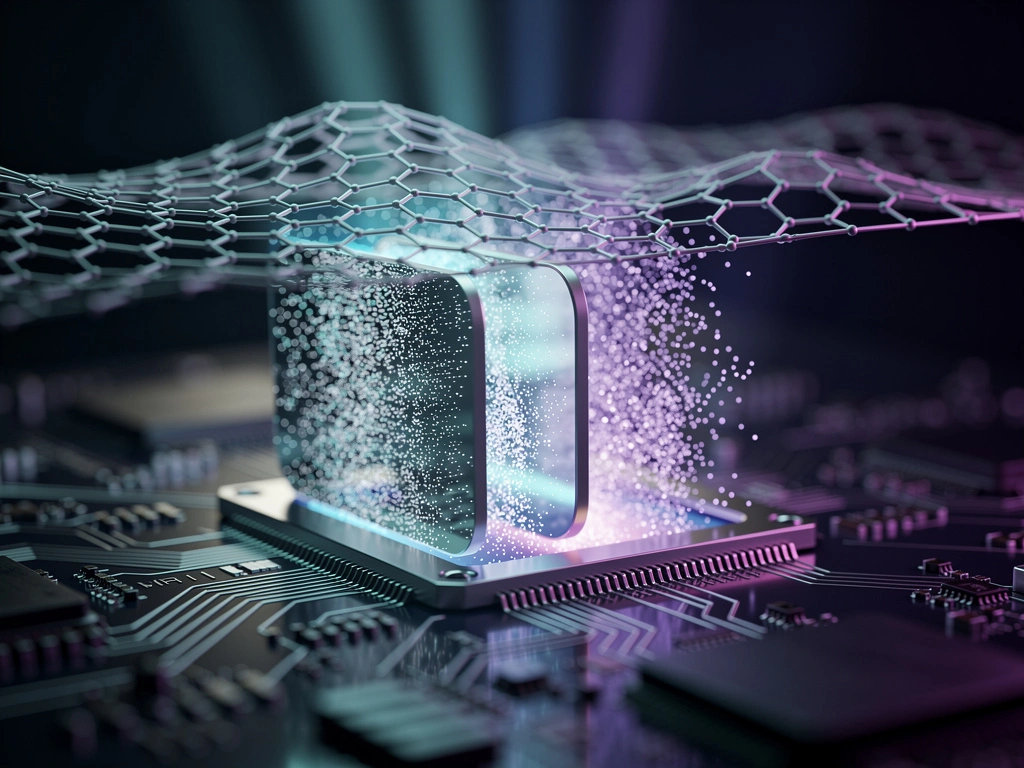
Free-Energy Microchips
A microchip that draws real power from the quantum vacuum would supply the one thing a compact orb can't carry in a battery: its own onboard energy source. Two labs are chasing that prize from opposite ends of the physics. Thibado harvests the heat already in the room; Moddel reaches for the vacuum itself, and his result is the strand still worth watching.
Ashton Forbes spends a June stream promoting free-energy microchips, then does something you don't expect. He points his "spook detector" at one of the inventors. "I love Sonny White," he says of the NASA warp-drive physicist now selling vacuum-energy chips, "but my spook detector is kind of going off the charts on this one."
He trusts the other two names on his list instead: Paul Thibado, a physicist at the University of Arkansas, and Garret Moddel, an engineer at the University of Colorado. Both have published real, peer-reviewed papers. Here's the part the "free energy" label hides: their two devices run on completely different physics, and only one of them is even claiming to touch the quantum vacuum.
1 The graphene chip that doesn't touch the vacuum
Start with Thibado, because his is the device that actually works, and it works on something more ordinary than the vacuum. In 2020 he and five co-authors published "Fluctuation-induced current from freestanding graphene" in Physical Review E (volume 102, article 042101). It's a serious paper in a serious journal, and it describes a real measured current.
The mechanism is heat. A microscopic sheet of freestanding graphene, one atom thick, never sits still at room temperature. It ripples and buckles constantly, driven by the thermal jostling of its own atoms, the same Brownian motion that makes pollen grains dance in water. Thibado's circuit couples that motion to a pair of diodes, and the rippling sheet pushes a tiny current back and forth through them. Harvest that current and you get power.
Now the important part, the part that gets lost every time this shows up in a headline. This is thermal energy, not vacuum energy. The graphene isn't pulling anything out of empty space. It's converting the heat already in the room into a small electrical current, and when the graphene cools, the effect stops. Forbes describes it on stream as harnessing Brownian motion "to produce infinite energy, to produce a battery." The first half is right. The second half is the exaggeration.
Even that thermal claim was controversial, and for a good reason worth understanding. Richard Feynman used a famous argument, the Brownian ratchet, to show you can't extract useful work from thermal fluctuations at a single temperature. Do it and you've built a perpetual motion machine of the second kind, forbidden by the second law of thermodynamics. Thibado's answer is that his circuit isn't sitting at a single temperature in equilibrium: the diodes and the changing resistance keep it out of balance, so no law is broken. Whether that answer fully holds is still argued in the literature.
What isn't argued is scale. Thibado's own framing is modest: a chip that might one day trickle-charge a low-power sensor. Micron-sized graphene, microvolts of output, nanoscale harvesting. That's a real and interesting result. It is a very long way from a microchip that powers your house, and Thibado has never claimed otherwise. The gap between what he published and what "free energy microchip" implies is the whole distance this page is about.
Evidence Assessment
| Claim | Source | Confidence |
|---|---|---|
| A graphene circuit produces a measured current from thermal (Brownian) motion | Thibado et al. (2020), Physical Review E, peer-reviewed | Established |
| That graphene current is zero-point / vacuum energy | Forbes framing; the paper describes thermal energy | Unsupported |
| Moddel's Casimir cavities extract net energy from the zero-point field | Moddel et al. (2021), Phys. Rev. Research + Symmetry; 1000+ devices, no external replication | Contested |
| These chips are a scalable, house-scale "free energy" source | Promotional framing; Thibado himself frames it as nanoscale sensor power | Speculative |
| Microspark ships a working free-energy microchip by 2028 | Company commercialization announcement | Speculative |
2 The one that actually claims the vacuum
Garret Moddel is the name that changes the stakes, because Moddel isn't talking about heat. He's claiming energy from the zero-point field, the residual jitter of the electromagnetic vacuum that persists even at absolute zero. If he's right, it's a far bigger deal than graphene. If he's wrong, it's a textbook example of how a careful experiment can still point at the wrong conclusion.
The work is published, which matters. Moddel and his team at Colorado reported "Casimir-cavity-induced conductance changes" in Physical Review Research (volume 3, L022007, 2021), with co-authors Ayendra Weerakkody, David Doroski, and Dylan Bartusiak, and a companion paper, "Optical-Cavity-Induced Current," in Symmetry the same year. The idea leans on real physics: inside a Casimir cavity, two mirrors spaced nanometers apart, some of the vacuum's electromagnetic modes are excluded, so the zero-point energy density inside is lower than outside. Moddel's group built more than a thousand such devices and measured a small, persistent current they attribute to that asymmetry, a "Casimir photoinjector" pulling electrons across the gap.
Picture the cavity itself, because the intuition is what makes the claim seductive. A Casimir cavity is two mirrors held a few billionths of a meter apart. The vacuum is full of electromagnetic waves of every wavelength, flickering in and out even in the dark and cold, and the narrow gap simply can't fit the long ones. So the space between the mirrors is a little emptier of vacuum energy than the space outside. That imbalance is real and measured: the Casimir force that pulls the mirrors together has been confirmed in the lab since 1997. Moddel's bet is that you can rig the geometry to turn that standing imbalance into a one-way flow of electrons instead of a static pull.
They also did the work a serious group does. Moddel's team ran eight separate checks for mundane explanations, thermal gradients, contamination, measurement artifacts, and reported finding none that accounted for the signal. That's the right instinct, and it's why this isn't crank work.
But here's the bar an extraordinary claim has to clear, and it isn't peer review. Peer review means the methods and math passed a couple of referees. It doesn't mean an independent lab, with no stake in the outcome, built the same device and saw the same current. Extracting net energy from the zero-point field would overturn a widely held reading of thermodynamics and hand you a genuine perpetual power source. A result like that isn't confirmed by one group's thousand chips. It's confirmed when someone who'd love to prove them wrong tries, and fails.
As of now, that independent replication doesn't exist in the literature. Moddel's claim sits where it should: published, carefully argued, genuinely interesting, and unconfirmed.
3 What Forbes rolls into one
On his June streams, Forbes folds Thibado, Moddel, and Sonny White's company into a single category, "free energy microchips," and hangs zero-point energy on all of them. He adds a fourth: Microspark, a chip he says entered stealth mode with commercialization pitched for 2028, built around "customized microscale geometries," with geometry as the keyword.
Give him credit for one thing his critics don't. He isn't uniformly credulous. His instinct fires on White, the most famous name of the group, and he says so out loud. He also relays a telling detail: he asked a source about White and got back "Sonny White's all talk." That's a sharper filter than most channels covering this material apply to anyone.
The physics rewards being kept straight, because the two devices sit at different confidence levels. Thibado's thermal graphene converts room heat at nanoscale power, a measured and replicated result. Moddel's vacuum cavity reaches for the zero-point field itself and still awaits an outside lab. Holding the two apart is what tells a reader which strand of the vacuum-energy stack is solid today and which is the live experiment worth watching.
The connective glue Forbes uses is geometry, the idea that the right microscale shape unlocks the vacuum. It's the same move as the vector-potential claim: take a real effect that depends on structure, the Casimir force genuinely depends on cavity geometry, and ask whether it extends into a general route to suppressed free energy. The structure-dependence is real physics. Whether geometry alone opens the vacuum is the open question Moddel's chips were built to test.
4 The test that hasn't happened
Every claim on this page splits cleanly on one question: has anyone outside the originating lab reproduced it? Thibado's thermal current has drawn replication attempts and theoretical scrutiny, and the debate is about interpretation, not whether current flows. Moddel's vacuum result hasn't been independently reproduced at all. White's commercial chips have been demonstrated only by his own company. Microspark is a 2028 promise.
So the honest ranking is more interesting than the flat "free energy microchip" label. Thibado's graphene is real and modest, a measured and replicated result. Moddel's vacuum extraction is the genuine, high-stakes strand: published, checked against eight mundane explanations, and waiting on the one test that would settle it. The commercial pitches past that, White's chips and Microspark's 2028 promise, still rest on demonstrations nobody outside the companies has seen. Moddel's is the strand worth watching, and it belongs on the same vacuum-energy stack the Casimir and propulsion-network research keeps building.
For 4Orbs the stakes are specific. If any of these chips genuinely pulls net power from the vacuum, it supplies the missing piece of the orb-propulsion argument, the onboard energy source a compact craft would need and that no battery or fuel cell can provide. That's why Forbes reaches for them, and why the same names keep circling his scalar-physics and inertial-mass claims. Replication here isn't academic housekeeping. The whole suppressed-energy thesis rests on whether one of these devices is real, and right now none has cleared the bar that would settle it.
None of this means the vacuum holds no usable energy, and it doesn't mean Moddel is wrong. It means the evidence for pulling power from empty space is exactly one lab deep, and one lab deep is where careful people stay skeptical, no matter how good the paper looks.
Watch for one thing, and it won't arrive on a livestream: the day a second lab publishes the same current from its own cavities, or publishes a clean reason the first result was an artifact. Either outcome is a real answer. Until one arrives, "free energy microchip" is doing a job no chip has done, standing in for a measurement nobody has independently made.
Thibado already told you the true version, and it's quieter than the hype. A sheet of graphene, shivering with room heat, can trickle a little current into a circuit. That's a real thing physics can do. Whether the vacuum will do more is still, honestly, an open experiment.