Gary V. Stephenson
A gravity laser turns light into gravitational waves. Stephenson has a design for one, credits the idea to someone else, and has never claimed to have built it. The published record backs him on all three.
Fifty-eight minutes into a two-hour Ashton Forbes stream, a clip plays of Gary V. Stephenson giving away the credit for the idea he's best known for. "I can't take credit for the original idea," he says. "This came from [Giorgio] Fontana." A minute later he says it again, more carefully, in case it didn't land: Fontana "deserves the original work, the original credit for the idea of converting a photon into a graviton using this mechanism."
Converting a photon into a graviton is the whole pitch. A laser makes coherent light by getting a lot of atoms to drop between energy states in step. A gaser, by the same logic, would make coherent gravitational waves by getting a lot of electron pairs in a superconductor to drop between states whose quantum numbers happen to match a graviton's. If it worked, you'd have a transmitter whose signal passes through the Earth without attenuation, which is why the idea keeps surfacing in propulsion and communication circles rather than in astronomy.
This site has already got Stephenson's name wrong once, crediting the concept to "Gary Stevenson", a British economist, across 202 generated files before a correction in August 2026 fixed it. Fixing a name doesn't fill the hole underneath it, so what follows is the paper trail: what a gaser is meant to do, who actually originated it, what Stephenson added, and what has and hasn't been built. The connection to the rest of this site's work is real but thin, and worth stating at its true strength up front: gravitational-wave emission is one candidate mechanism for the orb behaviour documented elsewhere here, and nothing on this page establishes that it's the mechanism.
1 The Man and the Paper Trail
Stephenson signs his 2024 conference paper from Seculine Consulting in Potomac, Maryland. That's the affiliation on the title page of "Gravitational Field Propulsion Techniques", his submission to the 17th Marcel Grossmann Meeting. It's also the most solid thing available about where he works. Treat it as of 2024, because nothing establishes his position since.
His involvement in this field goes back much further, to a specific room. In May 2003 the MITRE Corporation in McLean, Virginia hosted the first international conference devoted to high-frequency gravitational waves, drawing twenty-five research papers from nine countries. That detail doesn't rest on anyone's memory: Robert Baker records it in a 2004 conference paper, which makes it checkable independently of the people who were there.
Stephenson describes the same period in his own words, including a visit Fontana made to Hal Puthoff's operation in Austin, Texas. That part rests on his account alone and is repeated here as his account, not as established fact.
One caution about the 2024 paper before it gets cited any further. Its title page says "Draft Submittal". It's a conference contribution draft hosted on the meeting's Indico server, not a peer-reviewed proceedings article, and anyone citing it should say so.
- Gary V. Stephenson, "Gravitational Field Propulsion Techniques", Marcel Grossmann 17, Draft Submittal, 2024 : Sole author. Affiliation on the title page: Seculine Consulting, Potomac, MD. The title page misspells the meeting as "Marcel Grossman".
- Robert M. L. Baker, Jr., "Precursor Proof-of-Concept Experiments for Various Categories of High-Frequency Gravitational Wave (HFGW) Generators", STAIF-2004 : Records the May 2003 MITRE conference as the first international conference dedicated to HFGW, with 25 papers from 9 countries.
2 What a Gaser Is Supposed to Do
Start with the part that isn't controversial. In a superconductor, electrons pair up and the whole population falls into a single shared quantum state. That's why a superconductor carries current without resistance, and why it behaves electrically like one enormous coherent object rather than a crowd of separate particles. That coherence is what makes a laser possible in the optical case, and it's what the gaser proposal wants to exploit.
Now the specific claim. Copper-oxide high-temperature superconductors, the cuprates, can host electron pairs in two different symmetries, labelled s-wave and d-wave by the shape of the pair's wavefunction. Put an s-wave superconductor on one side of a thin insulating barrier and a d-wave superconductor on the other, and you have a dissimilar Josephson junction: a sandwich across which pairs can tunnel while changing symmetry.
The change in symmetry is the load-bearing part. Moving between an s-wave and a d-wave state is a transition of two units of angular momentum. Two units is the spin a graviton is predicted to carry, whereas a photon carries one. Fontana's argument is that this mismatch is what you want: a transition whose single-photon emission is forbidden, but whose graviton emission is allowed.
Drive photons through the junction, in this picture, and some come out as gravitational radiation. Fontana's 2012 treatment puts the working frequency around a terahertz and discusses population inversion, the same trick that makes a laser lase rather than merely glow.
Two numbers from Fontana's own 2002 paper keep this honest. He puts the ratio of graviton to photon transition probability for an electron at about 4.8 by ten to the minus forty-third, which is the size of the hole the whole design has to climb out of. And the forbidden channel isn't as clean as a one-line selection rule suggests: he notes that gravitational transitions "compete with multiple photon transitions, therefore methods for counteracting photon transitions have to be developed", and that the superconducting mirrors proposed for the job are "not considered perfect enough". Suppressing the competing electromagnetic emission is the central unsolved problem in the founding document, not a detail.
Why would anyone want this? Because gravitational waves interact with matter so weakly that essentially nothing stops them. A signal that passes through a planet is a communications channel with no shadow and no jamming, and a beam that carries momentum without a reaction mass is a propulsion concept. The same property that makes gravitational waves nearly impossible to generate is what makes them attractive if you ever could.
That "nearly impossible" deserves its weight. LIGO detects gravitational waves from merging black holes as a length change of about one part in ten to the twenty-first, and those are the most violent events in the observable universe. The gap between that and a benchtop device is the thing every claim on this page has to be measured against.
- Giorgio Fontana, "Possible Graviton Transitions and Gaser Action in High-Tc Superconductors", arXiv cond-mat/0208276, 2002 : Preprint. arXiv lists no journal-ref, so this specific document was never formally published.
- Giorgio Fontana, "High Temperature Superconductors as Quantum Sources of Gravitational Waves: The HTSC GASER", in Gravity-Superconductors Interactions: Theory and Experiment, Bentham Science, 2012, pp. 58-73 : DOI 10.2174/978160805399511201010058, resolved and confirmed. Describes a proof-of-concept device at roughly 1 THz.
3 Whose Idea It Was
Start further back than the channel usually does. A gravitational analogue of the laser was proposed by Leonard Halpern and Bertel Laurent in Il Nuovo Cimento in 1964. The gaser, in other words, wasn't Fontana's idea either. Every source on this page says so: Fontana's own 2002 abstract opens by noting the principles "have been theorized decades ago", Baker credits "Halpern and Laurent (1968)", and Stephenson's 2024 paper traces it to the same pair.
What Fontana originated is the part that makes it buildable: using a high-temperature superconductor as the active medium, and the s-wave to d-wave junction as the transition. He proposed it in April 1998, in a preprint on emission from d-wave to s-wave superconductor junctions, four years before the paper usually cited as the origin. That 1998 date is worth keeping, because it makes the idea twenty-eight years old rather than the twenty-something the retellings imply.
The 2002 arXiv paper revised that October, and it has sat there since without a journal reference attached. That matters for how it's described: the 2002 document is a preprint, and calling it a published paper would be wrong.
The concept itself did eventually reach a book. In 2012 Fontana contributed a chapter to Gravity-Superconductors Interactions: Theory and Experiment, published by Bentham Science, running from page 58 to page 73 under the title "High Temperature Superconductors as Quantum Sources of Gravitational Waves: The HTSC GASER". The DOI resolves. Bentham's editorial reputation is uneven enough that the venue is worth naming plainly rather than leaning on the phrase "published" to do work it can't do here.
Between those dates Fontana kept presenting it, including at the second HFGW meeting held at the Institute for Advanced Studies at Austin from 19 to 21 September 2007, with Robert Baker as honorary chairman and Hal Puthoff as co-chair. That's the 2007 date Stephenson refers to on camera. Sources differ on whether to call that meeting a workshop or a conference, and this page hasn't seen the proceedings.
Which brings the attribution back round. Stephenson could comfortably have left the origin vague, and instead he volunteers it twice, unprompted, in a friendly setting where nobody would have pushed him on it.
"Georgio Fontana deserves the original work, the original credit for the idea of converting a photon into a graviton using this mechanism. These mechanisms originate with Georgio Fontana."
That's worth recording plainly, because this site got it wrong in the other direction, and because a researcher who hands credit away on camera is telling you something useful about how much weight to put on the rest of what he says.
- Gary Stephenson, long-form interview (video MOuyP_-e9lk), at 58:26 and immediately following : Auto-captions render Fontana as "Jersey Fontana" and "Georgio Fontana", Puthoff as "Pudof" and "Poff", MITRE as "MITER", and Stephenson himself as "Stevenson". Quoted as transcribed.
- Fontana 2002 preprint and 2012 Bentham chapter
4 What Stephenson Added
Fontana's original device was bulky. Stephenson's description of it is "he actually had a bulk device in mind", and his objection is practical rather than theoretical: "it would have been very difficult to build a device he imagined", because it needs a great deal of superconducting material.
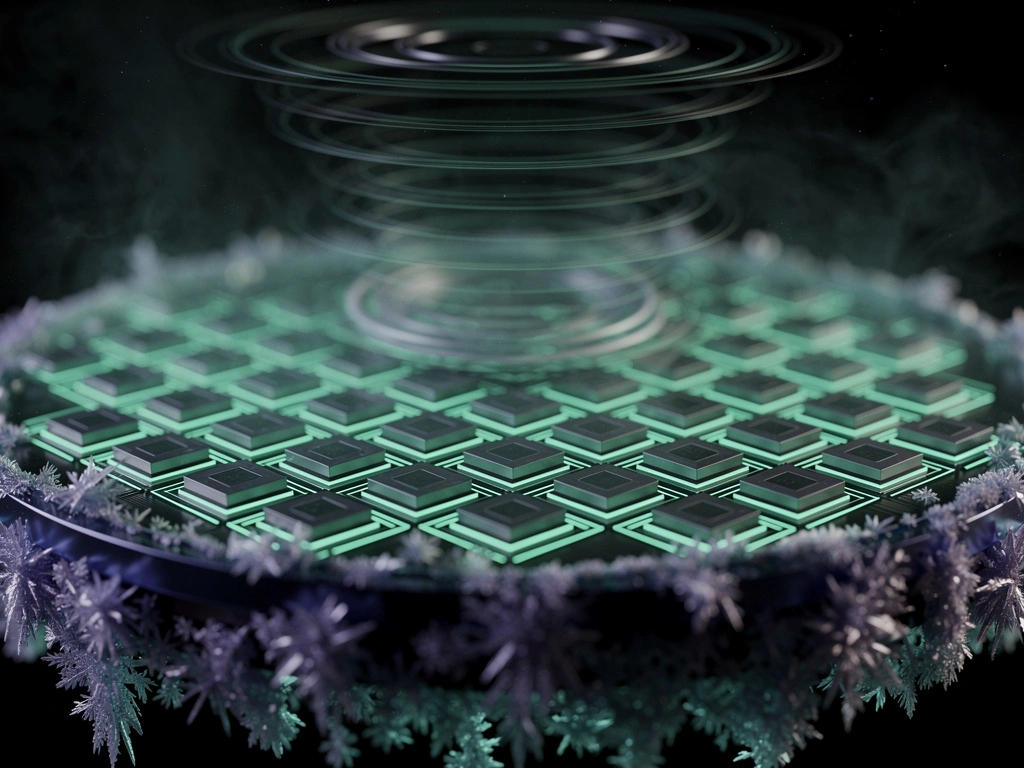
His contribution is a change of format. Instead of a bulk boule of cuprate, put the junction down as a thin film on a silicon wafer, the way a chip fab already lays down transistors. In his own words, he "redesigned it so it can be prepared in a thin film matter uh on a silicon wafer as if it was a a transistor array". The array framing that usually travels with this claim, including the reasoning that an array multiplies the output, comes from Forbes narrating over the clip rather than from Stephenson, and this page won't put it in his mouth.
The manufacturing logic is attractive. If the emission happens at the junction, you want junction area and a lot of junctions, which is the reasoning that moved semiconductors from discrete components to integrated circuits.
An objection to it sits in Fontana's own founding paper, though, and it deserves stating because the retellings never raise it. Fontana argues the emitted electromagnetic radiation has to stay trapped inside the bulk superconductor for the scheme to work, and warns that with measured penetration depths around 200 nanometres for YBCO, radiation "could not escape the material except for transitions localized not more than few hundred nanometers below the surface". A thin film on a wafer is precisely the geometry where every junction sits within a few hundred nanometres of the surface. Whether Stephenson has an answer to that isn't recorded anywhere this page could find, and it's the first question a referee would ask.
Now the part that has to be stated precisely, because the channel's framing of it has drifted. In one appearance Stephenson calls the thin-film version something "we did propose". In another he describes it as work done: "what I've done instead is redesigned it". Both are claims about a design. Neither is a claim about hardware. No fabricated device, no test run, no measured output and no gravitational-wave signal appears anywhere this page could find, and Stephenson doesn't say otherwise.
- Ashton Forbes, "The GASER - Gravity Wave Amplifier Microchip" (MOuyP_-e9lk), 14 July 2026, Stephenson clip at 59:48 : Stephenson's own words run to roughly 59:52 ("So what I've done instead is redesigned it so it can be prepared in a thin film matter uh on a silicon wafer as if it was a a transistor array"). From about 59:57 the speaker is Forbes, narrating: the "we also turned it into an array" line and the array-amplification rationale are his, not Stephenson's. This page attributes them accordingly.
- Stephenson, "High Frequency Gravity Waves" (video r7wFVfyXeGs), 10 July 2025 : Source of "we did propose a thin film version based on Fontana's design", and of the "just a lot of material" objection to the bulk design. The transcript renders Fontana's original as a "boat design"; from context and his other remarks this is the auto-caption's rendering of "bulk". Every segment in this transcript starts at zero, so no timestamp is available.
- Giorgio Fontana, arXiv cond-mat/0208276, section 4 : Source of the bulk-trapping objection and the ~200 nm YBCO penetration depth.
5 The Experiments Nobody Ran
The phrase "proof-of-concept experiments" attaches itself to this field, and it comes from a specific document: Robert M. L. Baker's paper to the Space Technology and Applications International Forum in Albuquerque, February 2004. It sorts every proposed way of generating high-frequency gravitational waves into three families, and the gaser sits in the superconductor family alongside impressed magnetic fields and the Gertsenshtein effect.
Read the abstract carefully and the title turns out to promise more than the contents deliver. The experiments "for each category except, possibly, the third are identified in general terms". And then, in Baker's own words: "Although no detailed experimental tasks are discussed, experimental test objectives in the form of a roadmap are proposed for each category."
A roadmap is not a result. Twenty-two years after that paper, this page could find no experiment from any of its three categories that has produced a validated gravitational-wave signal, and no gaser device at all. That's a search finding rather than a proof of absence, but the burden here sits with anyone claiming otherwise.
One disclosure belongs alongside Baker's name wherever it appears. The same abstract asserts that researchers have "demonstrated that their proposed devices were practical HFGW generators, capable of producing kilowatts of power, that were operational in a laboratory setting", which is a remarkable claim to make in passing and one no independent group has confirmed in the two decades since. Baker's byline on that paper gives his affiliation as senior consultant to GRAVWAVE LLC and Transportation Sciences Corporation. He has a commercial interest in the technology he's assessing, and that's worth knowing before weighing his enthusiasm.
- Robert M. L. Baker, Jr., "Precursor Proof-of-Concept Experiments for Various Categories of High-Frequency Gravitational Wave (HFGW) Generators", STAIF-2004, AIP Conference Proceedings 699, p. 1093 : Sole author, ADS bibcode 2004AIPC..699.1093B. Stephenson is not an author on this paper, contrary to how the paper is sometimes listed.
6 Where the Gaser Sits in His Own Map
The most useful thing in Stephenson's 2024 draft isn't an argument, it's a filing system. He sorts every proposed way of pushing on spacetime into nine classes across two families, gives each a four-letter code, and puts his own work in one box among many.
- GRFC: Gravitomagnetic acceleration fields from mass-flow toroids, the "Forward Coil"
- GRPQ: Plasma quadrupole oscillators making gravitational waves, as in a specially prepared fusion tokamak
- GREM: Classical conversion of an EM wave into a gravitational wave through a static EM field
- GRWD: Warp-drive solutions to the Einstein field equations
- GRWH: Wormhole solutions to the Einstein field equations
- GRTB: Tractor-beam or pressor-beam solutions
- QMGE: Direct stimulation of graviton emission. This is where the gaser sits
- QMMM: Stimulating metamaterials to engineer the quantum vacuum
- QMTP: Quantum-mechanically triggered teleportation
Reading that list tells you more about the state of the field than any single claim in it. Warp drives and wormholes sit in the same taxonomy as a superconducting junction, which is to say the field ranges from exact solutions of the Einstein equations that nobody can source the exotic matter for, through to a chip you could in principle fabricate. The gaser is at the buildable end. That's its real appeal, and it's why it keeps attracting engineers rather than relativists.
Stephenson's own framing is honest about status. He calls these classes and techniques, suggests nomenclature for them, and doesn't claim any of them has been demonstrated.
- Stephenson, "Gravitational Field Propulsion Techniques", MG17 Draft Submittal, 2024, introduction : The gaser falls under QMGE, "the direct stimulation of graviton emission".
Evidence Assessment
| Claim | Source | Confidence |
|---|---|---|
| The gaser concept originates with Halpern and Laurent (1964); the superconducting implementation is Fontana's (1998), not Stephenson's | Fontana's own 2002 abstract, Baker STAIF-2004 and Stephenson MG17 all credit Halpern and Laurent; Stephenson credits Fontana on camera at 58:26 | Established |
| Fontana's GASER work reached a formally published book chapter in 2012 | Bentham Science, pp. 58-73, DOI resolved | Established |
| Stephenson designed a thin-film, wafer-scale version of Fontana's bulk concept | His own words at 59:48 in MOuyP_-e9lk, and in r7wFVfyXeGs. The array rationale that usually accompanies this is Forbes narrating, not Stephenson | Strong (as a design) |
| A gaser has been built, fabricated, powered or tested by anyone in the 28 years since the proposal | No source. Stephenson does not claim it; nothing in the record supports it | Not supported |
| The precursor "proof-of-concept experiments" were performed | Baker STAIF-2004 states they are "identified in general terms" and proposed as "a roadmap" | Contradicted |
| Photon-to-graviton conversion works as described in a dissimilar Josephson junction | Fontana's theoretical treatment only. Cited by Modanese, Gallerati and Ummarino, but never fabricated, measured or independently calculated. Fontana's own bulk-trapping objection is unanswered | Speculative |
| A gaser is the mechanism behind the MH370 orb behaviour | Not established anywhere. It is one candidate mechanism among several the site documents | Open question |
7 Who Else Has Looked
The obvious test of an idea like this is whether anyone outside the group proposing it has taken it seriously enough to write it down. On the gaser the answer is yes, and the name that keeps appearing is Giovanni Modanese.
Modanese works on the interaction between macroscopic quantum systems and gravity, which is the field the gaser would belong to if it worked. In 2009 he and T. Junker published a survey of stimulated emission in anomalous gravity-superconductor interactions, and its reference list carries Fontana's HFGW design paper alongside Baker's. In 2022 he co-authored a review in Frontiers in Physics with A. Gallerati and G. A. Ummarino which files Fontana explicitly under high-frequency gravitational waves: "Articles by G. Fontana look at possible quantum gravitational emission in pair tunnelling between type-I and type-II superconductors."
He also edited the book the GASER chapter appears in. Gravity-Superconductors Interactions: Theory and Experiment was edited by Modanese and Glen A. Robertson, which means the 2012 chapter reached print through someone working in the mainstream of the same subject rather than through a venue with no gatekeeping at all.
So the idea has been read, cited and catalogued by specialists who don't have a stake in it. That's a stronger position than most fringe-adjacent propulsion claims ever reach, and it deserves saying plainly.
Here's what hasn't happened. In twenty-eight years, nobody has fabricated the junction, powered it, or published a measurement of what came out. The citations are of the "this has been proposed" kind, a sentence in a survey filing it next to other proposals, and not one of them reports a test, a replication or an independent calculation that confirms or kills the number. Victor Atanasov publishes peer-reviewed work on gravitational-wave emission from superconducting Josephson junctions, which is the closest thing to parallel effort in the literature, and his papers don't cite Fontana at all.
That's the honest ceiling. The mechanism is published, it's been noticed by the right specialists, and in twenty-eight years it has never been taken as far as an experiment. Nothing here says the physics is wrong. It does mean every number attached to it is still a calculation by the people who want it to work, and no claim built on it can be stronger than that.
One limit on the negative half, stated so it isn't overread: no fabricated gaser and no independent measurement were found by a targeted search of the literature and the citation graph, which is not the same as proving none exists.
- A. Gallerati, G. Modanese, G. A. Ummarino, "Interaction Between Macroscopic Quantum Systems and Gravity", Frontiers in Physics, 2022 : Section 2.2.3, "Other Works on High-Frequency Gravitational Waves", cites Fontana by name. DOI resolved and quotation confirmed against the published article.
- G. Modanese and T. Junker, "Conditions for stimulated emission in anomalous gravity-superconductors interactions", arXiv 0908.2747, submitted 19 August 2009 : Reference [4] cites Baker's STAIF-2004 paper and Fontana's "Design of a Quantum Source of High-Frequency Gravitational Waves (HFGW) and Test Methodology" (physics/0410022) together. 26 pages per the arXiv comments field; published in Classical and Quantum Gravity Research, Nova Science, pp. 245-269, which the arXiv journal-ref dates 2008.
- Gravity-Superconductors Interactions: Theory and Experiment, eds. Giovanni Modanese and Glen A. Robertson, Bentham Science, 2012 : Editor credit confirmed on the publisher volume record and in Stephenson's own MG17 reference list.
8 What Would Move It
The gaser has an unusual property for a fringe-adjacent claim: it's cheap to falsify. It doesn't need exotic matter, a reactor, or a budget. It needs a cuprate thin film, a barrier, a photon source at terahertz frequencies, and a detector. Fabs make stranger things every week.
Three things would change the assessment on this page. A fabricated junction array with a published measurement would settle it either way. A null result would be worth as much as a positive one, because it would put a number on something that currently has none. An engagement with Fontana's own bulk-trapping objection would tell us whether the thin-film geometry survives the physics of the paper it descends from. And a version of Stephenson's 2024 taxonomy that clears peer review would tell us it survives contact with referees.
Until one of those happens, the accurate summary is the one Stephenson himself would probably accept. There's a mechanism on paper, inherited from Halpern and Laurent, given a superconducting implementation by Fontana, and given a cheaper geometry by an engineer who wanted it manufacturable. Nobody has built it. The gap between a good idea and a demonstrated one is where this has sat since 1998, and no amount of retelling closes it.
Related Topics
The same junction physics used the other way round, as a detector rather than an emitter.
Another propulsion researcher whose published record the site has traced end to end.
The network Fontana visited in Austin, and the funding trail behind it.
A parallel case: real physics carrying a propulsion claim that has never produced a device.
Coherent emission from a population in step, which is the mechanism a gaser borrows.
Including the "Gary Stevenson" misattribution this page exists to close.