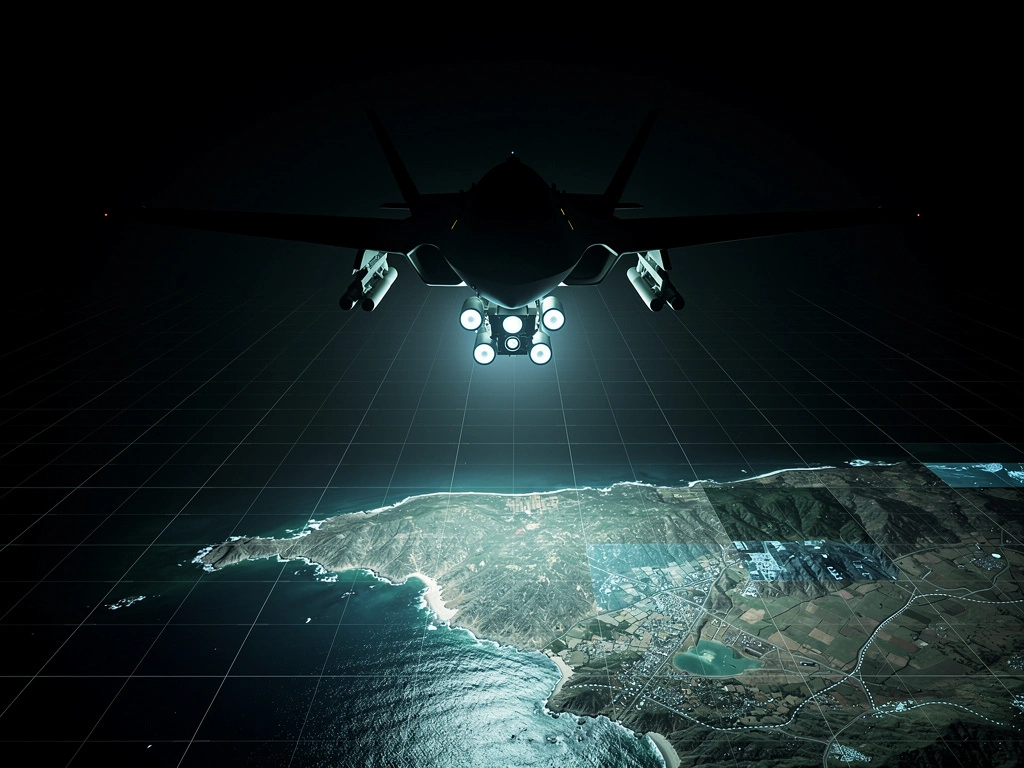
Gorgon Stare
Forbes says the MH370 footage is authentic wide-area drone imagery and reads the stitching seams as proof. In isolation that's suggestive rather than decisive. Weighed against everything else the investigation has assembled, it becomes the strand that's hard to explain any other way.
There's a surveillance camera that can watch an entire city at once, record every car and person moving in it for hours, and rewind to follow any one of them backward through time. It isn't hypothetical. The US Air Force has flown it on Reaper drones since 2011, and its name is Gorgon Stare.
Ashton Forbes points to it constantly. His argument, boiled down: the MH370 orb footage looks machine-stitched and gridded because it is a Gorgon Stare mosaic, shot from a drone, and not the CGI hoax his debunkers claim. Two things are true here at once. On its own the sensor match wouldn't settle anything, and it was never on its own. What makes it matter is where it sits, inside a stack of evidence this investigation has spent years assembling. Start with the camera, then weigh it with the rest.
1 What Gorgon Stare actually is
Start with the hardware, because the specifications are public and they're staggering. Gorgon Stare is a wide-area airborne surveillance system built for the MQ-9 Reaper, with Sierra Nevada Corporation as the integrator. Its second-generation sensor pod carries ARGUS-IS, a DARPA-funded array built by BAE Systems that packs 368 five-megapixel cameras behind four telescopic lenses into a single 1.8-gigapixel eye.
The numbers get more absurd the longer you look. From around 20,000 feet, ARGUS-IS can hold a live picture of an area roughly 4.5 miles across while resolving objects down to about six inches. It records at 12 frames per second and spits out several terabytes a minute. Increment 1 was first fielded in March 2011 and covered about 16 square kilometers. Increment 2, the ARGUS version, reached initial operating capability in early 2014 and pushed coverage to around 100 square kilometers.
The capability that makes it a surveillance revolution is memory. Because the sensor films the entire area continuously, an analyst can pick any point on the ground after the fact, a car, a doorway, a person, and scrub backward through hours of recording to see where they came from. A bombing goes off; you rewind the intersection and follow the vehicle back to the house it left. Nothing about that requires knowing what to watch in advance, which is what separates it from a normal drone's soda-straw camera. And one sensor serves a crowd: ARGUS can hand out on the order of 65 independent video windows at once, each user steering their own virtual camera around the same city-sized frame, none of them moving the aircraft. Sixty-five analysts, sixty-five soda straws, one eye.
Here's the part that matters for Forbes's argument. A single lens can't do this. The way you image a whole city at high resolution is to bolt hundreds of small cameras together and stitch their frames into one giant mosaic in software, in real time. That stitching is the defining feature of wide-area motion imagery, and it leaves a signature: a grid of seams where the individual camera tiles meet, and the near-perfect right angles of a machine-assembled image rather than a single handheld shot.
So when Forbes freezes a frame and points at "square intersections" that "prove it's cut out by a machine," he's describing something real. That's what a WAMI mosaic looks like. A person holding a camera can't produce that geometry. A rig of 368 synchronized sensors can.
Evidence Assessment
| Claim | Source | Confidence |
|---|---|---|
| Gorgon Stare / ARGUS-IS exists with the stated capabilities (368 cameras, 1.8 gigapixel, ~100 km², on the MQ-9) | USAF, DARPA, Sierra Nevada, BAE Systems, public record | Established |
| A grid/seam ("stitched") pattern is characteristic of wide-area imagery, not by itself a sign of CGI | WAMI sensor architecture (multi-camera mosaic) | Established |
| Static clouds in a short high-altitude clip are expected optics, not proof of a fake | Wide-area optics / apparent-motion scaling | Strong |
| Judged as an isolated clip, the WAMI match authenticates the footage | No released metadata / chain of custody for a lone clip | Unverified in isolation |
| Weighed with the site's other authenticity evidence, genuine wide-area drone footage is the best explanation | Cumulative case + inference to best explanation; no more plausible alternative offered | Strong (leading explanation) |
| The footage is a fabricated hoax | Requires independently manufacturing every corroborating strand | Weak |
2 The two claims Forbes gets right
Two of Forbes's uses of Gorgon Stare are stronger than his debunkers admit, and this page says so plainly.
The first is the stitching itself. The standard dismissal of the MH370 videos is that the gridded, tiled look betrays CGI. But that same look is exactly what genuine wide-area drone imagery produces, because genuine wide-area drone imagery is a machine-assembled mosaic. Pointing at seams and shouting "fake" ignores that the real system leaves seams too. On this narrow point, Forbes is right and the lazy debunk is wrong.
The second is the clouds. A recurring debunk holds that the clouds in the footage don't move, so the video must be a static fake. Forbes answers that a sensor staring down from a drone at high altitude, over slow-moving cumulus, filming a short clip, would show almost no apparent cloud motion at all. That's sound. Apparent motion scales with how much of the scene crosses the frame, and from tens of thousands of feet a cloud drifts a trivial fraction of a wide-area image in a few seconds. The static-cloud "gotcha" doesn't survive contact with how the optics work.
Give him the altitude point too, with a caveat. An MQ-9 Reaper has a service ceiling near 50,000 feet, so his estimate of a drone at 40,000 feet is inside the aircraft's envelope. The published Gorgon Stare resolution figures are quoted at around 20,000 feet, so the exact altitude of any specific clip is his inference, not a spec. The aircraft could be up there. Whether it was is a separate question.
3 Consistency, and why isolation is the wrong test
Here's the move a careful skeptic makes, and on its own terms it's fair. Taken by itself, "the footage looks like Gorgon Stare" is a claim about consistency rather than authentication. A machine-stitched, gridded, seam-laden image is what a real WAMI sensor produces. It's also what you'd produce setting out to fake wide-area drone footage convincingly, because the mosaic look is well documented and reproducible. In a vacuum, the seams prove that a machine was involved without telling you which one.
If this clip had arrived alone, with nothing attached to it, that's where an honest read would stop. What authenticates surveillance imagery by itself is provenance: sensor metadata, a chain of custody, a tasking record, the KLV telemetry that pins a camera's position, angle, and time. The MH370 videos don't ship with that packet, and its absence is the single real hole in Forbes's case. Held up as an orphan, the Gorgon Stare match is suggestive and no more than that.
An orphan is the one thing this footage isn't. Weighing a single strand as though it were the only strand is precisely the error this site was built to correct, and it's the error the debunk depends on. So grant the skeptic the point in isolation, then take the isolation away.
4 Now weigh it against everything else
Gorgon Stare is the collection end of the chain. For the dissemination end, the DISA archive that holds full-motion video from nearly 200 drone feeds and serves tens of thousands of cleared users a month, see UVDS. The footage doesn't sit in a vacuum. It sits inside a case this investigation has built strand by strand: the provenance analysis of the satellite and FLIR videos, the Inmarsat handshake data that puts the aircraft where the official search never looked, the debris that surfaced on timelines the drift models struggle with, the way the separate clips corroborate each other's altitude and angle. Each strand has its own page and its own argument. Gorgon Stare is one more, and the question that matters isn't whether it proves the case alone. It's whether it fits the rest.
It fits cleanly. The imagery carries the exact signature of a real, deployed, city-scale sensor that's been flying since 2011. It defeats the two debunks that were supposed to sink it, the seams and the motionless clouds, because both are ordinary features of authentic wide-area imagery. And it rides a platform, the MQ-9 Reaper, that was operational, capable, and routinely tasked over water nobody wants to discuss. A thing that would have to be true for the footage to be genuine keeps turning out to be true.
Now run the other reading. To call the videos a hoax, you need a forger who reproduced a classified sensor's mosaic signature, matched the geometry across two independent clips, understood the altitude-and-cloud optics well enough to pre-empt that debunk, and spent all of it manufacturing a conclusion the Inmarsat data, the debris, and the timeline were independently heading toward anyway. That's a tower of separate lies, each of which has to stand, built to fake a result the rest of the evidence already points at. Adding more evidence only makes that reading harder to hold.
This is where the isolation test misleads. Any single strand, held up alone, can be waved off as inconclusive, which is exactly why debunkers insist on taking them one at a time. Evidence doesn't work that way. You weigh the whole and ask which explanation covers all of it without special pleading, and by that test genuine wide-area drone footage stops being merely consistent with the record. It becomes the reading the record most economically supports, and no one has put forward a more plausible alternative that survives contact with the other evidence.
April 2026 sharpened that point from an unexpected direction. Finding a downed US airman hiding on an Iranian mountainside took a camera that held one ambiguous warm shape in frame for forty-five minutes at night, and a president who described the whole sequence at a podium while his CIA director confirmed the agency owns imaging technologies nobody else has. Nobody named a platform, and the range figure Trump gave doesn't fit a Reaper-borne pod, which is worked through on the Iran rescue reveal page. What the episode establishes is the thing that matters here: this class of capability is real, it's held by the intelligence community rather than only the Air Force, and it gets used.
The sensor earns its place independently, too. For a decade the official line on MH370 was that nobody happened to be watching that ocean, and Gorgon Stare is a standing rebuttal to the premise. Its first increment flew combat missions for more than three years without a break, over 10,000 hours of direct support between March 2011 and July 2014 at a 95 percent availability rate, much of it over Afghanistan. A country that can hold a live six-inch picture of a whole city, for hours, from an unmanned aircraft, does not lose an airliner for lack of eyes. The capability was mature and deployed. What was ever in doubt is where it got pointed, and whether anyone would say.
5 Where the evidence points
So here's the position, and it isn't a shrug. Held in isolation, the Gorgon Stare match wouldn't carry the footage across the line, and an honest read says so. Held where it actually lives, inside a body of mutually reinforcing evidence with no coherent innocent explanation, it becomes the strand that tips a strong case toward one that's genuinely hard to deny. The honest confidence here sits well above fifty-fifty: a heavy lean toward authentic wide-area drone imagery, kept short of certainty by one thing only, the metadata packet the people who hold it won't release.
That withholding is itself a data point. The camera is real, it's been flying since 2011, and it can see far more than the official story ever admitted was possible. Weigh everything the investigation has assembled, and the burden moves. The people who say a drone filmed MH370 have built a case out of many parts that agree. The people who say nothing was watching have a fleet of cameras, a record of where they fly, and a decade of silence to account for.