The Iran Rescue Reveal
In April 2026 the United States described, out loud and on camera, how it finds one hidden human being in a mountain range at night. Everyone repeated the forty miles. That number is the least reliable thing in the story, and what matters for MH370 is what the CIA was actually asked to supply: not a position, which a beacon was already transmitting, but proof of who was standing at it.
1 The Forty-Five Minutes
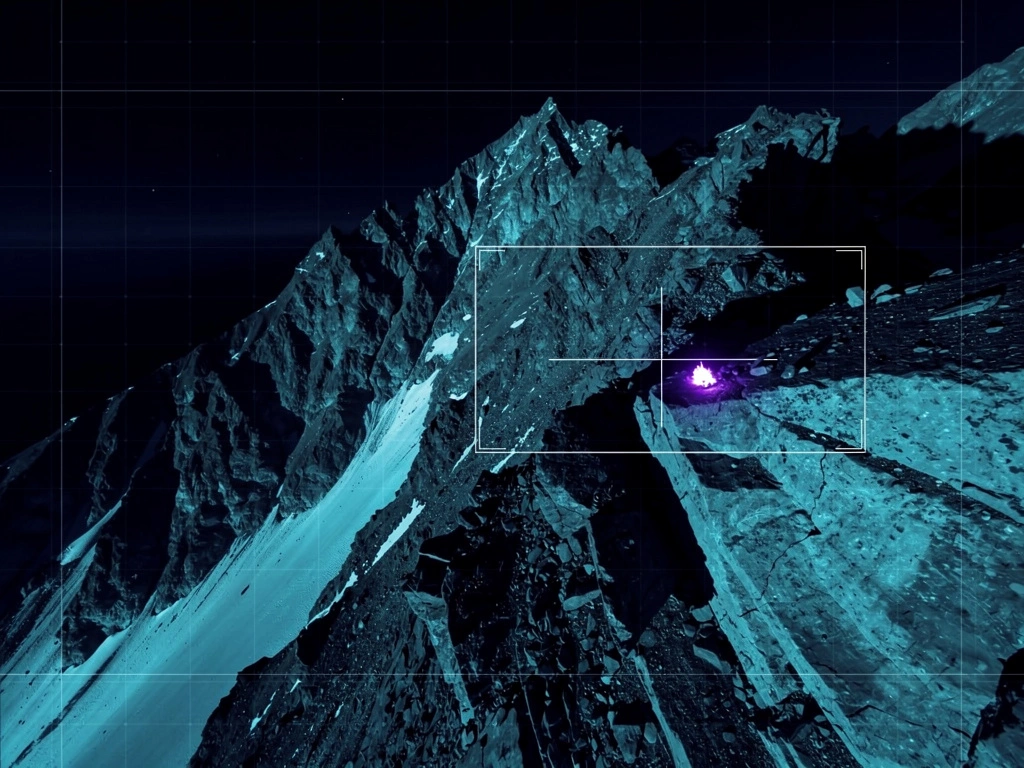
On Monday 6 April 2026, in the James Brady Press Briefing Room, Donald Trump described a camera. It had been pointed at a mountainside in southwestern Iran in the middle of the night, and it had held one ambiguous shape in frame while nobody watching could say for certain what it was. "This is a vast mountain, vast, thick with bushes, trees," he told reporters. "He said, 'We see something moving.' 40 miles away was the head of a human being. I'm telling you, it's moving. And then all of a sudden, 45 minutes later, he moved a lot. Stood up and they said, 'We have him.'"
Standing with him, CIA Director John Ratcliffe put the same event in the agency's own register: "At the President's direction, we deployed both human assets and exquisite technologies that no other intelligence service in the world possesses to a daunting challenge comparable to hunting for a single grain of sand in the middle of a desert."
Gen. Dan Caine, chairman of the Joint Chiefs, spent part of that briefing trying to keep his commander in chief from answering questions. Asked how many men had been sent altogether for the operation, Caine said, "I'd love to keep that a secret, Mr. President." Trump answered anyway. Hundreds.
For twelve years the official answer to why nobody saw what happened to MH370 has been that nobody was pointed at the right patch of ocean. April 2026 is the clearest public account anyone has of what happens when the United States decides to point. Read it closely, because the figure that got repeated afterwards is the least reliable number in the whole story.
- John Ratcliffe at the White House press briefing, Monday 6 April 2026 : His three statements are reproduced verbatim here and match the Washington Examiner's rendering. Most outlets drop the opening "At the President's direction," and PBS's wire copy carries only the fragment "exquisite technologies that no other intelligence service", without "in the world". Military Times renders the capability instead as "unique, exquisite capabilities", which is a different sentence.
- Military Times, "The rescue mission that brought 2 F-15E Strike Eagle crew members home", 8 April 2026 : Renders Trump as "40 miles away was the head of a human being... 45 minutes later, he moved a lot. Stood up and they said, 'We have him.'" The site's own archive corroborates it: at about 20:35 and 22:07 of Ashton Forbes' 7 April stream (wAXD1v6ite8) the briefing audio is replayed and auto-transcribed to the same words. Fox News compresses the passage to "We see something moving 40 miles away", which is not what the audio says, and that compression is what most retellings inherited.
- Fortune, 7 April 2026: the Caine exchange : Trump asked "How many men did you send altogether, approximately, for the operation?"; Caine replied "I'd love to keep that a secret, Mr. President"; Trump gave the answer regardless.
2 What Happened Between the Third and the Fifth of April
At about 04:40 local time on Friday 3 April 2026, an F-15E Strike Eagle carrying the call sign Dude 44 was hit over southwestern Iran on a deep strike mission flown as part of Operation Epic Fury. The aircraft belonged to the 494th Fighter Squadron of the 48th Fighter Wing, based at RAF Lakenheath in Suffolk. Trump later said a shoulder-fired heat-seeking missile brought it down, and that the Iranians got lucky.
Both crew ejected. They came down miles apart, made radio contact with US forces, and switched on their emergency locator beacons.
The pilot, Dude 44 Alpha, was out the same day. Secretary of War Pete Hegseth compressed both recoveries into one sentence: "We flew for seven hours in daylight over Iran to get the first pilot, and we flew seven hours in the middle of the night to get the second." That first flight cost something. One of the two HH-60W Jolly Green II rescue helicopters took ground fire with crew wounded aboard, and an A-10 flying Sandy escort was hit badly enough that its pilot nursed it into Kuwaiti airspace and ejected; the aircraft came down in Kuwait.
The weapons systems officer had a much worse weekend. Dude 44 Bravo, a colonel, hurt his ankle on ejection or landing. He carried a pistol, an aviator's survival vest and a Combat Survivor Evader Locator. With Iranian searchers already moving toward the wreck he hiked a 7,000-foot ridgeline in the Zagros on the injured foot and hid in a crevice, and Trump's account has him treating his own wounds while bleeding profusely, though Reuters later reported he came out with minor injuries and a light concussion.
Iran wanted him badly. IRGC units, Basij militia and armed tribesmen swept the hills, Iranian state media appealed to civilians for help finding him, and a reward reported at around $60,000 was put on the result. While that was happening the CIA, according to a senior administration official quoted by Jennifer Griffin, "first launched a deception campaign spreading word inside Iran that U.S. forces had already found him and were moving him on the ground for exfiltration out of the country."
What came for him on the night of 4 to 5 April was not subtle. Trump put the recovery force at 155 aircraft: four bombers, sixty-four fighters, forty-eight refuelling tankers, thirteen rescue aircraft and others. SOF News reports B-1s dropping roughly a hundred 2,000-pound bombs onto roads, IRGC garrisons and other targets, with approaches to the extraction zone cratered on purpose to keep Iranian reaction forces out. Two AFSOC C-130s landed on a disused farm airstrip south of Isfahan and turned it into a forward arming and refuelling point. From there a single MH-6 Little Bird flew to the ridge and brought the colonel back.
Then the C-130s bogged in the dirt and would not fly out. Rather than leave them, US forces destroyed both transports and several Little Birds in place and left on three replacement AFSOC aircraft; published counts of the helicopters destroyed run from two to four. Caine named the standard that decision comes out of: "people are more important than hardware. That is the standard we live by."
- SOF News, "2nd F-15E Aviator Recovered in High-Risk CSAR Mission Inside Iran", John Friberg, 4 April 2026 (updated) : The most granular published reconstruction: squadron and wing, the CSEL, the hide site, the forward airstrip, the B-1 bomb tally and the destruction of the bogged transports. Friberg is a retired US Army Special Forces chief warrant officer (CW5 180A). Two details here are SOF News alone and are flagged as such in the text: the bomb tally, and the A-10 pilot ejecting over the Persian Gulf, where Military Times has the aircraft coming down in Kuwait. Its 4 April speculation about the weapon (Bavar-373, S-300 or 9K333 Verba) was superseded within days by Trump naming a shoulder-fired heat-seeking missile.
- Military Times, 8 April 2026 : The 04:40 local shootdown time, which is this outlet alone; both crew activating rescue beacons; Operation Epic Fury; the Hegseth quote; the A-10 coming down in Kuwait; the 155-aircraft figure, which it attributes to Trump. Caine's "people are more important than hardware" sits in a passage about the leave-no-one-behind obligation, not specifically about destroying the aircraft.
- The War Zone, "F-15E Weapon Systems Officer Shot Down Over Iran Has Been Rescued" : Jennifer Griffin's senior-administration-official sourcing for the deception campaign, quoted verbatim, plus the assets deployed and the geolocation of the forward airstrip to 32.258394, 51.901927, which is south of Isfahan near Mahyar. The same deception account is attributed elsewhere to the Washington Post and the New York Times.
- Wikipedia, "2026 United States F-15E rescue operation in Iran" : Aggregate loss list, the reported Iranian reward figure, the Reuters report of minor injuries and a light concussion, and the coordinates for the forward airstrip. Used only where a mainstream outlet corroborates the same detail.
3 The Beacon Problem
Here's the thing that falls out of every retelling.
The colonel was already telling them where he was.
A Combat Survivor Evader Locator is an encrypted, GPS-capable, two-way survival radio, built so an isolated airman can report his position to a rescue coordination centre and authenticate that the person transmitting is him. He had one on that ridge and he used it, carefully, restricting his transmissions so Iranian electronic-warfare units couldn't fix him; a military official later described his signalling as intermittent. The location reached the Pentagon. The recovery force still didn't launch until the following night.
The reason runs through every account of the operation. US officials worried the beacon "could be a trap to lure U.S. forces," in the words of the Stars and Stripes report. Trump said he suspected the airman might be sending false signals, and the colonel's first radio message, "God is good," raised suspicion before it settled anything. That worry wasn't paranoia. Iran held the crash site, had thousands of people in the hills, had a price on him, and had every incentive to sit on a captured survival radio and wait for helicopters to arrive.
So the problem handed to the CIA came in two halves, and Ratcliffe named both at the podium. "On Saturday morning, we achieved our primary objective by finding and providing confirmation that one of America's best and bravest was alive and concealed in a mountain crevice, still invisible to the enemy, but not to the CIA." Finding, and providing confirmation. Time's account of the operation puts it in plainer words: the agency "used special technology to locate the airman and determine that it was him."
The second verb is the one that needed the exquisite technology. A beacon transmits a position; it can't prove who's holding it, and from outside Iranian airspace the only way to answer that question is to look at him. What does a camera give you that an encrypted radio can't? Proof of life, at range, without needing to trust the radio. That's what the forty-five minutes were: a sensor holding station on an ambiguous warm shape until the shape stood up and settled it.
Which makes this an imaging problem, of exactly the kind this site has spent years arguing the United States solved a long time ago. The camera that can hold a whole city in frame, record everything moving in it, and let an analyst rewind to any point on the ground afterwards is not a hypothetical: it's Gorgon Stare, it was first fielded on the MQ-9 Reaper in March 2011, and its specifications are published.
- John Ratcliffe, White House press briefing, 6 April 2026 : Verbatim, and the "On Saturday morning" anchor matters: it places the confirmation roughly a day after the 04:40 Friday shootdown, which rules out reading SOF News' fourteen hours as counted from the shootdown and leaves the hide site and beacon as the natural anchor.
- Time, "How a U.S. Airman Shot Down in Iran Was Rescued From a Mountain Crevice", 5 April 2026 : The CIA "used special technology to locate the airman and determine that it was him", plus the deception campaign, the crevice, the 7,000-foot ridgeline, the intermittent signalling reported by a military official, and Trump's suspicion that the signals were false.
- SOF News, rescue of the weapons systems officer : Verbatim: "On Friday, the aviator had moved away from the crash site, evaded enemy searchers, moved in a southeast direction from the crash site, found a hide site on a mountain ridge, and set up a beacon and emergency communications device. After 14 hours the Air Force received confirmation from the Central Intelligence Agency on his location and positive identification." The article doesn't state what the fourteen hours are counted from; the placement is what puts it after the beacon, and Ratcliffe's Saturday-morning anchor is consistent with that reading.
- Stars and Stripes, "Iran operation to retrieve downed US airman was as harrowing as it was hurried", 6 April 2026 : The airman used an emergency beacon to guide rescuers, and US officials worried it "could be a trap to lure U.S. forces". Also SEAL Team 6 on the ground, MQ-9 overwatch, and the destruction of the two stuck C-130s.
Evidence Assessment
| Claim | Source | Confidence |
|---|---|---|
| The operation happened as described: shootdown 3 April, pilot recovered same day, WSO recovered the night of 4 to 5 April, aircraft lost as listed | Military Times, SOF News, TWZ, Stars and Stripes, Time, plus officials on the record | Established |
| Trump described a camera held on the suspected airman for 45 minutes, and used a figure of 40 miles | White House briefing, 6 April 2026, on video and in multiple transcripts | Established |
| The CIA both located the airman and confirmed his identity, using capability Ratcliffe says no other intelligence service has | Ratcliffe in his own words, same briefing; Time reporting the same two functions | Established |
| A transmitting beacon wasn't sufficient to launch on, because US officials couldn't rule out an Iranian trap | Stars and Stripes, Time, and Trump's own account of suspecting false signals | Strong |
| The locating sensor was Gorgon Stare or a wide-area motion imagery derivative | No official statement. Inference from the described behaviour: persistent night stare, motion cue, long dwell over mountain terrain | Informed assessment |
| The "40 miles" is the sensor-to-target range of a Reaper-borne wide-area imaging pod | Ambiguous inside Trump's own passage, and runs against the published 100 km² footprint (5.6 km radius) | Weak |
| A biomagnetic sensor ("Ghost Murmur") rather than a camera made the find | Single-outlet reporting, disputed by physicists in the open literature. Assessed on its own page | Open question |
| As of 2026 the United States can find and positively identify a concealed, motionless individual at night across mountain terrain, and will spend 155 aircraft doing it | The officials' own statements plus the operational outcome | Established |
4 The Number That Doesn't Fit
Forty miles is the figure that travelled, and it came out of unscripted presidential speech. Inside Trump's own account it points at two different things. Earlier in the passage he says of the CIA officer who called the White House, "he was 40 miles away"; a moment later the number attaches to the seeing: "40 miles away was the head of a human being." Nobody has clarified which, and the Washington Examiner recorded at the time that Trump never said whether he meant a drone or a satellite.
Start with coverage. Gorgon Stare Increment 2, the ARGUS-equipped version that reached initial operating capability in 2014, images about 100 square kilometres from an MQ-9 Reaper at around 25,000 feet. A circle of 100 square kilometres has a radius of 5.6 kilometres, which is 3.5 miles. So if the forty miles is a sensor-to-target range, it is not the reach of a wide-area imaging footprint, because that footprint is eleven times smaller.
The Reaper's targeting turret doesn't stretch to it either, and this is our own calculation rather than anyone's specification, so here it is in full. The MTS-B sits in a 22-inch ball, which puts a generous ceiling of about 0.3 metres on the optical aperture. Rayleigh's criterion gives the smallest resolvable angle as 1.22 times the wavelength divided by the aperture. In mid-wave infrared at 4 micrometres, the band a night stare would use, that comes to roughly 1.6 x 10⁻⁵ radians. At 64 kilometres, which is forty miles, that angle subtends about one metre on the ground. A human head is roughly a fifth of that.
None of which makes the account false, because resolving a head and detecting one are different jobs. A warm object smaller than a single resolution element still announces itself when it moves against a cold static background, and that's among the easiest things in the world for a machine to flag. A man going from lying in a crevice to standing up shifts a thermal blob by a resolution element or two, which is exactly the event Trump describes. His "the head of a human being" is a president narrating what analysts concluded, not reading a specification sheet.
That leaves three readings and no way to choose between them from the public record. The forty miles describes the officer's standoff rather than the sensor's. Or the sensor was Reaper-class and detecting rather than resolving, which the physics allows comfortably. Or the aperture is larger than anything that hangs off a Reaper, which is close to what Ratcliffe said at the podium. What survives all three is the part nobody has to reconstruct: whatever was watching held one ambiguous warm shape on a mountainside for forty-five minutes in the dark, and came back with a name. Persistence and identification are the capability on display. The range was never the interesting number.
- Gorgon Stare programme record: Sierra Nevada Corporation (integrator), BAE Systems (ARGUS cameras), Exelis (IR arrays) : Increment 1 fielded March 2011 at about 16 km² and flown for 10,000 hours of direct combat support between March 2011 and July 2014; Increment 2 at about 100 km², 368 five-megapixel cameras, roughly 1.8 gigapixel, MQ-9 Reaper at 25,000 ft. Sierra Nevada announced on 1 July 2014 that Increment 2 had reached initial operating capability earlier that year, so the exact month is not public.
- Washington Examiner, "The extraordinary search and rescue mission in Iran" : Reports the camera and the 45 minutes, and records that Trump "did not clarify whether this referred to drone or satellite surveillance".
- 4Orbs calculation : Area to radius: r = sqrt(100 km² / pi) = 5.64 km = 3.51 miles; 40 / 3.51 = 11.4. Rayleigh limit: theta = 1.22 lambda / D = 1.22 x 4 micrometres / 0.3 m = 1.63 x 10^-5 rad; multiplied by 64.4 km gives 1.05 m, against a human head of roughly 0.21 m front to back. The aperture is inferred from the 22-inch MTS-B turret as an upper bound and is not a published figure; 0.3 m is about 54 per cent of the ball's outside diameter, at or above the generous end for a real gimbal. The result is band-specific: at the turret's visible-light wavelengths the same aperture would resolve about 0.16 m at the same range, but a night stare is a thermal problem.
5 The Layer Nobody Had to Leak
Three weeks before the F-15E went down, Palantir held its AIPCON conference and let the Pentagon's Chief Digital and AI Officer demonstrate the software live. Cameron Stanley walked the audience through Palantir Maven closing a targeting cycle end to end: "We've gone from identifying the target to now coming up with a course of action, to now actioning that target, all from one system." It had replaced, he said, "eight or nine systems where humans were literally moving detections left and right." Ted Mabrey, Palantir's chief commercial officer, told the same audience that the company was supporting Operation Epic Fury.
The scale is public too. Maven Smart System started as a $480 million five-year contract in May 2024, and a year later the Pentagon raised the ceiling to nearly $1.3 billion through 2029. At that point, May 2025, the National Geospatial-Intelligence Agency's director Vice Adm. Frank Whitworth put it at more than 20,000 active users across more than 35 service and combatant-command software tools, a base that had more than doubled since the January before. By March 2026 a memo from Deputy Secretary of Defense Steve Feinberg had moved oversight to the Chief Digital and AI Office, ahead of the system's transition to a formal program of record by the end of FY2026. A Palantir architect, Chad Wahlquist, gave the headcount version on stage: "I saw stats where normally we would have 2,000 intelligence officers... Now that's 20."
That's the piece that makes wide-area imagery usable, and it's the piece the MH370 argument has always needed. A sensor photographing 100 square kilometres continuously produces several terabytes a minute and, for most of its life, a staffing problem nobody could solve. Maven is the answer to "which pixel moved". Nobody had to leak it. It was demonstrated at a corporate conference, on camera, weeks before a president stood at a podium and described the result of using it.
- The Register, "Pentagon praises Palantir tech for battlefield strike speed", March 2026 : Palantir AIPCON. Cameron Stanley, appointed DoD Chief Digital and AI Officer in January 2026; Ted Mabrey confirming support to Operation Epic Fury; Chad Wahlquist's analyst figure, which he prefaces on stage with "I saw stats where".
- DefenseScoop, "Growing demand sparks DOD to raise Palantir's Maven contract to more than $1B", 23 May 2025 : The $480M five-year IDIQ of May 2024, the raise to nearly $1.3 billion through 2029, and Vice Adm. Frank Whitworth's user figures. Those figures date to May 2025 and the "more than doubled since January" baseline is January 2025; they circulate widely without a date attached, which is how they get quoted as current.
- DefenseScoop, "DOD components face aggressive timeline for Maven Smart System transition", 15 April 2026 : The Feinberg memo of 9 March 2026 moving oversight to CDAO, and the program-of-record transition by the end of FY2026. This article carries no user or tool counts.
- CSIS, "What Is Maven Smart System, and What Does It Do?" : Programme background and the NGA role from 2022. Its only contract figure is that the ceiling "surpassed $1 billion in May 2025".
6 What This Changes About MH370, and What It Doesn't
The official position on MH370 has never really been that the technology couldn't have seen anything. It's been that nothing relevant was pointed at the right ocean, and that whatever was pointed there produced nothing worth releasing. Both of those are claims about tasking and disclosure wearing the clothes of a claim about capability.
April 2026 pulls the two apart. Ratcliffe's sentence is a capability statement, made by the man who runs the capability, about technologies no other intelligence service in the world has. The operation around it is the tasking answer: when the United States decides that finding one specific person matters, it commits 155 aircraft, runs an influence operation inside a hostile country, and delivers a positive identification across a mountain range in the dark.
The archive matters as much as the sensor. Wide area motion imagery films its entire footprint continuously and stores it, so an analyst can pick a point on the ground long afterwards and scrub backwards through hours of recording to see what crossed it. Whether anyone was watching a stretch of the Andaman Sea live on 8 March 2014 is a different question from whether imagery of it was recorded. The system was built so those two questions have different answers. So which is it: nobody was watching, or nobody will say?
Weigh this where it belongs, which is on a stack rather than on its own. The orb footage carries the machine-stitched mosaic signature that a genuine wide-area sensor leaves behind. Gorgon Stare's first increment was flying combat missions from March 2011 to July 2014, a window that contains the night MH370 disappeared. The Inmarsat handshakes put the aircraft on an arc the official search never properly covered. And in 2026 the people who run the classified imaging layer volunteered, under no compulsion whatsoever, that they can find an injured man in a crevice on a mountain at night and tell you which man he is. Any one of those strands can be argued with alone, which is exactly why they get argued with one at a time. Taken together, "nobody could have seen anything" becomes the least economical reading on the table, and nobody defending it has produced an alternative that survives contact with the rest.
What the Iran operation does not do is prove anything about March 2014. No document has surfaced placing a wide-area imaging asset over the Andaman Sea that night, the increment flying then covered about 16 square kilometres rather than 100, and nobody at that podium said the word MH370. The reveal moves the capability baseline and it moves the credibility of the tasking argument. It doesn't move the tasking record, because the tasking record is still classified, which is the whole reason the primary-source and FOIA work exists.
7 What the Record Doesn't Say
Four holes, stated plainly:
- No official named a platform, a sensor or a programme. "Exquisite technologies" is a phrase chosen so it couldn't be pinned down, and it should be read that way.
- The forty-mile figure has never been explained, points at two different things inside Trump's own passage, and came with no statement of whether the president meant a drone or a satellite.
- The fourteen-hour sequence rests on one specialist outlet, SOF News, which doesn't state what the fourteen hours are counted from. Ratcliffe's "Saturday morning" narrows the possibilities without closing them.
- The claim that a biomagnetic sensor rather than a camera made the find comes from a single newspaper, is disputed by physicists working in the open literature, and is assessed on its own page rather than borrowed here to make this one stronger.
None of that is a reason to look away from what was actually said. A sitting president described a persistent, night-capable sensor holding one hidden man in frame for forty-five minutes, and his CIA director confirmed on the record that the agency owns capability nobody else on earth has and used it to establish not just where a man was but who he was. Then the coverage settled into arguing about the range figure. The interesting part was never how far away the camera was. It's that there was a camera, it was already looking at that mountain, and it was still recording when he stood up.
8 How Forbes Covered It
Ashton Forbes streamed the rescue on 7 April 2026 in "Iran War - Rescue Operation" (wAXD1v6ite8) and read the find as a Gorgon Stare result, playing the Trump briefing clip alongside the Sierra Nevada promotional video and the 2013 ARGUS demonstration. Two days later, after the New York Post published the Ghost Murmur account, he opened "Ghost Murmur - Quantum Aether Technology" (VUwEwdOivbs) by saying he had got it wrong: "I said they used simple Gorgon stare." He then held both readings at once, which is where the evidence actually leaves it. "I'm not saying they didn't use Gorgon Stare," he said at about 10:07. "They definitely still used wide area motion imagery to find the guy... Now, this goes well beyond it."
That layered reading is the one this page ends on too, with the layers assigned different confidence. Wide-area imagery finding and holding the target is an informed assessment consistent with every published account of how he was located. A quantum magnetometer reading his heartbeat through a mountain is a separate and much heavier claim resting on one newspaper, and it gets its own examination on the Ghost Murmur page rather than a free ride on this one.
- Ashton Forbes, "Iran War - Rescue Operation" (wAXD1v6ite8), 7 April 2026 : Forbes' Gorgon Stare argument at about 12:28; the Sierra Nevada promotional video at about 14:19; the 2013 NOVA ARGUS-IS segment at about 16:57; the Trump briefing clip replayed, so those words are the president's and not Forbes', from about 20:35 and again at about 22:07; the Maven demonstration clip from about 23:56.
- Ashton Forbes, "Ghost Murmur - Quantum Aether Technology" (VUwEwdOivbs), 9 April 2026 : Forbes speaking in his own voice: the self-correction at 05:36 and the layered position from 10:07 to 10:17. The ellipsis in the quotation elides only "No doubt. They're probably just using that normally." Transcripts checked at public/transcripts/ for both videos.
9 Chronology
Related Topics
The wide-area camera itself, and why the orb footage carries its stitching signature.
The heartbeat-detection claim from the same operation, weighed against the magnetometry literature.
SQUIDs, Josephson junctions and what biomagnetic sensing can actually reach.
The MH370 footage this capability question ultimately bears on.
Where the capability reveals sit alongside the direct evidence.
The FOIA and document work aimed at the tasking record this reveal does not touch.