The MH370 Videos, Measured
Parts Two and Three of The Vanishing rest on a set of checkable claims about two videos. Here's each one: whose point it is, the number we got, how to repeat it, and where the measurement stops.
Two videos went up on YouTube in May and June 2014. They appear to show a Boeing 777 over open sea, three bright objects circling it, a flash, and then nothing where the aircraft was. If they're real, the official account of MH370 is wrong. So is it possible to tell?
Ashton Forbes and an open-source community have argued since 2023 that the videos are real. For Part Two of The Vanishing we took that case point by point and measured it, on the earliest copies we could find: the Internet Archive's capture of the first video from 26 May 2014, a week after it was uploaded, and archived copies of the second. A second analyst then repeated the main measurements blind, without seeing the first set of results.
Part Three added two measurements, in sections 2 and 5: the shape the three objects hold between them, and what they do in the last sixth of a second before the flash.
Our read after doing it: the videos are more likely real than not. The whole stack of measurements gets you there, because a hoax has to account for every item on it, and had to do so by June 2014, when the second video went up.
Each claim below carries the labels the film uses on screen. FORBES marks a point he has made. MEASURED marks a number we took from the files ourselves. ON RECORD marks a dated public document, and STATED marks something a person has said that we can't check.
Evidence Assessment
| Claim | Whose point | What we found | Weight |
|---|---|---|---|
| The two videos show one event from two places | Forbes; measured by two analysts, one blind | In the stretch where both track cleanly, the objects circle the aircraft once in about 2.5 seconds, in both videos, at the same moment | Strong in the clean stretch |
| The three objects are one rigid triangle, and both videos show it | Measured, by a second analyst working independently | In every frame with three objects from about 28 seconds on, their average position holds still (under two pixels in four stretches of the thermal video, 111 frames; about a third of a pixel in 71 satellite pictures once a slow drift is taken out) and the circle through them keeps its size to about half a per cent. The triangle spins and tumbles, and the two videos place each object typically within 0.04 of the ring radius of each other | Strong |
| The flash lights the scene the way real light would | Forbes; measured | A halo out to about six times the visible disc; two small effects of the sign real light would give, weaker in the blind run | Support, not proof |
| A cold patch rides ahead of the orbs, and the flash reads black | Forbes; measured | A colder patch beside the orb in 62% of 709 frames, against 11% at the same spot with no orb; 305 of 439 lie ahead of the path through the air at an assumed airliner speed; the flash is the lowest point on the scale in the video; compression of the file ruled out | Strong for the pattern |
| The objects converge just before the flash | Forbes; measured | In the last four thermal frames two objects move in on screen, and at frame 1276, with all three in view, the triangle is about a quarter smaller with its centre unmoved, if the three kept their even spacing. One object's move is among the largest in the footage; four other pieces of track show one as large. One camera, one clean frame | Seen on screen; thin |
| The first video behaves like a recording of a live screen | Forbes; measured | Picture at 6 frames a second, pointer at up to 24; coordinates move with the picture in all seven drags | Strong for the behaviour |
| The picture behaves like wide-area motion imagery | Forbes; the records; measured | Cloud layer moves by less than a pixel in up to ten seconds; a 12-a-second sensor was on record four days before the upload | Informed assessment |
| The aircraft is about the size of a Boeing 777 | Measured | The on-screen coordinates give a length of about 50 metres on their own, within a fifth of a 777 | Within a fifth |
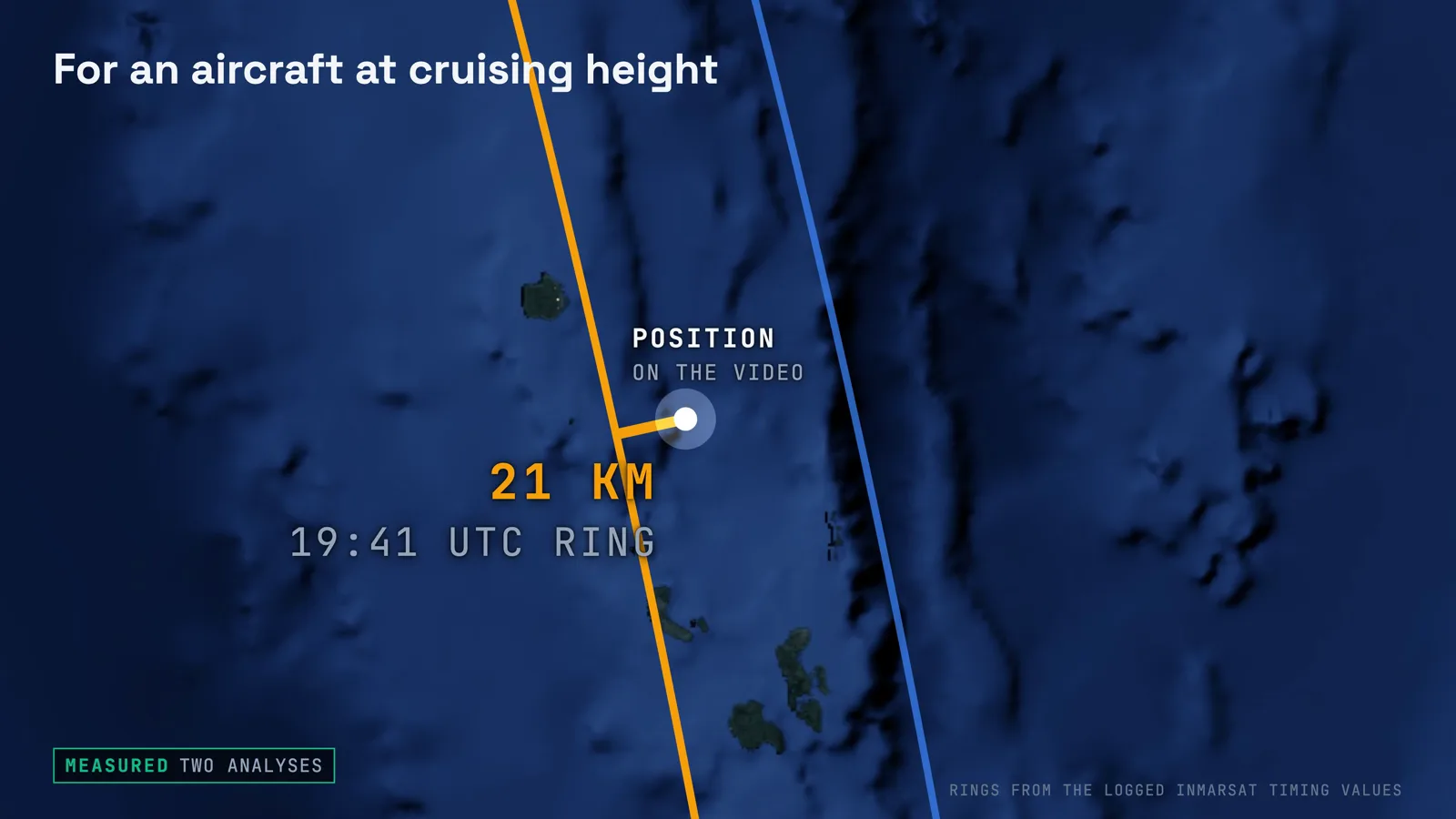
| The position fits the flight | Forbes; measured | Reachable in 27 minutes from the last radar fix; at cruising height, 21 km and under 50 km from two satellite rings whose data was released after the upload | Close, outside the official tolerance |
| The flash is a stock explosion effect | Corridor Crew; Forbes; measured | One frame of four partly matches one frame of 36. Forbes shows frames from unrelated blasts laid along the same rim. No control sample tested | Untested either way |
| The matching cloud was put into the photographs after the fact | Forbes; measured; our view | The match is real. No independent record of the three photographs is dated before the videos. A copied fingerprint from unseen pictures passes every check we have | Our view; the files cannot settle it |
| The videos are real | The whole body of evidence | A hoax has to account for every row above, by June 2014 | More likely real than not |
1 Two Videos, One Event
Forbes showed the two videos side by side, with the drone's view mirrored, and said the three objects circle the aircraft in perfect sync. That's a claim you can time.
We tracked the aircraft and each object in both videos and measured the angle of each object around the aircraft, frame by frame. In the seconds where both videos can be tracked cleanly, the objects go round once in about two and a half seconds. In both videos. At the same moment. Through that stretch both speed up at a similar pace, and they hold the same distance, about one aircraft length from its centre.
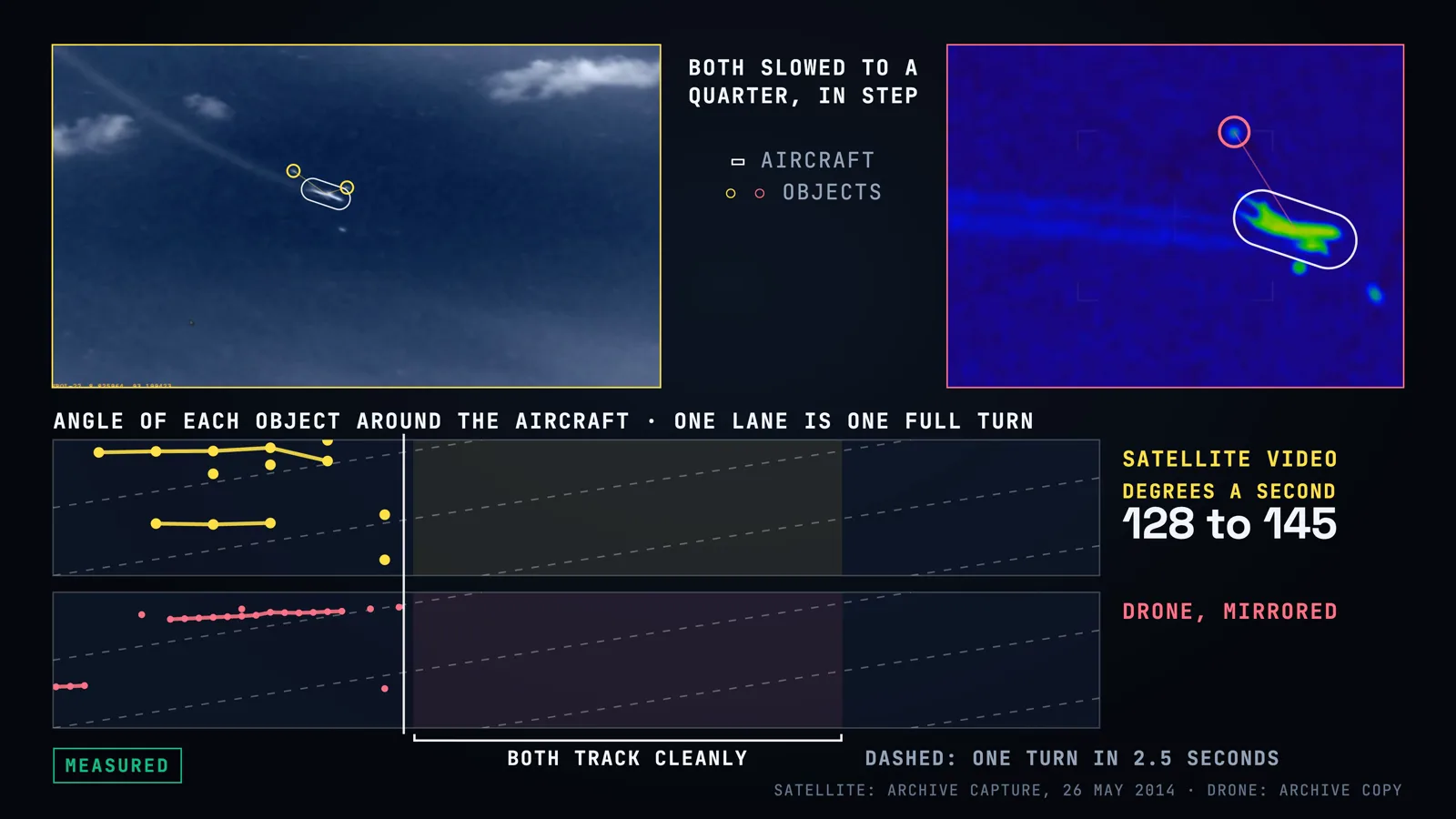
The second analysis, run blind, found the same rate in the same stretch. It also found the agreement loosens where the objects stall: the match holds in the clean passage, about a second and a half of it, and weakens outside it.
Why does this carry so much weight? The first video appears to look straight down. The second shows the scene from the side, through a thermal camera. Two fakes made separately have no reason to agree on how fast three objects circle at a given second. One event seen from two places does. To get the same result, a hoaxer has to build a single scene in three dimensions and film it twice.
To repeat it: take the Internet Archive's 26 May 2014 capture of the first video and an archived copy of the second, mark the aircraft and the three objects in each frame, and fit the rate at which each object swings from one side of the aircraft to the other. What it doesn't show: that the scene is real. A single three-dimensional model rendered from two cameras would also pass.
2 A Rigid Triangle That Tumbles
Watch the three objects for long enough and the circling looks untidy. They seem to stall, to reverse, to drift in and out. For Part Three of The Vanishing we asked what shape the three of them hold between them, and the answer is tidier than the picture.
The test needs no model of the motion. Three points spaced evenly round a circle have their average position at the circle's centre, whatever angle the circle is seen from and however it's turning. Three objects on separate loops don't. So in every frame that shows all three objects, we averaged their positions and watched whether the average moved.
From about 28 seconds into the satellite video, it stays put. Before that the three are still closing in, and the triangle they make is larger and off-centre. In the thermal video, in each of four stretches (111 frames in all), the average holds to under two pixels while the ring the objects sit on is 200 to 270 pixels in radius. In the satellite video, across 71 pictures, it holds to about a third of a pixel once a slow drift of 1.4 pixels over 17 seconds is taken out (about 0.6 of a pixel with the drift left in), and the circle through the three objects keeps its size to about half a per cent once the picture's sideways stretch is taken out. That steady size, with the steady average, is what makes it one rigid shape. From about 28 seconds until at least 45, the three objects sit at the corners of one equal-sided triangle centred on the middle of the aircraft, each about one fuselage length out.
Would the test notice if that were false? We ran it on made-up tracks with the real frame times, the real gaps and the real tracking noise. Three objects on one ring give an average steady to about half a per cent of the ring's radius, whether the ring is fixed or tumbling. Three objects each on its own ring, the rings 25 degrees apart, give 8 to 14 per cent. The real videos give 0.3 per cent from above and 0.7 from the side. On the satellite numbers, the test would catch the objects' planes differing by a single degree.
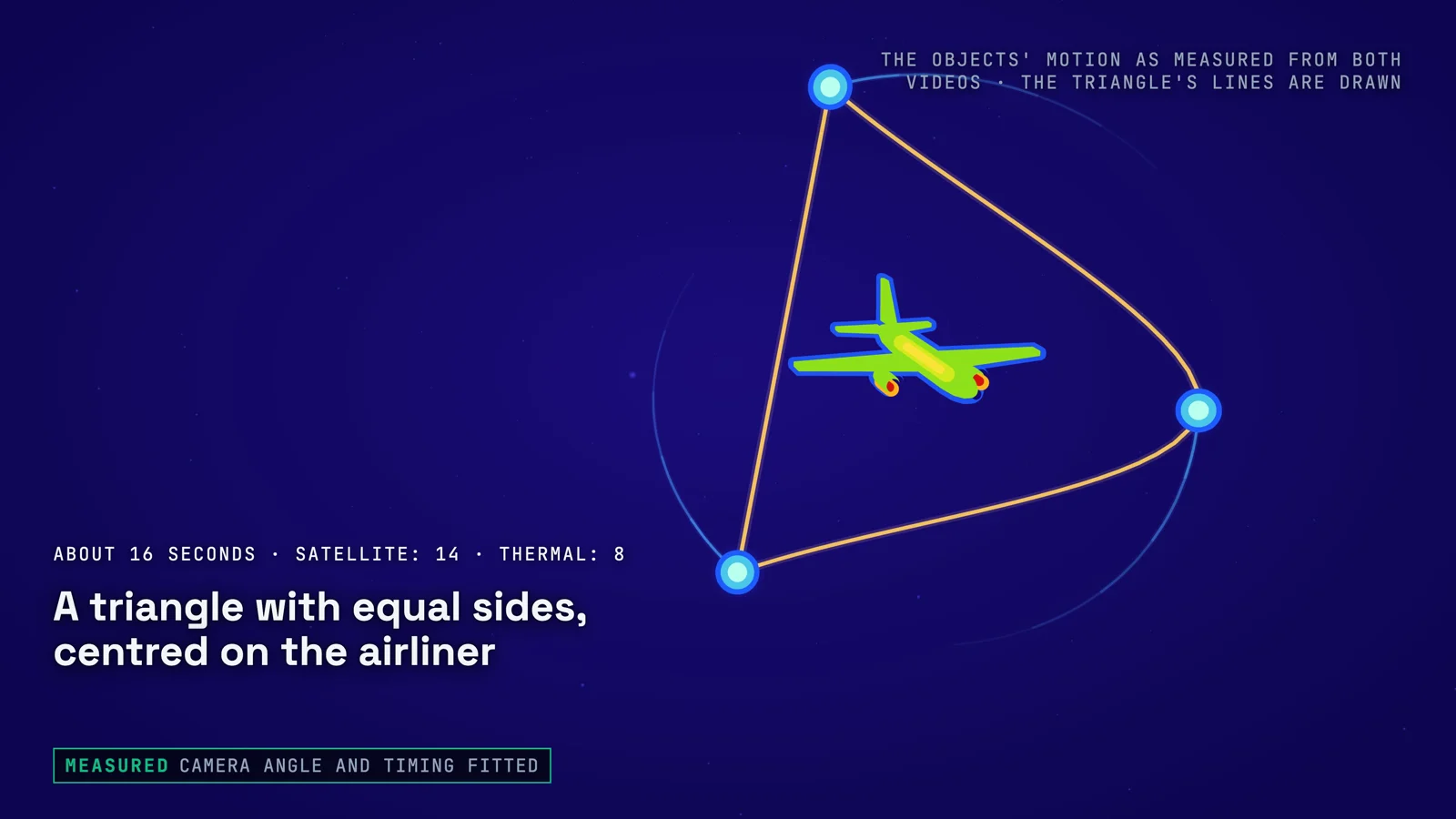
The triangle doesn't lie still, though. It spins in its own plane, one lap every 2.0 to 3.3 seconds, and the plane tips over as it spins, at 40 to 55 degrees a second. By the time an object has gone round once, the plane has tipped by 90 to 140 degrees, so no object comes back along its own path. Each one roams over a ball about one fuselage length in radius, passing above, below, ahead of and behind the aircraft. The stalls and reversals a viewer sees are the circle turning edge-on to that camera.
Each video gives the triangle's attitude picture by picture, with no help from the other. Line them up, fitting the angle between the two cameras and the timing (the thermal clock comes out 1.33 seconds behind the satellite's), and they agree on the spin second by second and on the tumble. That includes 32.5 to 33.5 seconds, where section 1 reports the match loosening: the ring was passing edge-on there, and measured as the triangle's spin the two videos agree. The position of each object worked out from one video lands within 0.04 of the ring's radius of the position worked out from the other. That's the middle value of 123 positions at 41 moments; nine in ten are inside 0.07. For a ring one fuselage length in radius it comes to two or three metres. Shift one video a second against the other and the misfit between them rises from 2 to 4 degrees to between 10 and 23.
Our own first pass got this wrong. It found the objects crossing the same direction at different distances and read that as three separate loops, and its fits assumed a steady ellipse across two and a half seconds, long enough for the ring to tip most of the way over. A second analyst, given the tracks and none of that work, found the rigid triangle. We re-ran the centre test ourselves and it holds.
Section 1 found two videos agreeing on a rate. This is far tighter. Two cameras, their lines of sight more than 120 degrees apart if neither video is mirrored, each show one rigid body in the same attitude at the same moment, to within a few metres. A hoaxer needed one three-dimensional scene with a tumbling triangle in it, filmed from two places.
To repeat it: mark the three objects in every frame that shows all three, average the three positions, and see whether the average moves. What it doesn't show: that the scene is real, since one model filmed twice would pass, or what holds the triangle rigid. The positions in three dimensions cover two stretches, 27.8 to 35.2 seconds and 36.5 to 45.0, and nothing from 45 seconds to the flash; the last second is measured on the thermal screen only. Which way the triangle leans in depth can't be told from the objects, so we took the reading in which the satellite sees the top of the aircraft and neither video is mirror-reversed. Both cameras were treated as flat views with no perspective. The ring's radius is known only to lie between 0.95 and 1.3 fuselage lengths, because "aircraft length" measures differently in each video.
3 The Flash
At 55 seconds into the first video there's a single flash at the aircraft's position. It lasts a sixth of a second, and afterwards the aircraft is gone. Forbes has argued that the flash lights the clouds around it the way a real light would.
Three things in the flash frame point that way. The scene brightens far beyond the visible disc, out to about six times its radius. Bright cloud gains a little more than the dark sea beside it, though less than plain reflection would give. And on the cloud to one side of the flash, the flanks facing it gain slightly more than the flanks facing away. Run the same tests on frames with no flash and they find nothing.
The effects are small, and they came out weaker in the blind re-run than in the first analysis; the blind analyst wouldn't call the flank effect shown. Glare in a lens, or a careful visual effect, could produce them too. We count this as support and not as proof.
4 A Cold Patch Ahead of the Orbs
Forbes has pointed since November 2023 to something in the thermal video that most viewers never see: a dark mark beside each orb. On this camera's colours dark means cold, and he puts the mark in front of the orb, where an engine's exhaust would trail behind it. "The dark cold lines are in front of the orbs not behind the orbs," he said on 2 December 2023. He has also said they're hard to see in the original and show up in colour-changed versions.
We measured it on the original colours. The copy is the Internet Archive's capture of the YouTube file, the only one we hold at its native 24 frames a second. There's no temperature scale on screen, but every pixel of the first pass sits on, or within a few levels of, a single colour curve: black, navy, blue, cyan, green, yellow, red. The engines sit at the red end and open sky at navy, so red is hot and black is cold. Positions on that curve are ranks, so no temperature can be read off them.
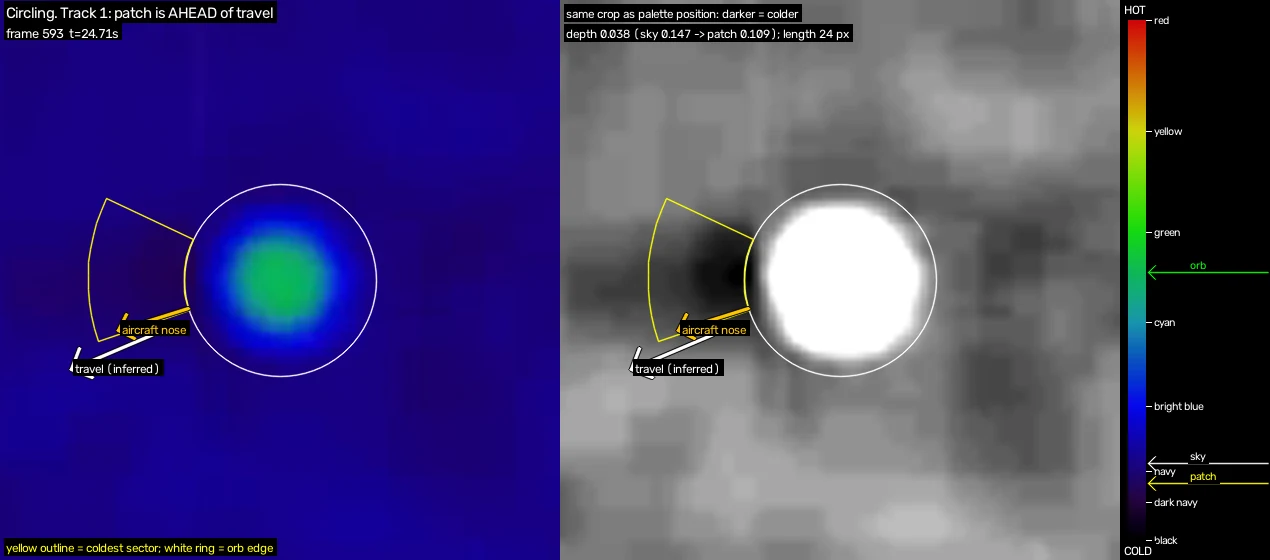
Across 709 tracked frames of an orb, taken from the stretches where the whole aircraft is in view, 439 carry a patch lower on the scale than the sky around it. That's 62 per cent. Run the same detector on the same spot beside the aircraft half a second earlier or later, when no orb is there, and it finds one 11 per cent of the time. The patch is short and soft, about one orb's width, and it comes and goes: two frames is the typical run, 32 the longest.
Which side is it on? Of the 439, 305 lie ahead of the orb's path through the air, 68 behind and 66 to the side. That path is the orb's circling plus the aircraft's own forward speed, which the picture can't give, so we set it at 250 metres a second, an airliner at cruise. Judged by motion across the screen alone, the same patches split almost evenly: 165 ahead, 144 behind. The patch also swings round the orb as that path turns: when the orb's course bends to one side of the aircraft's heading, the patch moves to that side too, across 327 frames. So it follows a path the screen doesn't show and ignores the one it does. Try other aircraft speeds and the fit is broad, best around 150 to 200 metres a second and little different anywhere from 100 to 300, so we count the speed as consistent with an airliner and no more.
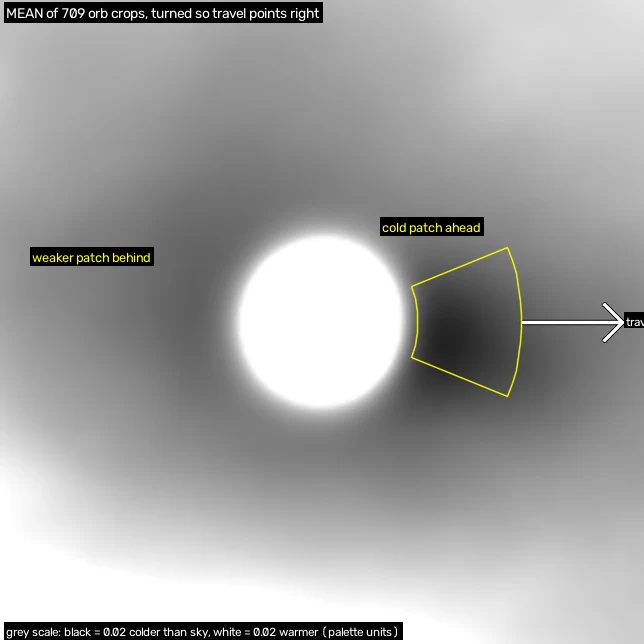
Forbes's later account has the lines changing with the encounter: behind the orbs as they approach, on both sides while they circle, only in front just before the flash. The averages lean the same way in all three phases. The circling stretch carries that firmly, with 425 patches. The approach rests on a single orb over 42 frames, and in the last second before the flash the patch is faint, so those two are a lean and no more.
Could the file's compression have made it? We tested that directly. A warm blob drawn onto the video's own sky and squeezed twice to this file's bitrate grew cold patches no more often than empty sky does, 2 to 3 per cent of frames. Compression artefacts follow motion across the screen, and these don't. They're the same depth on every kind of frame the encoder makes. The aircraft's nose, a bright edge moving the same way, never carries one, in 0 of 319 frames. In the uploader's enlarged replays the orbs are nearly six times bigger, and the patch is enlarged with them, still one orb wide, which this file's encoder can't do. A second copy through a different encoder shows the patches pointing the same ways.
The flash fits. In the thermal video it sits at the black end of the scale for three frames, lower on the scale than anything else in the whole first pass, with nothing in those frames warmer than the sky: no hot core, no warm rim. In the satellite video the same moment is bright. Forbes described both, and both measure as he describes them: black in one, bright in the other.
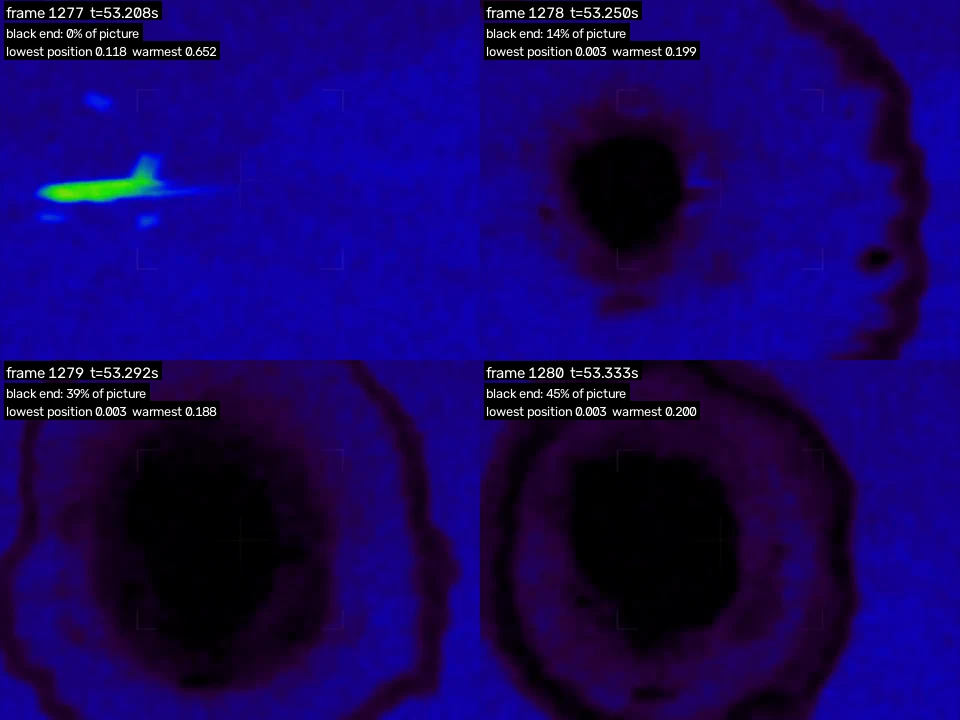
Forbes's point is that a hoaxer in 2014 had no reason to reach for a cold mark ahead of each object or a cold flash; a hot trail and a bright explosion are what effects work gives you. Whoever made this, if someone did, put a cold patch ahead of the orbs' path through the air in most frames, on a path the screen never shows, and shifted it as the encounter moved on.
Forbes says the lines show up best in colour-changed copies, so we measured the one he plays in "The Orbs Changed Modes Three Times", his video of December 2025. Its dark marks are the patch measured here: same orbs, same side, a median 5 degrees apart in direction. In his colours they look a little longer, about one and a half orb widths past the orb's edge against one and a quarter in the original, and about one in twenty runs two orb diameters or more. The long ones are there in the original's colours too, so the recolouring makes them easier to see without making them. That copy keeps, in effect, only the original's blue channel, which also turns anything far warmer than the sky dark: the aircraft shows near black. So in those colours dark can mean hot as well as cold. Checked against the original, the marks beside the orbs are the cold kind.
Does a real thermal camera do this by itself? We ran the same detector, with the same controls, over 270 infrared clips of aircraft, helicopters and drones from a public research set published by Halmstad University in Sweden. A patch beside the aircraft turned up in 12 per cent of frames, and about as often, 14 per cent, at the same spot once the aircraft had gone. None of the three groups leaned ahead. One clip in 270 had the MH370 pattern, a patch in most frames and rarely without the object, and there the dark bands ran above and below the whole aircraft, the look of a camera sharpening its edges. That sample can't settle it, though. The Halmstad camera follows its target, so the objects barely move across the screen, about a hundred times slower than the orbs, and most are 4 or 5 pixels wide against the orbs' 24. What a camera does with a small warm object crossing the frame by its own width every frame, these clips don't show, so we give no odds.
The Pentagon's UAP office has met a trail beside a fast object in drone infrared before. In May 2023 AARO closed three cases in which aircraft, one of them an identified Airbus A380, seemed to leave wakes in the air. Its finding: "the 'wake' is a sensor artifact in each case." One of its science partners traced the trails to "the object rapidly traversing the camera's field of view" and noted that "other objects in the videos also leave a similar trail." That artifact trails behind the object as it crosses the screen. The patch here doesn't: judged by motion across the screen it falls ahead and behind about equally, and it leans ahead only against the path through the air, which the screen never shows.
The orbs themselves give less away. From centre to edge their glow fades the way a plain, evenly warm disc does once this camera's blur and this file's compression have softened it, and an evenly glowing ball fits just as well. A sharply centre-peaked shape doesn't. The footage holds no more detail than that about what's inside an orb.
What it doesn't show: that the patch is a real drop in temperature. Black on a thermal palette can mean colder than the bottom of the range, or a signal outside the band the camera sees, and Forbes has offered both readings since April 2025. Measuring a picture can't show how the picture was made: compression of the archived file is ruled out, anything done before upload isn't. These measurements came after Part Two was published, so they aren't in the film.
5 The Last Sixth of a Second
Forbes gives the three objects a job. "You can produce a wormhole by having three of these orbs converge," he said in July 2024. Leave the wormhole aside: "converge" is a claim about the footage, and the thermal video's last second can be measured.
For most of that second nothing changes. The thermal video holds the aircraft and the objects together from frame 1257 to frame 1277, the last before the flash, and they're still circling about one aircraft length out, no faster than before. There's no spin-up.
Then, in the last four frames, two of them move in. One goes from 0.97 aircraft lengths out to 0.59 between frames 1273 and 1277. The other goes from 1.11 to 0.93 between 1272 and 1276. The third slides to the left edge of the picture after frame 1269, and from 1272 to 1275 only its rim shows there. It was already drifting inward on screen as the triangle turned; it's back in full view at frame 1276, under the aircraft's nose, 0.68 lengths out where it had been 0.94 seven frames earlier.
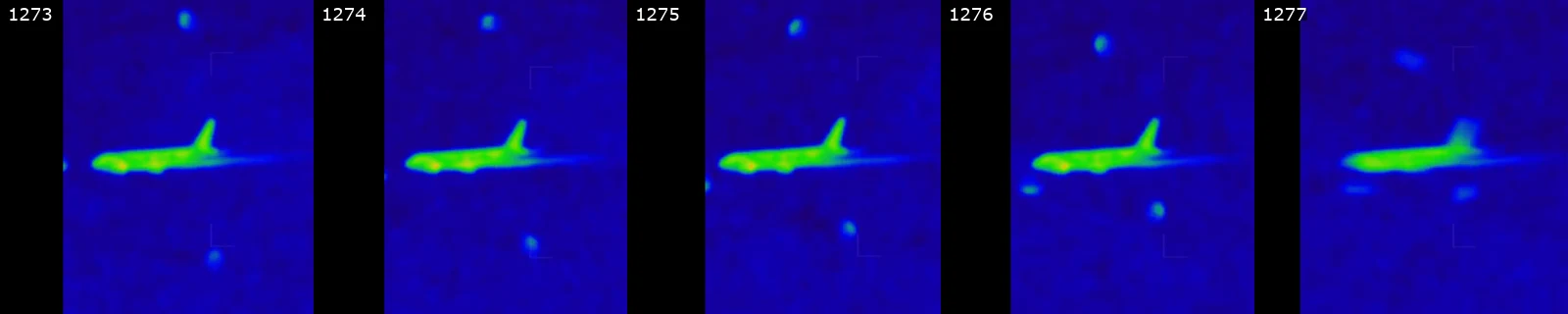
How unusual is that? We slid a four-frame window along all 26 pieces of track in the video, 602 windows in all. Fourteen show an inward move as large as the first object's or larger: its own, and 13 more from four other pieces of track. So its move is among the largest in the footage and isn't the only one of its size. The second object's move is ordinary; 76 windows match it.
Moving in on screen isn't the same as moving in. The triangle tumbles, and a ring turning edge-on to the camera also brings its objects toward the middle of the picture. Three points evenly spaced on a circle show on screen as three points on an ellipse, and the long half of that ellipse equals the circle's true radius at any tilt, so it tells a tilt from a change of size. From frame 1261 to frame 1268, with the triangle turning all the while, that figure stays between 1.17 and 1.21 aircraft lengths. At frame 1276, the one late frame that shows all three objects sharply, it's 0.87, about a quarter smaller, and the centre hasn't moved: the three positions still average to the same point, within 0.01 lengths. Frame 1277, the blended frame, isn't an independent reading, because only two of its three positions are measured: the second object has no reading there. With that one placed by continuing its path the figure is 0.74; with it held where it was, 0.82.
So the last thing the thermal camera records before the flash is the three objects drawing in together. If they kept their even spacing and their centre, the triangle shrank by about a quarter, most of it in the last twelfth of a second. That's what Forbes's word describes, and it was in the file ten years before he said it.
To repeat it: track the three objects through frames 1257 to 1277 and measure each one's distance from the aircraft's centre in aircraft lengths. What it doesn't show: where the objects went next, because the next frame is the flash. They hadn't met at the aircraft: in the last sharp frame they're still 0.65 to 0.93 lengths from its centre. This is one camera, so depth is unknown, and the size test assumes the three stay evenly spaced. It rests on one frame in which all three objects are measured, and no second analyst has repeated it. The third object's position in the blended frame was read a second time after the position first exported for the film proved wrong by a quarter of a length. The size test was made after the film's narration was recorded: the film says only that the objects move in on screen. The satellite video can't confirm any of it: in its last six seconds the aircraft is over cloud and the objects can't be picked out.
6 A Recording of a Live Screen
The first video has two clocks in it. The scene itself updates six times a second. The mouse pointer moves in between those updates, at up to 24 a second. Forbes described this: a slow picture inside a faster screen recording.
The line of coordinates along the bottom follows the operator's hand. It sits still for up to twelve seconds while the picture runs, then changes with every frame while the view is dragged. In Forbes's words, the numbers "only change when the person moves the screen." We measured that across all seven drags in the video, comparing how far the picture slides with how far the numbers move. They move together, with north up and east to the right.
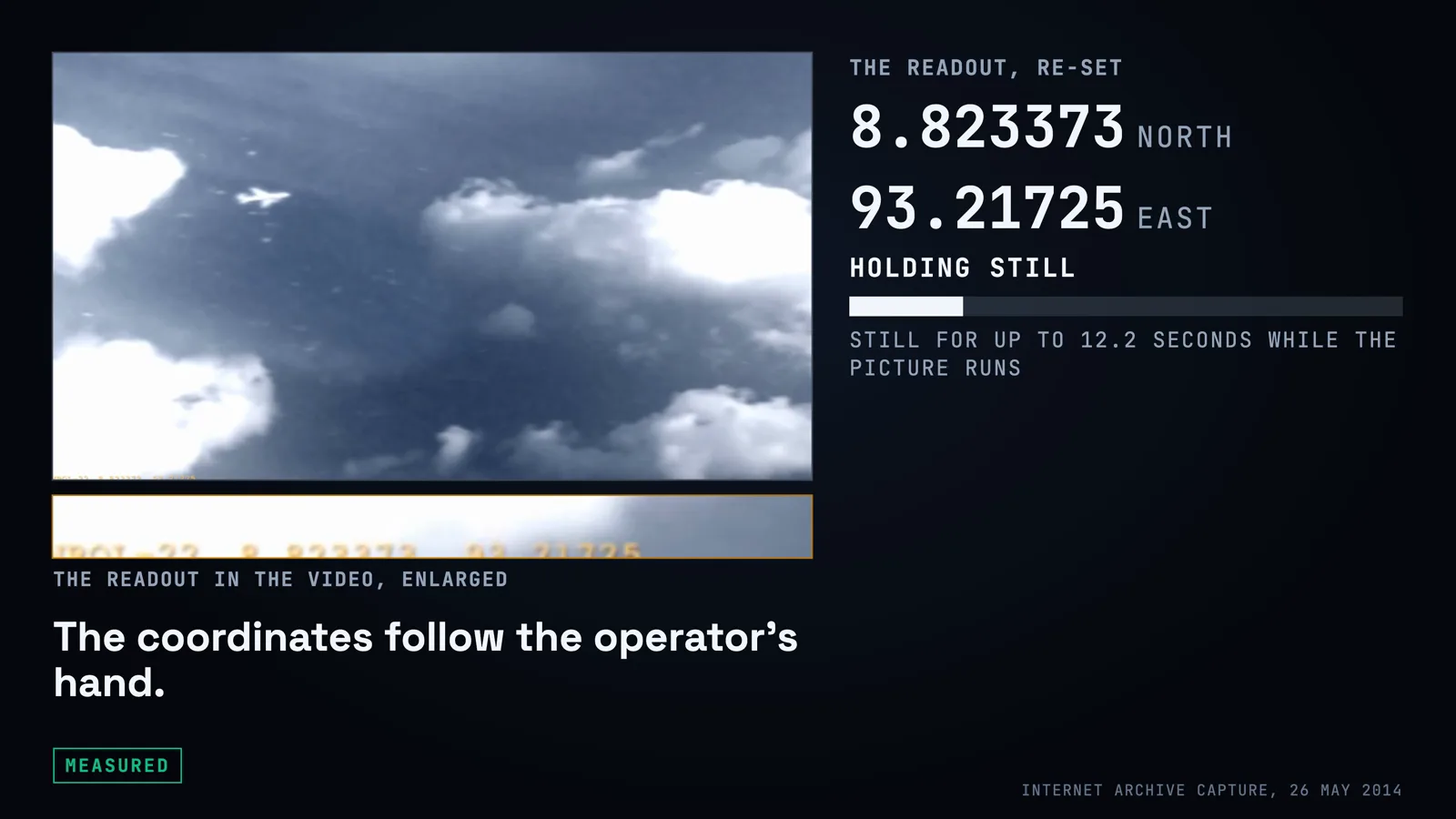
That lock is the finding. An effects artist who typed plausible coordinates onto a moving picture would have to keep them consistent with every drag, in direction and in distance, for the whole clip. An animator who drove both the camera and the text from one position value would get the same lock, so this shows how the picture behaves, and can't show where it came from.
The frame has the marks of a window cut from a larger screen, as Forbes says. The bottom edge slices the line of text through the middle, and the pointer comes and goes across the top and right edges. After the flash the recording runs on for fourteen more seconds of picture and then almost a minute of black, which fits a recorder left running.
One caution on the number 24. It's the frame rate of the file YouTube served, so it's a ceiling on what we can see. It was also a default limit in some Citrix remote-desktop software of that period, which the Air Force's secure workstation supports, but nothing ties a Citrix version to this recording.
7 The System Forbes Names
What kind of system shows a picture like this? Forbes's answer is wide-area motion imagery, and it isn't a camera in the ordinary sense. One such system whose design is public, DARPA's ARGUS-IS, has 368 sensors behind four lenses. Their views overlap, software joins them into one very large image several times a second, and operators open windows onto that image and move them about.
The software does more than join. From a circling aircraft, near things slide against far ones. Research done for the Air Force Research Laboratory describes correcting that with a three-dimensional model of the scene and rendering the result to any viewpoint.
If the video came from such a system, three things should follow, and all three can be checked: a window dragged across a larger picture, a picture rate far below video, and a scene that holds still. The first two are in the section above. For the third, wherever the view rests, the cloud layer moves by less than a pixel in up to ten seconds.
Forbes names the system: Gorgon Stare, the US Air Force's wide-area sensor, carried under the MQ-9 Reaper. Its first version was reported at two frames a second. The sensors of its second version collect twelve. Exelis, the firm that built the infrared sensors, described them on 15 May 2014, four days before the video was uploaded: multiple views, twelve times a second, combined into a single seamless image. Six is half of twelve. That last step is Forbes's inference. The figures are on the record.
So is the timing. Air Force budget papers from March 2014 say the second version began fielding in fiscal 2013. Sierra Nevada Corporation, the system's maker, called it the Air Force's only operational day-and-night wide-area system. And the announcement that it had reached service came on 1 July 2014, six weeks after the video was online.
What it doesn't show: that this video came from Gorgon Stare. The behaviour fits, and the sensor existed on the aircraft Forbes names at the right time. A still background is also what a flat photograph gives you, which is why the cloud photographs matter so much.
8 Scale and Position
If the aircraft is a 777, the picture has a scale. The fuselage is about 60 pixels long, and Boeing's planning document gives 63.7 metres for the 777-200 and 200ER. So each pixel covers about a metre, and the objects are circling 60 to 70 metres from the aircraft's centre.
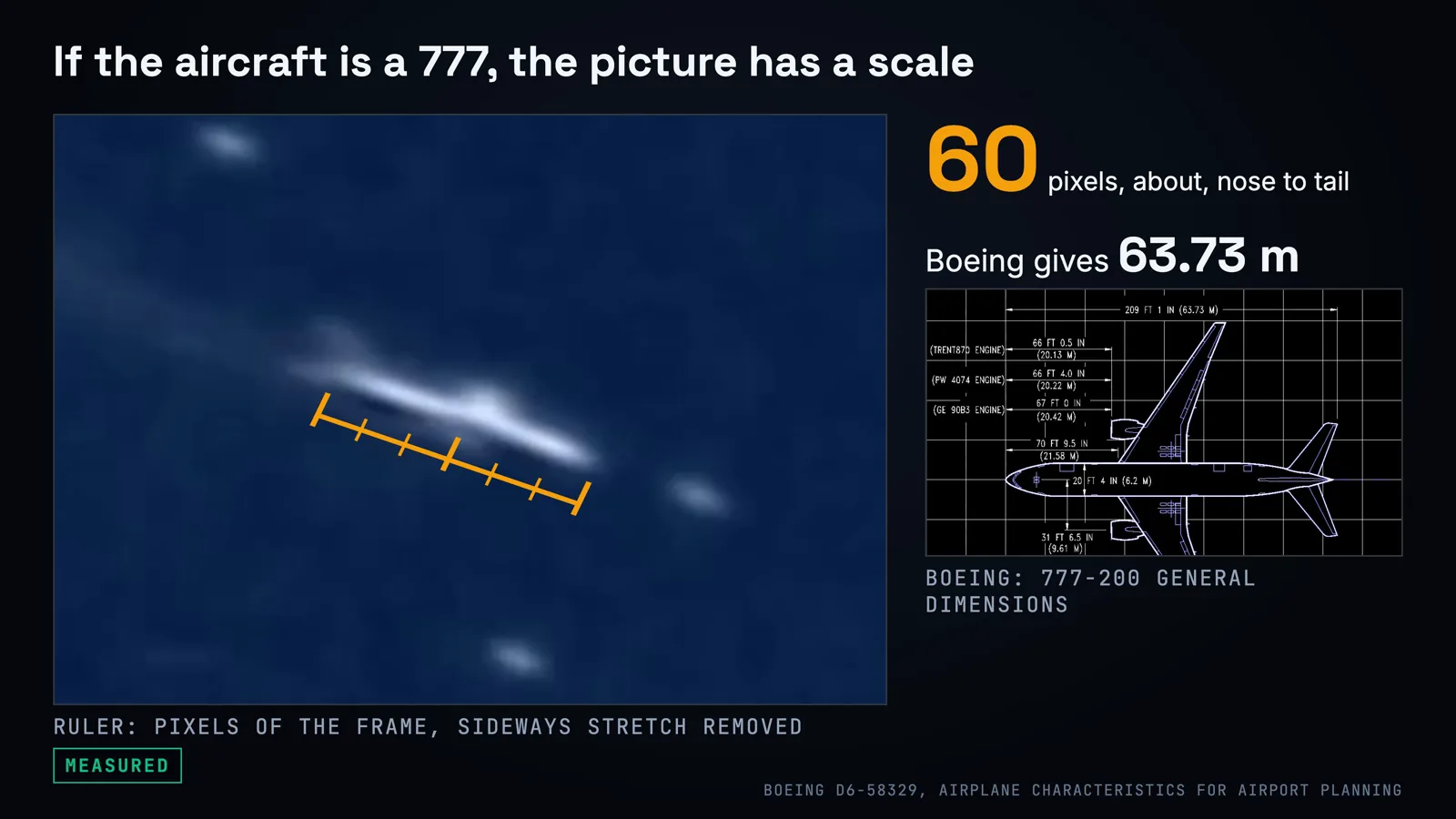
The coordinates carry a second scale, completely separate from the first: how far the numbers move when the view is dragged a known number of pixels. By that scale the aircraft is about 50 metres long. That's within a fifth of a 777, from numbers typed along the bottom of the screen.
Then the numbers themselves. 8.83 degrees north, 93.2 degrees east is open sea in the Andaman Sea, inside the Nicobar island chain, 231 nautical miles north-west of the last military radar fix. At its last recorded speed the aircraft could have been there 27 minutes later.
Forbes has pointed out that the satellite data for this flight was released only after the video was online, so we measured the fit. Each Inmarsat handshake draws a ring on the Earth. For an aircraft at cruising height, the ring from the handshake at 19:41 UTC passes 21 kilometres from the position on the video, and the ring from an hour later passes within 50. That's close, though outside the official ten-kilometre tolerance. The measurements needed to draw those rings were released on 27 May 2014. The video had been online for eight days.
One witness sits in the same stretch of sea. In the early hours of 8 March 2014 the sailor Katherine Tee was on the yacht Aaza Dana between northern Sumatra and Great Nicobar, and saw what she described as an aircraft glowing orange and trailing black smoke. She posted her account on 31 May 2014, twelve days after the first video went up, so the video can't have been built from her story. Her yacht's track puts her about 280 kilometres south-south-east of the position on the video.
9 The Objections, Measured
The satellite label. A fact check published by France 24 in March 2023 quoted an image analyst who took the satellite name on the video to be NROL-33, which launched on 22 May 2014, after the disappearance. Forbes answered it that year, and the archived video bears him out: the label reads NROL-22. That satellite launched in June 2006.
The effects artists. In November 2023 the YouTube channel Corridor Crew concluded the footage was fabricated, pointing to a cloud background that doesn't move, to noise and colour, to the smoke trail, and to the flash. Forbes's answer on the clouds is wide-area processing's parallax correction, which the research above says rests on a model of the scene. Neither Corridor Crew video examined the frame rates or the coordinates.
The stock flash. Corridor Crew laid one frame of a 1990s stock explosion over the first frame of the thermal flash, and part of the rim and one dot do line up. We checked the rest. The flash in the video lasts four frames; the stock clip runs 36 and only ever grows, while the flash grows and then shrinks. The next two frames of the flash fit nothing in the clip. Forbes has also shown a compilation in which frames from three unrelated blasts are laid along that same rim: a supernova simulation, a laboratory explosion and an exploding ring of particles. Blast waves, he argues, share this rippled ring.
A single frame that partly matches, when Forbes shows frames from unrelated blasts laid along the same rim, can't by itself be considered evidence that the video is not real. We haven't tested a large sample of real flashes against each other, so we put no odds on the match either way.
10 The Cloud Photographs
The hardest objection came in December 2023. A Reddit account six days old posted that the clouds in the first video are stock photographs: a set called Aerials0028 on Textures.com, a site that sells images to effects artists. This site once said that claim had been answered. That was too quick, so we tested it from both sides.
The match is real. We gave the video and the photographer's raw camera files to two separate analyses, the second run blind. Both found the same three photographs. Mirrored left to right, they line up with the video's sky cloud for cloud. In the blind analysis, 85 per cent of the parts of the frame with any detail match one of the three, and the rest is mostly the aircraft, its trail, the pointer and the text.
So the video and the photographs share a sky. What the files can't say is which existed first.
Forbes's account is that the photographs were made from the original wide-area imagery, without the aircraft, and placed inside a real photographer's set to discredit the video. Here's what fits it. The video shows about a tenth of each photograph, and a window onto a far larger image is what a wide-area recording is. No dated picture of these three photographs exists from before December 2023. The earliest dated trace of the set is an archived page from March 2016, itself after the videos. And the Internet Archive first saved the three pictures about twenty minutes after the Reddit post.
STATED Textures.com answered on X in the days after the Reddit post. On 9 December 2023 the company said it had looked the pictures up on its storage drive and that they were "processed by me ... in March 2012 along with other photos from his Japan trip", with a screenshot of the folder; the screenshot shows file names, not dates. Two days later it said the pictures "have been uploaded in 2012 and never altered in any way past that point", and on 12 December it explained the December 2023 dates on its own pages as a monthly script that rewrites a sort-order field across the whole table. That fits what we saw. It also said it had changed servers at least four times since 2012. That's the company's own account. It doesn't claim upload logs or a database backup from 2012, so it isn't the independent record the question needs.
Then there are the camera files. Nineteen raw files carry the fingerprint of one camera sensor, in every block of the image, including the areas the video uses. Files from three other cameras of the same model don't. Seven faulty pixels sit in the same place in all nineteen. Several frames in the run show Mount Fuji, and in one the snow matches a photograph taken from the ground on the day the photographer says he flew, 25 January 2012.
Pictures from the sets numbered just before and just after this one were archived before the flight, and they're frames from the same camera. Forbes's account has an answer to all of that: the photographer's 2012 set is real, and the matching cloud was put into it. That could be done by adding frames, or by editing real ones, which would leave Mount Fuji, the camera settings and the timing exactly as the camera wrote them. The second version is our suggestion, not Forbes's wording. Either way the hard part is the same: giving new picture content that camera's fingerprint. Copying a sensor's fingerprint out of real files and into a new picture is a known technique. Miroslav Goljan, Jessica Fridrich and Mo Chen described it in 2011 as the fingerprint-copy attack: estimate the fingerprint from a set of the camera's pictures, then add it to a picture from somewhere else.
The same paper cuts both ways, and that's useful. Its authors demonstrated the attack on JPEG pictures, not raw files, and they published a way to catch it. When two or more forged pictures carry the same copied fingerprint, their test can expose them without access to the pictures the forger started from. A 2017 paper by Haodong Li and colleagues describes an improved attack that weakens that test. So we ran it.
The test asks whether the three matching photographs share more with each of the other sixteen files than one true fingerprint explains. A copied fingerprint is an average of real pictures, so it drags a little of each picture's own noise along with it. To be sure the test could see that, we planted forgeries ourselves: pictures from three other cameras of the same model, given a fingerprint copied from this set at the strength the real files show. When the copy was made from eight of the files, the test flagged it clearly, in six to eight of the eight files used. When it was made from all sixteen it flagged it weakly, in one or two.
On the three matching photographs it found nothing. They behave like the sixteen files nobody disputes.
That rules out only the simplest version: a fingerprint copied from the files we hold. And the test is easy to get around. We copied the fingerprint from eight of the files, hid those eight, and examined the forgery with the other eight. It passed as this camera, at exactly the strength of a real file, and the test found nothing. The fingerprint belongs to one sensor, not to the model, but a forger doesn't need the camera. Pictures from it are enough, and the stock site carries the neighbouring sets from the same one. We also searched the three files for other traces of a forgery (pasted cloud, rebuilt grain, a photograph of a screen) and found none.
Two readings remain. In the first, the video is real and the photographs were made from its imagery and planted. In the second, the photographs came first and someone built the video's sky from them. The second needs only one person and ordinary software, but the sky is all it explains. The photographs hold no aircraft, no objects and no flash. Whoever used them still had to build two videos whose objects circle at the same rate, a flash with a halo six times its width, and everything else on this page.
We think the first reading is the stronger one: the photographs were planted. That's a judgement and we label it as one, because the files themselves don't show it. Taken alone, they read more simply the other way: three ordinary frames from a real camera. Our view rests on the absence of any independent record before the videos, and on everything the second reading leaves unexplained.
11 What We Couldn't Verify
- Who uploaded the videos. The uploader has never been publicly identified. The case has to come from the pictures.
- The original files. The video measurements were made on YouTube's compressed copies as archived in 2014 and later, and the flash comparison on a third party's 2014 re-upload of the second video. Nobody outside the source has the recording itself.
- Forbes's library check. He says his community checked two pirated copies of the Textures.com library, from 2014 and 2018, and that the three photographs were in neither. That's his statement. We haven't seen those copies.
- The fingerprint test's reach. Our version of the test was checked against forgeries we planted on pictures from other cameras. It can't see a fingerprint copied from pictures we don't hold, and a second form of the test, which compares the suspect files with each other, didn't separate our planted forgeries cleanly, so we draw nothing from it.
- The 3D copy. The earliest archived copy of the first video includes a 3D version whose second view shifts steadily from the top of the frame to the bottom. That's what Forbes's reading predicts. An automatic 3D conversion of the kind YouTube ran in 2014 could produce it too, and the shift alone can't tell them apart. The mouse pointer is shifted along with the picture, which says the 3D step came after the screen was recorded.
- What the cold patch is. The video gives colours, not temperatures, and carries no scale bar, so the patch's temperature can't be read. The direction "ahead" depends on an assumed aircraft speed. A control sample now exists, 270 real infrared clips, but its objects are tiny and barely move across the screen, so it can't say how often a real camera shows a dark patch ahead of a small warm object crossing the frame as fast as the orbs do.
- What holds the triangle, and where it went. The measurements show three objects keeping a rigid triangle and then drawing in. They can't show what keeps it rigid. The move in is measured from one camera, across the screen and, in one clean frame, in the triangle's size. The satellite video's last seconds are over cloud and add nothing.
- Which way the triangle leans. The positions in three dimensions have a mirror twin in depth that fits both videos equally. We took the one in which the satellite sees the top of the aircraft and neither video is mirror-reversed.
- The Lin account. The claim that satellite video was brought into the court-martial of Edward Lin reaches us at third hand, from a phone call that wasn't recorded. The Navy has withheld its investigation file.
12 Sources
Related Topics
The film these measurements were made for.
What the objects would have to be, and the two measurements made for it.
The two videos, their upload history and Forbes's case in full.
The wide-area sensor Forbes names, and what the public record says about it.
The handshakes behind the rings measured against the video position.
The court-martial where satellite video is said to have figured.
What the three objects might be, if the videos are real.