The Classified YouTube
If the MH370 videos are real, somebody moved them. A Department of Defense archive that 64,000 cleared people browse every month turns that from a question about who authorised a leak into a question about how many people could reach the file.
1 "Almost like a classified YouTube"
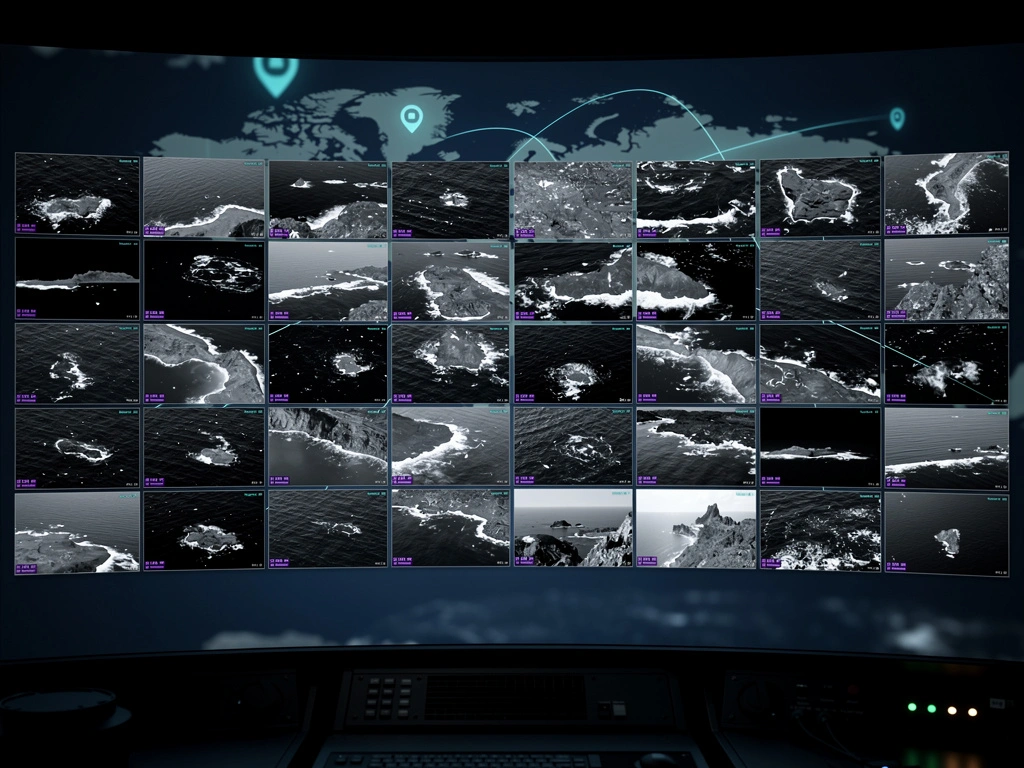
A man who used to watch drones for a living sat down in September 2026 and described his desk. Two screens on the unclassified side, green. Two more on the secret side. On the secret pair he'd open a program he calls UVDS, and what came up was a map of the world with every drone that happened to be streaming at that moment. He could pick any of them, pull the feed full-size, and watch. On a normal shift he kept about nine going at once.
"On the sipper side there's UVDS which is basically almost like a classified YouTube," he told Ashton Forbes on 5 September 2026 (video j5SJ9TNDhTE, 0:55:37). "Sipper" is what the auto-captions make of SIPR, the secret network. His description of the workstation is ordinary to the point of being boring, and that's the part that should hold your attention. He isn't describing a vault. He's describing a browser tab.
That matters for MH370 because this site has spent years on what the satellite videos show and almost none on how they could have left a classified network in the first place. The honest answer has always been a shrug. If the footage is real, somebody moved it, and the usual assumption is that moving it took either extraordinary access or somebody senior deciding to let it go. UVDS is a documented US Department of Defense program, and what the government says about it in its own contracting paperwork suggests neither assumption is necessary.
2 What UVDS actually is
The Unified Video Dissemination System belongs to the Defense Information Systems Agency, and its lineage is longer than the acronym suggests. A DISA presolicitation posted on 10 April 2008 sets out the history in its own opening paragraph: the Joint Staff tasked DISA in 1998 to work with the Defense Mapping Agency, now the National Geospatial-Intelligence Agency, and the Air Force Predator Joint Program Office on "an end-to-end Full Motion Video (FMV) Dissemination Methodology". Then the line that matters: "The system was successfully deployed in 2001."
By 2008 the drone fleet had outgrown it. The same notice says the growth in "the number, type and capabilities of the unmanned aerial vehicles (UAV) fleet" had rendered the 2001 system obsolete, and DISA announced its intent to award the replacement to Teralogics, LLC under the FY08 Defense Acquisition Challenge Program.
Five years after that, DISA was paying to keep the result running. A sources-sought notice from the Satellite Communications Gateway Sustainment Branch (NS112) at Fort Meade, solicitation number UVDS, went up on 13 August 2013 with responses due at 3pm on the 27th. DISA described its own system this way:
"The UVDS provides the DoD and Intelligence Community (IC) with a single solution for both dissemination of Intelligence, Surveillance, and Reconnaissance (ISR) data and 'real-time' viewing of Full Motion Video (FMV) streams and metadata, video archives, and a common operational picture of FMV Intelligence, Surveillance, and Reconnaissance (ISR COP). UVDS' robust, fully redundant, underlying network-along with a web-based portal application-provides users with access to 'real-time' ISR data being collected worldwide."
Two phrases in there carry the page. "Video archives" means the system stored footage rather than only passing it through. "Web-based portal application" means you reached it the way you reach any internal site, through a browser. And the office asking for help was a sustainment branch, the part of a programme office that keeps a running system running.
MH370 disappeared on 8 March 2014, six months and three weeks after that notice, and thirteen years after DISA deployed the first version.
The fuller public description came in April 2017, when DISA announced that UVDS had gone live at its Wiesbaden datacentre. The version carried by the Navy's CHIPS magazine on 6 April 2017 is the one to read, because the AFCEA write-up four days later drops both details that matter most here. UVDS "can support simultaneous FMV feeds from nearly 200 sources, typically drones", routing video through DISA's satellite gateways and the Defense Information Systems Network "to UVDS server locations for storage and further dissemination". From a SIPRNet browser, "users are able to select among incoming sources and simultaneously view multiple live or archived videos/images without the need for dedicated point-to-point circuits from each source". Rick Shaw, deputy commander of the DISA Africa Field Office, called Wiesbaden "the first major step towards providing a global ISR distribution capability with multiple global points of presence". Prior to that activation, the same article notes, there were only two UVDS locations, in DISA datacentres at Mechanicsburg, Pennsylvania and Oklahoma City, Oklahoma.
So the 2017 story is an expansion to a third site. Anyone reading that date as the system's birthday has the timeline backwards, and the difference between 2017 and 2001 is the difference between a system that existed when MH370 vanished and one that didn't.
UVDS timeline
- 1998 The Joint Staff tasks DISA to build an end-to-end full-motion video dissemination methodology with the Defense Mapping Agency (now NGA) and the Air Force Predator Joint Program Office
- 2001 That system is "successfully deployed", in DISA's own later wording
- Apr 2008 DISA posts a presolicitation for the next-generation replacement under the FY08 Defense Acquisition Challenge Program, intending to award to Teralogics, LLC
- Aug 2013 DISA's SATCOM Gateway Sustainment Branch seeks engineering support for the running system, describing "video archives" and a "web-based portal application"
- Mar 2014 MH370 disappears
- Apr 2017 UVDS activates at Wiesbaden, its third site after Mechanicsburg and Oklahoma City. DISA publishes the 64,000 monthly users and 250,000 monthly viewing hours figures
- Sep 2026 A former drone-monitoring analyst describes the system on an Ashton Forbes livestream as "basically almost like a classified YouTube"
3 Where the two accounts meet
Neither description is derived from the other. The operator was talking on a livestream in 2026 about a job he used to have. DISA was writing contracting paperwork in 2008 and 2013 and a press release in 2017. He gives the acronym and nothing else: across 2,778 transcript segments the words "unified" and "dissemination" never appear, so he's naming a system he used rather than reciting one he read about. Put the two accounts side by side.
Start with scale. DISA's figure is "nearly 200 sources, typically drones", and his account of the interface is a map of the world showing "every drone that's currently streaming live", any of which he could tap into and maximise. Where DISA writes that users "select among incoming sources and simultaneously view multiple" feeds, he says he usually ran nine at a time.
Then the network. Access in the DISA description runs through a SIPRNet browser, and he puts UVDS on the "sipper side" of a two-network desk alongside the green NIPR screens, describing the arrangement the way you describe furniture.
Storage is the correspondence that matters most for MH370, because a live feed you can only watch is no use to a leaker. DISA's 2013 notice lists "video archives"; the 2017 description covers "live or archived videos/images". His version is a shared folder of clipped events that colleagues had been adding to before he arrived, holding footage "going back like 10 years plus" (0:55:14), and a throwaway line about telling a coworker to "watch this video that I found on UVDS on the Share Drive" (1:24:34).
Three correspondences, and the striking thing is how mundane each one is on his side. He volunteers no capability figures, no programme history, nothing that reads as research. Nine feeds at once is oddly specific for a fabrication, and it's what a system built to show "multiple live or archived" streams would put in front of an operator. Describing a two-network desk with green screens on one side is the sort of thing you say without thinking if you sat at one, and the sort of thing you get wrong if you didn't.
Forbes hadn't heard any of it before the stream started, and his reaction is on the tape: "I just heard this right before the live stream and I'm just reeling" (0:56:23).
Five minutes later he connects it to the theory he's been running for years. "If you're putting things onto a share drive you can definitely get them off," he says at 1:01:28. "This is how the videos got out, right? Something just like this. We've been wondering how these videos got out, how they got clipped, like how'd they get access to them. Edward Lynn wasn't there in the drone. He was had access to the footage." ("Edward Lynn" is how the captions render Edward C. Lin.)
That move supplies a mechanism his argument had been missing. Lin flew as a sensor coordinator on EP-3E Aries II signals intelligence aircraft with VQ-1 and later VPU-2, so the footage in question was never collected by anything he sat in. Our own Lin page already records that the compromise reached well past his airframe: twelve Original Classification Authorities reviewed the material, and four of them, PACOM, OPNAV, JSOC and AFRICOM, produced Stipulations of Fact at trial. A browsable archive is one concrete answer to how a person's reach exceeds the aircraft they fly in.
4 Sixty-four thousand people
More than 64,000 unique visitors reached UVDS every month, and they watched more than 250,000 hours of video between them. DISA published both figures itself in April 2017.
Sixty-four thousand cleared people a month, browsing an archive of drone footage from a web portal. That population is too large to be a secret in any meaningful sense, and too large for the usual framing of a leak, where somebody with rare access makes a deliberate choice. A system at that scale doesn't need a decision-maker for material to escape. It needs one person out of tens of thousands to save a clip they found interesting, which is what the operator describes his colleagues doing, casually, into a shared folder, for years.
So why does the public conversation about leaked military footage always start with the question of who authorised it?
Forbes takes the same figure somewhere harder. If drone crews across the defence contracting world were watching anomalous objects routinely and talking about them in real time, he argues, then the prominent former military figures who speak publicly about UAP can't plausibly be unaware of the MH370 footage, and he names Ryan Graves as someone who has never addressed it. That inference is his, reported here as his. This site takes no position on what any individual does or doesn't know.
Stripped of the names, the access-scale argument is simpler and stronger. A very large number of cleared people could reach archived drone video from a browser. Some of them kept what they found.
5 What this does not establish
The operator's identity isn't established. He's presented as Anthony Williams; one analysis of the interview flags the name as a pseudonym, and nothing in his employment history has been corroborated outside his own account. Everything in section 3 is a correspondence between what he describes and what DISA documents, which is a weaker claim than "this man worked there", and the correspondence is what carries the weight. A person who hadn't sat at that desk would have to be unusually well briefed to produce it.
Nothing here shows the MH370 videos were on UVDS. No document, no witness, and no file listing places that specific footage in that specific archive.
UVDS carries aerial ISR. DISA's descriptions say full-motion video from manned and unmanned aerial platforms, "typically drones". The MH370 material is usually discussed as satellite imagery alongside drone footage, and satellite collection is disseminated through other channels entirely. Anyone who wants to put the satellite frames on UVDS has more work to do than this page has done.
Mechanical coherence isn't proof either. Showing that Lin could have reached archived video through a portal makes the leak theory work as a story, and a story that works isn't a story that's true. Lin was convicted of disseminating classified national defense information, and the connection between that case and this footage remains Forbes' interpretation rather than anything in the court record.
Evidence assessment
Strong that UVDS is what DISA's contracting record says it is, and that it predates MH370 by years: three government records, two of them primary SAM.gov notices, plus an official 2017 article. Strong that the operator is describing this system rather than inventing one, on the correspondence between his account and documents he shows no sign of having read. Open on whether the MH370 footage passed through it, which no source establishes. Weighed with the rest of the investigation, this strand adds opportunity to a case that already had authenticity, and it's the first part of the provenance argument that can be checked in federal contracting records rather than in the pixels.
6 Where it fits
The provenance argument on this site has always run through what the footage shows: the parallax, the thermal signature, the frame analysis, the sensor match. Those strands go to authenticity. This one goes to opportunity, and it's the first piece of the case that's checkable in federal contracting records rather than in the pixels.
The next move is a Freedom of Information Act request to DISA for UVDS access-control policy, user population figures by year, and retention schedules for archived FMV. All three are the kind of administrative record that survives FOIA review when the underlying imagery never would.
Sources
- DISA presolicitation, "Unified Video Dissemination System (UVDS)", 10 April 2008. SAM.gov 7d9ec0e2f9572c8d9dff82160ec01f2a
- DISA sources sought, "Unified Video Dissemination System (UVDS) Engineering Support Service", solicitation UVDS, posted 13 August 2013, response due 27 August 2013. SAM.gov 526f8c9af368a674574f8fceb408070d
- "DISA system improves access to, quality of intelligence, surveillance, and reconnaissance video", CHIPS, Department of the Navy CIO, 6 April 2017. doncio.navy.mil
- "DISA Improves ISR Video Capabilities", AFCEA SIGNAL, 10 April 2017. afcea.org
- Ashton Forbes, "Hung Jury: Do we deserve the TRUTH?", 5 September 2026. Transcript and analysis
Related Topics
What the footage shows, and the provenance debate this page supplies a mechanism for.
The collection side of the same chain: the wide-area camera that could have shot it.
The signals officer whose case Forbes ties to the footage, and what the court record actually holds.
The contrast case: release that somebody decided on, rather than access nobody policed.