Altermagnetism
The third kind of magnet: silent to the outside world, ferociously spin-active inside. Named in 2022, confirmed in 2024, and now carrying a free-energy claim it doesn't support.
In Plain English
Take a fridge magnet apart in your head. What makes it a magnet is that the electron spins inside it point the same way, billions of them lined up like troops on parade, and all those tiny magnetic moments add into one field strong enough to hold a shopping list to steel.
Now flip every other spin. Up, down, up, down, in a checkerboard running through the crystal. The fields cancel and the material goes quiet: no pull, no stray field, nothing a compass notices from across the room. Physicists have known that arrangement since the 1930s and call it an antiferromagnet.
There's a third option, and until 2022 nobody had a name for it.
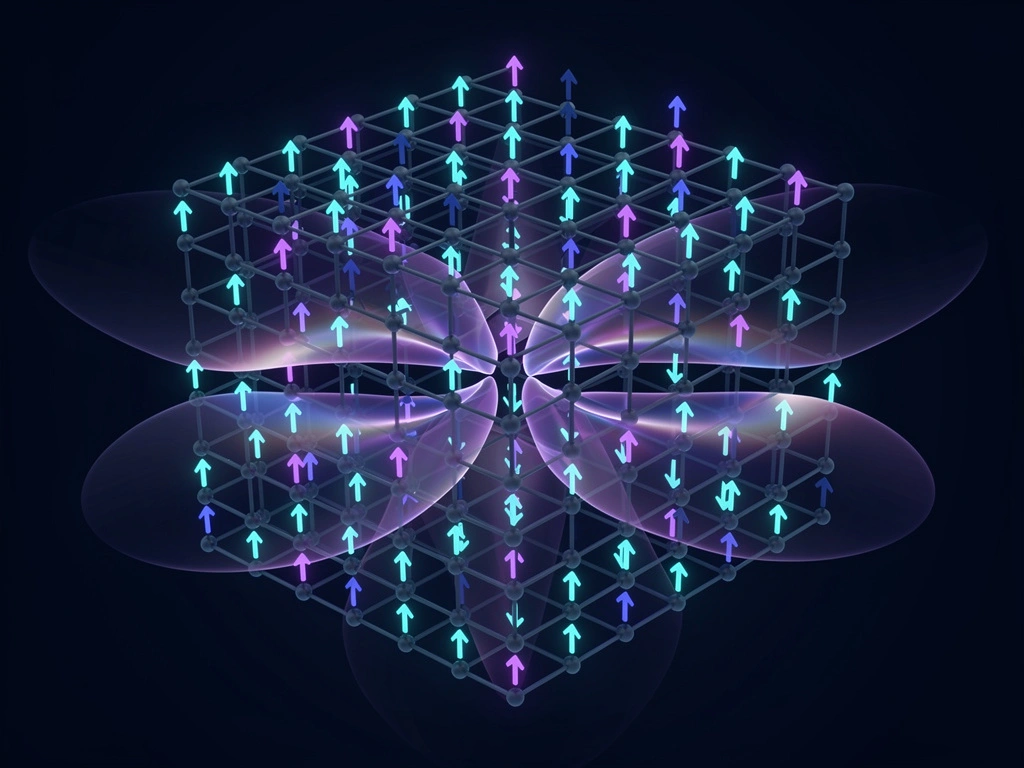
In an altermagnet the spins still cancel, so there's still no external field. What changes is how the two halves of the crystal relate to each other. Rotate one to get the other, instead of sliding it across, and the electrons inside start behaving as though they're in a ferromagnet: they feel a strong force that depends on both their spin and the direction they're travelling. Silent from the outside. Ferociously spin-active within.
That combination is why altermagnetism reached this site. If you wanted a compact device that manipulates spin hard while radiating nothing a magnetometer could catch, this is the material you'd draw on the whiteboard.
Ashton Forbes went further. In a livestream on 31 March 2026, across roughly half of its 85 minutes, he worked through two 2026 papers on altermagnets and concluded they showed, in his words, "unambiguously free energy". Both papers are real and he identifies them correctly. So this guide does three things: it explains what an altermagnet is, it reports what the field has actually measured since 2022 against what's been forecast, and it walks the free-energy reading up to the wall it runs into. That wall is one this site has already mapped somewhere else.
The Three Magnetic Phases
A ferromagnet's spins all point the same way, so the fields add and the magnet announces itself. In both an antiferromagnet and an altermagnet the spins cancel and nothing escapes. The difference is the symmetry connecting the spin-up half of the crystal to the spin-down half: slide one onto the other and the electron bands stay paired; rotate one onto the other and they split.
A Rotation Instead of a Shift
Where the Word Comes From
Libor Šmejkal, Jairo Sinova and Tomas Jungwirth made the case in Physical Review X on 23 September 2022, under a title that states the claim outright: "Beyond Conventional Ferromagnetism and Antiferromagnetism: A Phase with Nonrelativistic Spin and Crystal Rotation Symmetry" (volume 12, article 031042). A companion paper followed on 8 December, mapping out what the new phase might be good for (volume 12, article 040501). Those two papers are where the word comes from.
The Symmetry That Does the Work
The argument turns on a piece of bookkeeping that sounds dry and isn't. In any magnet whose spins cancel, the spin-up half of the crystal and the spin-down half have to be connected by some symmetry operation. If that operation is a translation or an inversion, you get the textbook antiferromagnet, and one of its consequences is that every electron state comes paired with an opposite-spin state at exactly the same energy. That pairing is called Kramers degeneracy, and lifting it was supposed to require either a net magnetisation or a broken inversion symmetry.
Altermagnets connect their two halves by a rotation. That one change lifts the degeneracy without either of the things that were supposed to be necessary. The bands split by spin, but the sign of the splitting alternates as you move around in momentum space, in a d-wave, g-wave or i-wave pattern set by the crystal. Average over every direction and it comes to zero, which is why the outside world sees nothing at all. Look along a single direction and it's enormous.
How Big the Splitting Actually Is
How enormous is the point. T. Osumi and eight colleagues measured the splitting in manganese telluride at 0.8 electronvolts at non-high-symmetry momentum points, published in Physical Review B on 1 March 2024 (volume 109, article 115102). Their own comparison is to the spin-orbit gap of about 0.3 eV along the same material's high-symmetry cut, which the splitting dwarfs. This is a ferromagnet-scale effect hiding inside a material with no magnetisation, and the same paper puts MnTe's ordering temperature at 307 kelvin, above room temperature. Whatever else is uncertain here, the magnetic order itself doesn't need a cryostat.
Which is why the field went off like a rocket. Antiferromagnets are fast, dense and externally invisible, and that's what memory engineers want; ferromagnets give you spin-polarised currents you can read and write with, which antiferromagnets can't. Altermagnets offer both properties in one material. Within three years the word went from a proposal to a subfield with its own review literature.
Confirmed in One Material, Withdrawn in Another
Confirmed: Manganese Telluride
Direct confirmation landed on 14 February 2024 in Nature, from 23 authors led by J. Krempaský, working on manganese telluride ("Altermagnetic lifting of Kramers spin degeneracy", volume 626, pages 517 to 522).
Their tool was angle-resolved photoemission spectroscopy, which is the closest thing condensed-matter physics has to looking directly at electrons. Shine light on a crystal, knock electrons out, and measure their energy against the angle they leave at. Add a spin detector and you can map how the bands split by spin, direction by direction. MnTe showed the alternating pattern the theory called for, in a material with no net magnetisation and its inversion symmetry intact.
Ten months later a second Nature paper photographed it. O. J. Amin and 20 colleagues used X-ray microscopy to resolve altermagnetic vortices around 100 nanometres across and single-domain regions ten micrometres wide in the same material, and showed those textures could be created to order, by patterning the film lithographically and by cooling it in a field (volume 636, pages 348 to 353, 11 December 2024). Predicted in 2022, seen in a spectrometer in early 2024, imaged and deliberately shaped by the end of it.
Withdrawn: Ruthenium Dioxide
Now the part that makes those results worth citing. The field's original poster child was ruthenium dioxide, a well-studied conducting oxide that theory said should be a strong altermagnet, and a run of papers reported the predicted effects in it. Then the magnetism failed to turn up. In April 2024 M. Hiraishi and six colleagues, across six Japanese institutions, published muon spin rotation measurements in Physical Review Letters (volume 132, article 166702) putting the upper limit on the ruthenium moment in bulk RuO2 at 4.8 times ten to the minus four Bohr magnetons, which is a technical way of saying they found no magnetic order at all. That October, Philipp Keßler and ten colleagues reached the same verdict in npj Spintronics (volume 2, article 50), using muon spectroscopy and neutron diffraction together and reporting bounds for both bulk crystals and epitaxial films orders of magnitude below the neutron results that had motivated the altermagnetic reading in the first place.
You can't have an altermagnet without magnetic order. A material carrying a large share of the field's early evidence got pulled out from under it inside two years, by physicists publishing against their own field's momentum.
How many research programmes do you know that will publicly demolish their own flagship material that fast?
Manganese telluride (MnTe)
Spin splitting seen directly by ARPES in Nature, February 2024, then imaged and deliberately patterned by X-ray microscopy in Nature, December 2024. Splitting up to 0.8 eV, magnetic order to 307 K. This is the result the field stands on.
Ruthenium dioxide (RuO2)
The field's original poster child. Muon spin rotation (April 2024) and muon plus neutron work (October 2024) found no magnetic order in bulk material at all. Strained thin films are still being argued over in public, in both directions, through July 2026.
RuO2 has not gone quiet since, and this page would be misleading if it left you with a verdict. Both null results were on bulk, unstrained material, and the strained thin-film question has kept moving in both directions: a September 2025 Nature Communications paper argued for a single altermagnetic variant in RuO2(101) films, a January 2026 Nano Letters paper found no transport spin-splitting effect, and in July 2026 a 27-author Science Advances paper reported mirror-odd and mirror-even spin texture in ultrathin strained films. Live, in other words, and being fought over in public.
That's what makes the MnTe result citable and the RuO2 literature worth reading in its own right. A field arguing this openly about its own evidence is one whose surviving claims carry weight, and a caution for anyone treating a fresh preprint as settled, which is exactly where this page goes next.
The Property Worth Caring About
A ferromagnet announces itself. Carry one through an airport and it tugs at every steel surface, swings a compass from across a room, and writes itself into any magnetometer sweeping the area. That stray field is also why magnetic memory can't be packed arbitrarily tight: the bits shout at each other.
An altermagnet has effectively no stray field and still carries spin-split bands. Drive a current through one and it comes out spin-polarised, which is the thing ferromagnets are used for and antiferromagnets can't deliver. It also responds on picosecond timescales, in the terahertz range that makes antiferromagnets attractive in the first place, because the internal exchange fields are ferocious even though they cancel on the way out.
Forbes puts it in one line: "if you wanted something that were stealth, this would be an amazing material science discovery." He's right, and it's the least speculative sentence about altermagnets in the whole stream. Strip the stealth framing and the published literature says the same thing, which is why the 2022 review pitched the whole phase at spintronics.
The Two 2026 Papers
The First Paper: A Switchable Casimir Torque
The first is a preprint. Zixuan Dai and Qing-Dong Jiang posted "Vacuum Torque Without Anisotropy: Switchable Casimir Torque Between Altermagnets" to arXiv on 20 January 2026, as arXiv:2601.14381. As of August 2026 it carries no journal reference, so treat it as unrefereed.
Some background on what it's claiming. Bring two plates close together in vacuum and they pull toward each other, because the quantum fluctuations of the electromagnetic field between them are more constrained than the ones outside; that's the Casimir effect, and this site has a guide to it. If the plates are made of something with a preferred internal direction, a birefringent crystal say, they also want to twist into alignment, and that twist is the Casimir torque. It's been measured. The built-in asymmetry it needs is something Dai and Jiang describe as conventional rather than necessary: anisotropic material, asymmetric geometry, or a field applied off-axis.
Dai and Jiang argue that two-dimensional altermagnets get a torque out of a field with no asymmetry in it whatsoever. Apply the magnetic field perpendicular to the plane, leaving the in-plane rotational symmetry completely untouched, and the altermagnetic order supplies the symmetry-breaking by itself through a combined crystal-and-time-reversal operation they write as C-n-T. The torque comes on continuously and grows with the square of the field strength. In the phrase that carries the weight for everything after it, the field can "even reverse the torque's sign".
The Second Paper: Persistent Spin Currents
The second paper is peer-reviewed and heavier. "Persistent Spin Currents in Superconducting Altermagnets", by Kyle Monkman, Joan Weng, Niclas Heinsdorf, Alberto Nocera, Yafis Barlas and Marcel Franz, ran in Physical Review X on 16 March 2026 (volume 16, article 011057) after about eight months on arXiv. Cite the published author list if you cite it at all: the July 2025 preprint had five names, and Barlas joined for the journal version.
Their result is that when an altermagnetic metal goes superconducting, the leading instability isn't one condensate but two. Spin-up electrons pair with each other, spin-down electrons pair with each other, and in the non-relativistic limit the two condensates are independent of one another. Because they're independent, you can arrange a state where the two charge currents cancel exactly and the spin currents don't. No net charge moves. Spin does, and it doesn't decay.
They call the generation mechanism the spin-current dynamo effect, and the durability claim is the striking one. Add spin-orbit coupling and magnetic disorder, the two things that make spin currents decay over short distances in an ordinary metal, and the spin current picks up spatial oscillations but shows, in the paper's words, "no dissipation or decay".
Both Papers at a Glance
The Casimir torque paper
Zixuan Dai and Qing-Dong Jiang, arXiv:2601.14381. No journal reference as of August 2026.
Claims a two-dimensional altermagnet produces Casimir torque from a perpendicular field with no built-in asymmetry, the order supplying the symmetry-breaking itself. Torque grows with the square of field strength, and the field can "even reverse the torque's sign".
The persistent spin current paper
Monkman, Weng, Heinsdorf, Nocera, Barlas and Franz. Physical Review X 16, 011057, 16 March 2026. Cite the published six-author list, not the five-author preprint.
Describes a spin-current dynamo effect that survives spin-orbit coupling and magnetic disorder, picking up spatial oscillations but showing, in the paper's words, "no dissipation or decay".
What Forbes Concluded On Air
Forbes reads both on air, mostly through Grok summaries he narrates from the screen, and lands in one place. Of the spin current: "How is that not free energy though? ... How can something spin forever persistently but there's no all the electric charge canceled out? ... Sounds like a perpetual motion machine to me." Of the torque paper: "this paper would seem to indicate the one that's mentioned up here above that we have unlimited energy extraction as possible." He hedges twice while doing it, on his own reading of the crystal structure ("this part I'm not sure about") and on the whole conclusion ("unless there's a completely different interpretation that I'm missing here").
A Note on the Captions
One practical note for anyone checking this page against the video. YouTube's captions render "altermagnet" as "ultra magnet" or "alter magnet" almost everywhere, so a search on the correct spelling turns up a single transcript in this site's archive while a search across every phonetic variant turns up eleven. The captions also mangle the authors into "Monkman and Dai Jen", which welds Kyle Monkman from the spin-current paper onto Zixuan Dai and Qing-Dong Jiang from the torque paper. Two papers, two teams, no overlap in the author lists.
Why Persistent Doesn't Mean Free
Equilibrium Is Not a Power Source
Both results describe equilibrium states, and an equilibrium state is the one thing in physics that definitionally can't be a power source.
The Superconducting Ring Precedent
Persistent currents aren't new or exotic. Cool a superconducting ring below its critical temperature with a little magnetic flux threaded through it and a current will circulate in that ring indefinitely: years, decades, as long as you keep it cold. Nobody has ever run a generator off one. The current persists precisely because it isn't doing work on anything. Draw power off it and it decays, and what you get out is what was put in, once.
The Monkman result is that species of persistence, upgraded. A spin current surviving spin-orbit coupling and disorder is a genuinely hard problem solved, and it's why the paper is in PRX. But "flows without dissipation" and "delivers energy" are different sentences with different consequences. The paper's own framing is spin transport: shuttling angular momentum around a device without the Joule heating that limits ordinary spintronics. Useful, publishable, and not a power plant.
The torque paper has the same shape. A Casimir torque is what you get when the Casimir free energy depends on the angle between two objects: rotate them, the vacuum energy shifts, and there's a restoring twist. Flipping that twist's sign with a perpendicular field is a real and surprising piece of physics. It's also a field you have to supply and maintain, and the round trip has to be paid for somewhere.
Robert Forward walked into this exact wall. His paper "Apparent Endless Extraction of Energy from the Vacuum by Cyclic Manipulation of Casimir Cavity Dimensions" went into the NASA Breakthrough Propulsion Physics Workshop proceedings (NASA document 19990023210, 1999), and the word doing the work in that title is "apparent".
Forbes walks through that history in the same stream and draws a line partway across it. His words are: "So the [Casimir] effect does not show infinite energy. It shows zero point energy extraction but not infinite energy." The brackets are ours, because the captions spell the name phonetically. He puts the rebuttal to Forward's cycle on screen, the objection that the walls cannot oscillate for free and the cycle needs an equal energy input, and he rejects it: "Okay. I disagree and I think that it's a conceptual problem." His reasoning is that the objection assumes empty space is empty, and that if space is not empty there is something to tap; the geometry, on his account, just has not been found yet.
That's a real disagreement about physics rather than a slip, and it deserves stating as one rather than being quietly absorbed. Where this page comes down is that the objection isn't about whether the vacuum has energy in it, which Forward, Forbes and the site all accept. It's about bookkeeping around a closed loop. The two 2026 papers don't settle it either way, because neither of them attempts a cycle.
So the honest summary is the one the researchers give. Altermagnets look like a strong route to lossless spin transport and a new handle on vacuum forces. Neither paper claims net energy gain over a cycle, and the reason isn't timidity or a classification order. It's that the states doing the interesting work are ground states, and a ground state is where energy has already finished going. That pattern holds across this whole subject: the site's side-by-side on the two vacuum-chip startups found the same thing, where the closer you get to the bench the more modest the claim becomes.
The Pais Overlap, and What Would Have to Be True
Forbes' bridge from altermagnetism to this site's core material runs through Salvatore Pais: "this actually aligns with Salvatore Pais's high temperature superconducting patents. Ultra magnetism provide a realistic approach that could support exactly what Salvatore Pais has been saying." That wording is the caption text of the 24 April 2026 clip, which is a re-cut of the same 31 March stream and transcribes the audio more cleanly; the livestream captions garble the surname twice, to "Py" and "Pis". The clip and the stream are one source, not two.
The Pais Patent, Checked
The patent is checkable, and it's one this site already tracks. US20190058105A1, "Piezoelectricity-induced Room Temperature Superconductor", filed for the Department of the Navy by Salvatore Cezar Pais on 16 August 2017, published 21 February 2019, abandoned on 12 November 2019 after the Navy let an office action lapse. Its mechanism is a wire: insulator core, a coating of aluminium or lead zirconate titanate, and a pulsed current run through it while the whole thing is vibrated. Pais invokes the Meissner effect, bipolaron formation and the Prigogine effect, and argues that the vibration frequency supplies the magnetic induction that superconductivity would otherwise need cooling to reach.
Set that next to altermagnetism and the two don't share a mechanism. Pais is driving a non-equilibrium state by mechanically vibrating an engineered composite, while altermagnetism is a static property of a crystal's magnetic symmetry group, present whether or not anything is vibrating. They aim at the same target, superconductivity without cryogenics, from opposite ends of the problem.
The connection that does hold is narrower and better sourced than the patent one. Superconductivity in altermagnets is real published theory: Song-Bo Zhang, Lun-Hui Hu and Titus Neupert showed in Nature Communications on 27 February 2024 (volume 15, article 1801) that Cooper pairs in a proximitised altermagnet pick up finite centre-of-mass momentum despite the material's zero net magnetisation, and a substantial literature on altermagnetic Fulde-Ferrell-Larkin-Ovchinnikov states has grown out of it since. None of it produces room temperature. What it produces is superconducting states with spin structure built into them, which is unusual and useful and not the same claim.
So set the orb claim out as conditions, the way this site does with the dense plasma focus. For altermagnetism to be doing real work inside an MH370 orb, four things have to hold.
A crystalline material has to keep its magnetic order at plasma temperatures.
The spin polarisation has to cross from the solid into the plasma and survive there.
The device has to run without a net energy source, or carry one.
The material has to exist in a form nobody has published, because every confirmed altermagnet so far is a laboratory solid: a grown crystal or an epitaxial film, measured on a bench or at a synchrotron.
The first condition is where the argument is thinnest by a wide margin. Altermagnetic order is a property of a crystal lattice, and plasma is what you get when lattices stop existing. Forbes half-sees it himself: he asks how the orbs can be superconductive when "their temperature is way too high", then wonders "what if they're using ultra magnetism in combination with plasma". That's a fair question with no published answer, and naming it beats assuming an answer in either direction.
None of which sinks the wider orb case, because it never rested here. The dense plasma focus argument, the field-reversed configuration argument and the superradiance argument each stand on evidence of their own. Altermagnetism is the newest strand in that bundle and, as of August 2026, the thinnest.
What would thicken it is specific and dated: the Dai and Jiang preprint clearing peer review with the sign-reversal result intact. That's arXiv:2601.14381 gaining a journal reference line. Anyone can check it in thirty seconds, which makes it a better thing to wait for than disclosure.
Mainstream vs. Speculative
This site covers both established science and unproven claims. Here's where the line falls for this topic.
Altermagnetism is a real third magnetic phase, named in 2022 and confirmed in manganese telluride by ARPES in 2024, then imaged and patterned later that year. The spin splitting reaches 0.8 eV and the magnetic order holds to 307 K. The field withdrew its own flagship material, ruthenium dioxide, when the magnetism failed to appear in bulk. Both 2026 papers are real, and both describe equilibrium states.
That either 2026 paper demonstrates free or unlimited energy. That the Casimir torque preprint will survive peer review with its sign-reversal result intact. That altermagnetism supports the Salvatore Pais room-temperature superconductor patent, which drives a non-equilibrium state by vibration rather than resting on crystal symmetry. That altermagnetic order could survive inside a plasma orb, in a material form nobody has published.
Key Terms
Altermagnet
A magnet whose spin-up and spin-down sublattices are linked by a rotation rather than a translation. The spins cancel, so there's no external field, but the electron bands split by spin anyway. Named in 2022, confirmed in 2024.
Antiferromagnet
The textbook cancelling magnet, known since the 1930s. Its two sublattices are related by a translation or an inversion, which leaves every electron state paired with an opposite-spin state at the same energy.
Kramers Degeneracy
The pairing of opposite-spin electron states at identical energy. Lifting it was thought to require either a net magnetisation or broken inversion symmetry. Altermagnets lift it with neither, which is what made the 2022 claim worth a new name.
Spin Splitting
The energy gap between spin-up and spin-down bands. In an altermagnet its sign alternates with direction in momentum space, in a d-wave, g-wave or i-wave pattern, so it averages to zero over all directions while being large along any single one.
Casimir Torque
The twisting counterpart of the Casimir force: two plates with a preferred internal direction want to rotate into alignment. It has been measured. The 2026 preprint claims altermagnets produce it without any built-in asymmetry.
Persistent Spin Current
A spin current that circulates without decaying, like the current in a cooled superconducting ring. It persists because it isn't doing work on anything. Draw power off it and it decays, which is why "flows without dissipation" is not "delivers energy".
Key Takeaways
Altermagnetism is real and confirmed. A rotation instead of a translation between the two spin sublattices splits the electron bands without producing any external field.
The effect is large, not marginal: 0.8 eV of splitting in manganese telluride against a 0.3 eV spin-orbit gap in the same material, with magnetic order holding above room temperature.
The field corrected itself in public. Ruthenium dioxide carried much of the early evidence and was pulled when muon and neutron measurements found no magnetic order in bulk material.
Neither 2026 paper shows free energy. Both describe equilibrium states, and an equilibrium state is the one thing in physics that definitionally can't be a power source.
There's a dated thing to watch: arXiv:2601.14381 gaining a journal reference line with the sign-reversal result intact. Anyone can check that in thirty seconds.