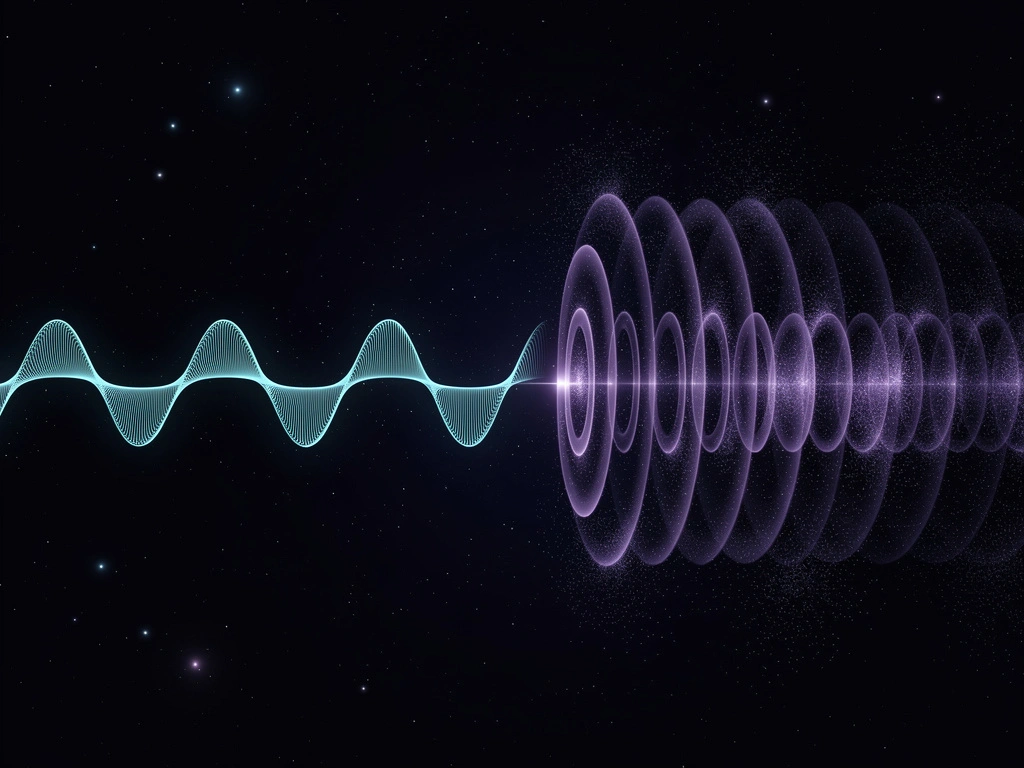
Scalar Electromagnetics
The history is true: Heaviside really did throw something out of Maxwell's equations in the 1880s. What gets built on that history is a different question, and the answer turns on where you look for a longitudinal wave.
In Plain English
If you spend any time in this material you'll meet a particular vocabulary: scalar waves, longitudinal waves, conditioned potentials, the missing piece of Maxwell's equations, energy from the vacuum. It runs through 194 of the 791 transcripts in this site's archive. It's the language Salvatore Pais reaches for, the language Ashton Forbes uses on stream, and the language of a retired US Army lieutenant colonel named Thomas Bearden, who spent forty years arguing that physics took a wrong turn in the 1880s and has been covering it up ever since.
Here's the thing that makes this hard to sort out, and the reason this guide exists. The historical claim at the centre of it is true.
Maxwell's equations really did start out as twenty equations rather than four. Maxwell really did work in quaternions in places. And Oliver Heaviside really did take a hatchet to the whole apparatus in the 1880s and throw out the scalar and vector potentials, leaving the four compact equations every physics student learns today. That isn't a fringe reading of history. It's in Physics Today.
So the interesting question was never whether something got removed. Something did. The question is whether what got removed was a physical effect that we could be using, or a piece of mathematical bookkeeping that nobody misses.
This guide walks that question. It covers what Heaviside actually did, why the answer is mostly "bookkeeping" but not entirely (the site has a whole page on the exception), what Bearden's own record looks like when you check it, and where a longitudinal wave turns out to be completely real after all. That last part is the payoff, and it lands closer to this site's core subject than anything else on the page.
What Heaviside Removed, and Where Longitudinal Waves Live
The history along the top is the checkable part: Maxwell's twenty equations, the quaternion Treatise, and Heaviside cutting it to four by eliminating the potentials. Underneath is the test this guide exists to give you. The same question about longitudinal waves has opposite answers in vacuum and in plasma, and almost every argument in this vocabulary collapses the two.
What Heaviside Actually Did
Who Heaviside Was
Oliver Heaviside was a self-taught telegraph engineer whose formal education ended at sixteen, who was left nearly deaf by childhood scarlet fever before recovering most of his hearing, and who spent the decade or so from 1874 working in near-total isolation in his parents' spare room. He is a large part of why you can write electromagnetism on a postcard.
Where the Count of Twenty Comes From
Where the famous count of twenty comes from is worth getting right, because it is the number every version of this argument leans on. Maxwell's 1865 paper set out eight general equations of the electromagnetic field, and six of those eight were written out once for each Cartesian axis, which is what turns eight into twenty equations in twenty unknowns. His 1873 Treatise lists twelve general equations including those eight, and presents them in quaternion form: a four-component number system with one scalar part and three vector parts. Heaviside found quaternions, in his own words, "antiphysical and unnatural".
What He Actually Removed
So he rebuilt the whole thing, assembling the vector calculus still taught today, the grad, div and curl operators, and using it to compress the system down to four equations. Josiah Willard Gibbs had walked a similar path a few years earlier without publishing until later, so this is shared credit rather than sole invention. What Heaviside did that mattered here is that he eliminated the vector and scalar potentials, written A and psi, and rewrote everything purely in terms of the electric and magnetic fields E and H.
That is the event, and it is the historical claim every scalar-electromagnetics argument is built on. Bearden's version, in the archival clip Forbes plays, is that Maxwell "simply assumed, out of thin air, the transverse string wave because that's what everybody was familiar with when he wrote the first equations, and it's never been changed to this day".
Heaviside had a reason, and it wasn't laziness. He thought the fields were the physically real objects and the potentials were scaffolding, a view he summed up by insisting that the energy of a current doesn't flow inside the wire at all but through the field around it and in through the sides. That turned out to be right, and it is how energy transfer in circuits is understood today.
Why Throwing Out the Potentials Cost Nothing, Almost
Gauge Freedom
The potentials have a property that makes them look like bookkeeping: you can change them without changing anything you can measure. Add the right kind of mathematical term to A and psi together, and every electric and magnetic field they produce comes out identical. Physicists call this gauge freedom, and it means there's no single correct value for a potential. There are infinitely many, all equally valid, all giving the same physics.
Which is why Heaviside could drop them without losing information. If a quantity can be changed at will with no observable consequence, it can't by itself be carrying an observable effect.
Then in 1959 Yakir Aharonov and David Bohm found the exception, and it is genuinely strange. Send an electron beam around a region where the magnetic field is exactly zero but the vector potential isn't, and the interference pattern shifts. The electrons respond to something in a place where there's no field to respond to. It was confirmed experimentally, it's in graduate textbooks, and this site covers it in detail on the A vector potential page.
So the instinct behind scalar electromagnetics isn't stupid. Potentials really are more than bookkeeping, and a physicist in 1880 who told you they were pure fiction would have been wrong.
What Aharonov-Bohm Does and Doesn't Deliver
But notice exactly what Aharonov-Bohm delivers. It's a phase shift in a quantum interference pattern, measured in a lab, and it's still gauge invariant when you do the accounting properly: what matters is the loop integral of the potential, which is a real physical quantity. It doesn't hand you a new wave, a new force, or a source of energy. The gap between "the potentials matter" and "therefore there's a suppressed longitudinal wave carrying free power" is the entire distance this page is about.
The Longitudinal Question Has Two Answers
Bearden's central claim, in the clip Forbes plays: "If you add back in the wave that is missing, guess what you get. You get equal and opposite waves in the vacuum. These waves are in fact longitudinal waves. They are more sound-like, and Tesla was right, and all the textbooks in the world are wrong."
In Vacuum: Forbidden
Take the vacuum part first, because it's the part with a clean answer. Light is a transverse wave: the electric and magnetic fields wobble at right angles to the direction it's travelling, like a flick sent down a rope. A longitudinal wave is a compression, like sound, where the oscillation runs along the direction of travel.
In empty space, Maxwell's equations forbid the second kind. Not "we've never seen one" or "we haven't looked". Set the charge density to zero, which is what empty means, and the mathematics forces the electric field perpendicular to the propagation direction. A longitudinal electromagnetic wave in vacuum isn't an undiscovered phenomenon; it's excluded by the same equations that predict light.
In Plasma: Routine Since 1929
Now the part that should interest anyone reading this site.
Longitudinal waves are completely real in plasma. They're called Langmuir waves, or electron plasma oscillations, and they're in every plasma physics textbook and on every plasma physics course. Displace the electrons in an ionised gas and the charge separation pulls them back, they overshoot, and the whole thing rings at a frequency set by the electron density. The electric field in that wave points along the direction the wave travels. That is a longitudinal wave, in a real medium, doing exactly what Bearden says a longitudinal wave should do. Lewi Tonks and Irving Langmuir published it in Physical Review in February 1929, under the title "Oscillations in Ionized Gases" (volume 33, pages 195 to 210), which puts it just shy of a century old.
There's a precision worth keeping. Langmuir waves are electrostatic rather than electromagnetic in the strict sense: they're oscillations of charge density that couple to the electric field, not self-propagating light. That distinction is why "longitudinal electromagnetic waves don't exist" and "longitudinal waves are routine in plasma" are both true statements, and it's the distinction that scalar-electromagnetics writing collapses.
Sit with what that means for this site's argument. The whole orb thesis is about plasma structures, not about empty space. The vocabulary that is flatly wrong for the vacuum turns out to be the correct vocabulary for the medium 4Orbs actually cares about. Anyone wanting to make a serious case about longitudinal effects in an orb doesn't need a suppressed nineteenth-century equation at all. They need plasma physics, which has been published and taught since before the Second World War.
The Gyroscope Argument
Bearden offers one piece of physical evidence for the missing wave, and it's worth taking seriously enough to actually examine. From the same archival footage: "when you longitudinally disturb a gyro that's restrained, it will precess sideways... a gyro reaction precesses at right angle to the actual disturbance, which proves that it is a longitudinal wave in the vacuum. If you do not believe that, you must throw away all gyro theory."
Push a spinning gyroscope and it moves at right angles to your push. Genuinely counterintuitive the first time you feel it, and completely real.
That this proves a longitudinal wave in the vacuum. Precession is what gyro theory already predicts, from rigid-body mechanics dating to the 1700s. The challenge "you must throw away all gyro theory" gets the burden exactly inverted.
The Observation Is Correct
The observation is correct. Push on a spinning gyroscope and it moves at right angles to your push, which is genuinely counterintuitive the first time you feel it.
The Inference Is Not
The inference is where it comes apart, and it does so in an unusually clean way: gyroscopic precession is what gyro theory predicts. A torque changes angular momentum in the direction of the torque, and because the existing angular momentum points along the spin axis, adding a perpendicular contribution swings the axis sideways. That's rigid-body mechanics from the 1700s. It needs no extra dimension, no vacuum wave, and no missing term.
So the challenge lands backwards. "If you do not believe that, you must throw away all gyro theory" gets the burden exactly inverted, because gyro theory is the thing that explains precession without any of the additional machinery.
The Record, Checked
Thomas Bearden was a real retired lieutenant colonel in the US Army, and his 2002 book Energy from the Vacuum runs to three pounds of paper. Its title page lists the author as "Lt. Col. Thomas E. Bearden, PhD (U.S. Army retired)".
Martin Gardner went and checked the PhD, in the Skeptical Inquirer of January 2007 (volume 31, issue 1, page 18). It was awarded, in Bearden's own words, for "life experience and life accomplishment", and it came from Trinity College and University: a British institution that Gardner describes as having "no building, campus, faculty, or president", run out of a post office box in Sioux Falls, South Dakota. The book itself was published by Cheniere Press.
Does a purchased doctorate make the physics wrong? No, and it would be lazy to argue that it does. Arguments stand or fall on their content. What a bought credential does is remove a reason to extend trust in advance, which matters when the claims are hard to check and the checkable ones haven't gone well.
The most checkable one is a patent. US Patent 6,362,718 B1, "Motionless electromagnetic generator", was granted on 26 March 2002 to Stephen L. Patrick, Thomas E. Bearden, James C. Hayes, Kenneth D. Moore and James L. Kenny, assigned to Magnetic Energy Ltd, filed 6 September 2000, and it has since expired.
What it claims is a coefficient of performance well above one. Extrapolating their measurements to a 100 volt input, the inventors put the input power at 14 watts and the output at 48 watts for each of the two output coils, giving a coefficient of 3.44 per coil from a device with no moving parts. The US Patent Office granted that.
It's tempting to say a patent doesn't certify that a thing works, and that would be wrong: US law requires an invention to be "new and useful", and the utility requirement includes operability, which is why the patent office can demand a working model for a perpetual-motion claim. The accurate point is narrower and more useful. An examiner assesses a written application against prior art; nobody from the USPTO builds the device and puts a meter on it. A grant records that the claim cleared an office, not that anyone measured it. In the two decades since, no independent replication has appeared in the peer-reviewed literature.
The credential
Martin Gardner checked the PhD in Skeptical Inquirer, January 2007. Awarded for "life experience and life accomplishment" by Trinity College and University, an institution Gardner describes as having no building, campus, faculty or president, run from a post office box in South Dakota. It doesn't make the physics wrong; it removes a reason to extend trust in advance.
The journal paper
A theory paper on the MEG ran in Foundations of Physics Letters in February 2001, with fifteen authors including Jean-Pierre Vigier, who collaborated with de Broglie, and the plasma physicist Bo Lehnert. Serious people signed it. Nobody in that list measured a MEG producing more energy than it consumed, and explaining an unverified result leaves it unverified.
One complication belongs here, because leaving it out would make this tidier than the truth. A theoretical paper explaining the device did appear in a real physics journal: "Explanation of the Motionless Electromagnetic Generator with O(3) Electrodynamics", Foundations of Physics Letters volume 14, issue 1, pages 87 to 94, February 2001, published by Kluwer at the time and now part of the Springer list. It carries fifteen authors including Bearden, and among them are Jean-Pierre Vigier, who collaborated with Louis de Broglie, and Bo Lehnert, a plasma physicist of long standing. Serious people put their names to it.
It's still a theory paper rather than a test. Nobody in that author list measured a MEG producing more energy than it consumed, and a proposed explanation for an unverified result leaves the result unverified. But "fifteen authors including a de Broglie collaborator" is a more honest description of the record than "pseudoscience, next question", and a reader is better served knowing both halves.
What to Do With the Vocabulary
Forbes' framing in the April 2026 clip is that this was all solved and then buried: "They classified it, and they classified it for national security, and it leads to free energy." That's a claim about suppression, and this site takes suppression claims seriously enough to have built pages out of FOIA responses and budget documents. Which is the standard to apply here too. The controlled-disclosure record rests on the Robertson Panel's own text and AARO's own findings. There is no comparable document behind the classified-unification claim, and saying so is what keeps the documented cases strong.
So here's the practical advice this page exists to give. When you meet "scalar" or "longitudinal" in this material, ask one question: in what medium?
In vacuum, a longitudinal electromagnetic wave is excluded by Maxwell's equations and the term is doing rhetorical work. In plasma, it names a real, textbook, measurable thing. That single question separates the two halves of a vocabulary that otherwise arrives fused together, and it happens to point anyone serious toward the plasma physics where this site's strongest technical material already lives.
The same test works on the history: "Heaviside removed the potentials" is true and checkable, while "therefore there is a suppressed wave carrying unlimited energy" is a separate claim needing its own evidence. After forty years the evidence on offer is an expired patent with no independent replication.
None of which touches the site's central argument, because that argument never depended on this. The dense plasma focus case rests on sixty years of published device physics, the Casimir material on a measured force, the Schwinger limit on a calculation nobody disputes. Scalar electromagnetics is the one strand in this vocabulary that brings no measurement with it, and the argument is stronger for not leaning on it.
Mainstream vs. Speculative
This site covers both established science and unproven claims. Here's where the line falls for this topic.
Heaviside really did cut Maxwell's system to four equations and eliminate the potentials, and the count of twenty is a real historical fact about how the 1865 paper was written. Gauge freedom means the potentials carry no observable effect on their own. Aharonov-Bohm is real and measured, and still gauge invariant. Longitudinal waves are forbidden in vacuum and routine in plasma, where Langmuir waves have been textbook physics since 1929.
That Heaviside's edit suppressed a real wave carrying extractable energy. That gyroscopic precession evidences a longitudinal vacuum wave, when rigid-body mechanics already explains it. That the Motionless Electromagnetic Generator produced more energy than it consumed: the patent exists, the independent replication does not. After forty years this strand still brings no measurement with it, which is why the site's stronger arguments don't lean on it.
Key Terms
Scalar and Vector Potential
Written psi and A. Mathematical quantities the electric and magnetic fields can be derived from. Heaviside eliminated them in the 1880s and rewrote everything in terms of the fields themselves.
Gauge Freedom
You can change the potentials in specific ways and every measurable field comes out identical. There is no single correct value for a potential, which is why dropping them cost no information.
Aharonov-Bohm Effect
A measured phase shift in quantum interference caused by a potential in a region with no field. Proof the potentials are more than bookkeeping, and still gauge invariant: what matters is the loop integral. It delivers no new wave, force, or energy source.
Transverse Wave
The oscillation runs across the direction of travel, like a flick sent down a rope. Light is one. In vacuum, Maxwell's equations permit nothing else.
Longitudinal Wave
The oscillation runs along the direction of travel, like sound. Excluded in vacuum by the same equations that predict light, and entirely ordinary in a medium with free charges.
Langmuir Wave
An electron plasma oscillation: displace the electrons, charge separation pulls them back, they overshoot, and the whole thing rings. Longitudinal, electrostatic rather than electromagnetic in the strict sense, and published by Tonks and Langmuir in 1929.
Key Takeaways
The history is true and checkable. Heaviside did compress Maxwell's system to four equations and did eliminate the potentials, and he had a reason that turned out to be right.
It cost nothing because of gauge freedom. A quantity you can change at will with no observable consequence can't by itself carry an observable effect.
Ask "in what medium?" every time. Longitudinal waves are excluded in vacuum and completely routine in plasma, and collapsing those two answers is what most of this vocabulary does.
The orb case doesn't need this vocabulary. Longitudinal effects in a plasma structure are plasma physics, published and taught since before the Second World War.
Separate the checkable from the inferred. "Heaviside removed the potentials" is verifiable; "therefore a suppressed wave carries unlimited energy" is a separate claim needing its own evidence, and after forty years the evidence on offer is an expired patent with no independent replication.