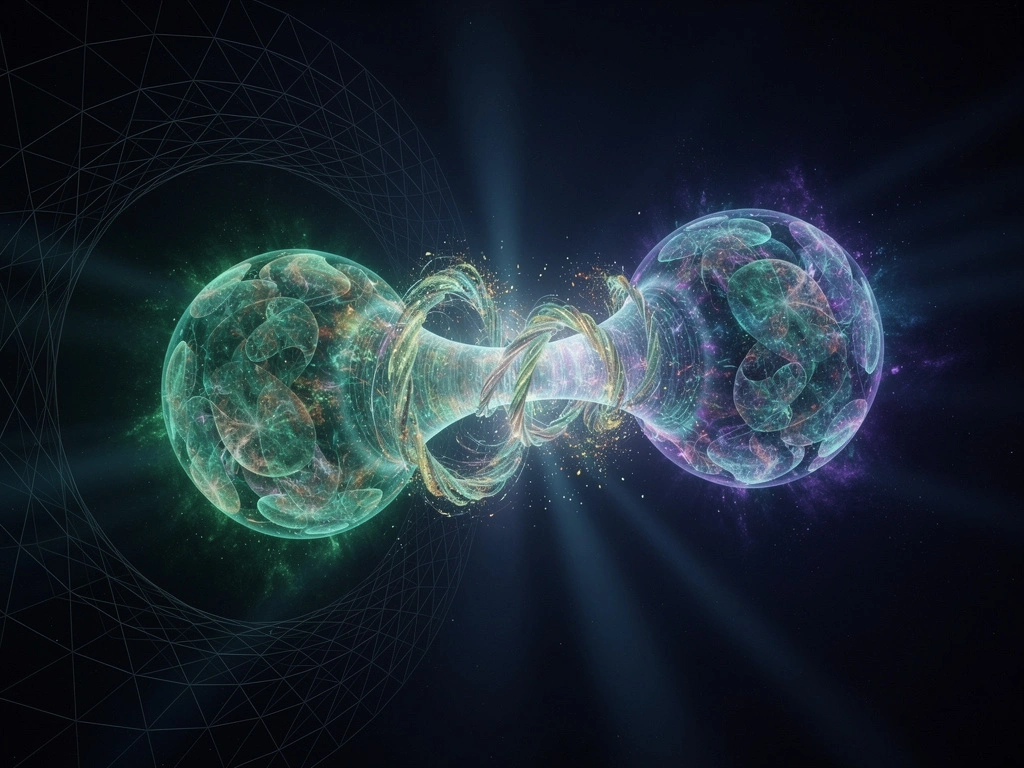
ER=EPR & the Holographic Wormhole
Two physicists proposed that entanglement is a wormhole. A decade later, a team ran wormhole dynamics on a quantum computer. Here's what that proves, what it doesn't, and why it matters for MH370.
1 The Claim
In a July 2026 livestream titled 'The Key Code That Connects Gravity to Electromagnetism,' Ashton Forbes put it flatly: 'They've already literally proven ER equals EPR is true. These people have already proven it's true experimentally.' The experiment he means is real. It ran in 2022, it went on the cover of Nature, and one of its authors is a Caltech physics professor who leads a US Department of Energy research programme.
Strip away the acronyms and ER=EPR says something a non-physicist can hold onto: two particles that are quantum entangled aren't just correlated, they're connected, joined by a microscopic wormhole. Pull hard enough on that idea and you get a mechanism. If entanglement is a wormhole, and a wormhole can be made to carry something through it, then you have a physical route from here to there that doesn't cross the space in between.
That mechanism is the whole reason this page exists. The 4Orbs case for what happened to MH370 rests on a specific claim: three plasma orbs generated a man-made Einstein-Rosen bridge and the aircraft went through it. When an anonymous senior scientist described the footage to Steven Greer, that's the exact phrase he reached for. So the question isn't academic. Does the physics that would make that possible actually exist, or is it a word borrowed from a textbook to dress up a guess?
The honest answer has two halves, and both matter. The theoretical framework is real, taken seriously by some of the most credentialed physicists alive. The experiment Forbes cites is also real, but what it demonstrated is narrower than "proven," and the gap between those two things is where the interesting work is.
Evidence Assessment
| Claim | Source | Confidence |
|---|---|---|
| ER=EPR is a serious, published conjecture from leading physicists | Maldacena & Susskind, Fortschr. Phys. 61 (2013) | Established |
| A quantum processor ran wormhole-teleportation dynamics in 2022 | Jafferis et al., Nature 612 (2022), peer-reviewed | Established |
| The experiment created a literal spacetime wormhole | Contested (Kobrin et al. 2023); authors say holographic dual | Overstated |
| Wormhole teleportation is a physically grounded mechanism, not a metaphor | Gao-Jafferis-Wall protocol (JHEP 2017) | Strong |
| This is the mechanism that took MH370 | Forbes' interpretation, cross-linked to orb footage + Greer | Informed lean |
2 What ER=EPR Actually Says
Albert Einstein wrote both halves of this equation in 1935, and never noticed they were connected. In one paper, with Nathan Rosen, he described a bridge joining two distant regions of spacetime, the mathematical object we now call a wormhole. That's the ER. In another paper that same year, with Boris Podolsky and Rosen again, he described the 'spooky action at a distance' of entangled particles, two systems whose measurements stay correlated no matter how far apart you move them. That's the EPR.
For seventy-eight years they sat in separate corners of physics. Then in 2013, Juan Maldacena of the Institute for Advanced Study and Leonard Susskind of Stanford published a paper with the almost poetic title 'Cool horizons for entangled black holes' (Fortschritte der Physik 61, arXiv:1306.0533). Their proposal was a single line of arithmetic dressed as a conjecture: ER = EPR. The wormhole and the entanglement are the same thing, seen two ways.
Here's what that means in plain terms. Take two black holes and entangle every particle in one with a partner in the other. Maldacena and Susskind argued that the geometry connecting their interiors is an Einstein-Rosen bridge, a wormhole. Scale the same logic down and it applies to any entangled pair at all: two electrons, two photons. The entanglement isn't a signal passing between them. It's a shortcut in the shape of space itself, too small and too fragile to send anything through, but there.
This isn't fringe. Maldacena is the physicist who, in 1998, wrote the single most-cited paper in modern theoretical physics: the AdS/CFT correspondence, the working mathematics of the holographic principle (arXiv:hep-th/9711200). Susskind is one of the founders of string theory. When these two say entanglement builds spacetime, the field listens, because the same authors handed the field its current understanding of quantum gravity.
So why does it stay a conjecture and not a law? Because you can't reach inside two entangled particles and photograph the wormhole between them. ER=EPR makes a claim about geometry at scales no instrument touches. What you can do is build a system where the same mathematics plays out somewhere you can measure it. Which is exactly what a group at Caltech, Google, and Fermilab set out to do.
3 The Experiment on Google's Sycamore
"Traversable wormhole dynamics on a quantum processor"
Daniel Jafferis, Alexander Zlokapa, Joseph D. Lykken, David K. Kolchmeyer, Samantha I. Davis, Nikolai Lauk, Hartmut Neven & Maria Spiropulu
Nature 612, 51–55, published 30 November 2022 (cover article)
DOI: 10.1038/s41586-022-05424-3
Lead author Daniel Jafferis (Harvard) • senior author Maria Spiropulu (Caltech, who leads the DOE-funded Quantum Communication Channels for Fundamental Physics programme)
On November 30, 2022, Nature published the paper on its cover. The team took a small model of quantum gravity, a nine-qubit version of the Sachdev-Ye-Kitaev (SYK) model, and ran it on Google's Sycamore processor, the same chip Google used for its 2019 quantum-supremacy claim. They injected a qubit of information on one side, applied a coupling between the two halves of the system, and watched the information reappear on the far side.
What made it a wormhole story rather than an ordinary teleportation story was the signature. The information didn't just arrive; it arrived carrying the fingerprints that gravity predicts. The team observed 'perfect size winding,' the pattern a message picks up as it traverses a wormhole throat, and they saw the teleportation strengthen when they applied a coupling that corresponds to a negative-energy shockwave, the exact thing that holds a wormhole open in the theory. In the holographic dictionary, they weren't simulating a wormhole from the outside. They were running the system whose gravity dual is a traversable wormhole.
The theory behind the trick was already on the books. In 2017, Ping Gao, Daniel Jafferis, and Aron Wall showed that coupling the two mouths of a wormhole makes it traversable, and stated outright that the setup is the gravity dual of quantum teleportation (JHEP 2017:151, arXiv:1608.05687). The Sycamore run was that protocol, executed on hardware. Not a cartoon of a wormhole. The dynamics themselves.
Maria Spiropulu, the senior author, isn't a fringe figure either. She's the Shang-Yi Ch'en Professor of Physics at Caltech and an experimental particle physicist who worked on the Higgs boson discovery at CERN. The programme that funded this work is a US Department of Energy quantum-information initiative. When the establishment says a subject can't be serious, it helps to notice who's doing the experiments.
4 What Was Demonstrated, Precisely
Forbes says the experiment 'literally proved' ER=EPR. That's the enthusiast's compression of a more careful result, and the careful version is still remarkable. Nobody opened a hole in spacetime in a Santa Barbara lab. What the team demonstrated is that a quantum system on real hardware reproduced the dynamics that the wormhole picture predicts, closely enough that the wormhole description earned its place as the simplest way to explain the data.
In early 2023, a group led by Bryce Kobrin, Thomas Schuster, and Norman Yao at Berkeley pushed back (arXiv:2302.07897). Their argument: the nine-qubit model the team learned was small enough that its wormhole-like signatures could be generic features of the simplified system rather than proof of emergent gravity. The original authors answered in kind (arXiv:2303.15423), holding that the sparsified model preserves the gravitational features that matter, and Nature published a formal Author Correction in 2025 (DOI 10.1038/s41586-025-08788-4) tightening the language. Read the exchange and one thing is clear: the fight is over how much gravity the toy model captures, not over whether the experiment ran or whether ER=EPR is worth taking seriously.
There's a second caveat worth stating plainly, because getting it wrong is what turns real physics into crank physics. Quantum teleportation, the 1993 protocol of Bennett and his co-authors, does not move matter and does not beat the speed of light. It copies a quantum state onto a distant particle, and it needs an ordinary classical message to complete, which is what keeps it inside Einstein's speed limit. The no-communication theorem is not a loophole waiting to be picked. Entanglement on its own carries no signal.
So what survives all the caveats? Quite a lot. The idea that entanglement and wormholes are the same object is a live, published research programme from the people who built modern quantum gravity. The idea that you can make a wormhole traversable by coupling its mouths is worked out in the literature. And a quantum computer has now run those exact dynamics and seen the predicted fingerprints. None of that is a metaphor. It's the difference between "wormhole teleportation is science fiction" and "wormhole teleportation is a physics problem people are actively measuring."
Where the confidence sits: "ER=EPR is real, serious physics" is established. "A quantum processor ran wormhole dynamics" is established. "It literally built a spacetime wormhole" overshoots what the 2022 experiment showed. Keeping those apart is what lets the strong part carry weight.
5 The Man-Made Einstein-Rosen Bridge
Here's where the physics stops being abstract. The 4Orbs case for MH370 is that the aircraft didn't crash, it was moved, through a man-made Einstein-Rosen bridge generated by three plasma orbs in the configuration captured on the satellite and thermal footage. For years the standard objection to that claim was simple: wormholes are science fiction, so the argument is dead on arrival.
That objection is now weaker than it was. When a peer-reviewed paper in Nature runs traversable-wormhole dynamics on a quantum computer, "wormholes aren't real physics" stops being a conversation-ender. It doesn't prove an aircraft went through one. It removes the reason to dismiss the possibility without looking.
And this strand doesn't stand alone. It converges with testimony the site has already documented. When Dr. Steven Greer relayed what an anonymous senior scientist told him about the MH370 footage, the phrase that scientist used was 'a man-made Einstein-Rosen bridge', the same object Maldacena and Susskind put at the heart of ER=EPR. A source with no stake in a physics conjecture reached for the physics conjecture's exact language to describe a video. That's convergence, and convergence is corroboration.
Weigh it against the rest of the stack rather than in isolation. Sonny White, a NASA warp physicist, keeps landing on geometries that match the three-orb formation. Harold Puthoff's polarizable-vacuum model and David Froning's vacuum-propulsion papers describe how you'd bend the metric in the first place. Salvatore Pais holds Navy patents for spacetime-modifying craft. Now add a Nature cover showing the wormhole side of the physics running on hardware. Each strand is attackable alone. Taken together, they describe a coherent physical picture in which a man-made wormhole is an engineering question, not a fantasy.
Run the alternative. To keep insisting the MH370 orb footage shows nothing real, you have to explain away the parallax analysis, the sensor provenance, an independent scientist volunteering the exact wormhole language, a NASA physicist's matching geometry, and a decade of vacuum-engineering literature, all as unrelated coincidence, and you have to do it while a peer-reviewed experiment demonstrates the underlying mechanism is measurable. That's a heavier stack of coincidences than the explanation it's trying to avoid.
Where does that leave the confidence level? "ER=EPR proves MH370 was teleported" would be dishonest overreach, and it's not the claim. The claim is narrower and it holds: the physics that would make a man-made Einstein-Rosen bridge possible is real, published, and now partly demonstrated, and it's the same physics an independent witness used to describe the footage. That moves the orb thesis off "impossible" and onto the evidentiary map, where the cumulative case is strong and getting stronger.
6 Timeline
7 Key Sources
Related Topics
The plain-English primer on the ER=EPR conjecture and the Einstein-Rosen bridge.
How general relativity bends spacetime, the geometry a wormhole exploits.
The exotic negative-energy that holds a traversable wormhole open.
The hub tying entanglement, the Aharonov-Bohm effect, and spacetime together.